With the language of motion pictures now so indelibly fixed in our
collective consciousness, it's hard to imagine that early filmmakers
actually had to sit down and construct that language. D.W. Griffith
may have pioneered such all-important filmmaking techniques as close-ups,
tracking shots, and cross-cutting. But, outside of stationary theatrical
productions, there was simply no guideline for telling a story on film
through the use of music. That's why Rouben Mamoulian's Love Me
Tonight (1932) is considered a pivotal moment in movie history. With this
picture, Mamoulian, as much as any other director, shaped the language of
movie musicals. In fact, many critics would argue that its dazzling opening
sequence has never been equaled for sheer resourcefulness.
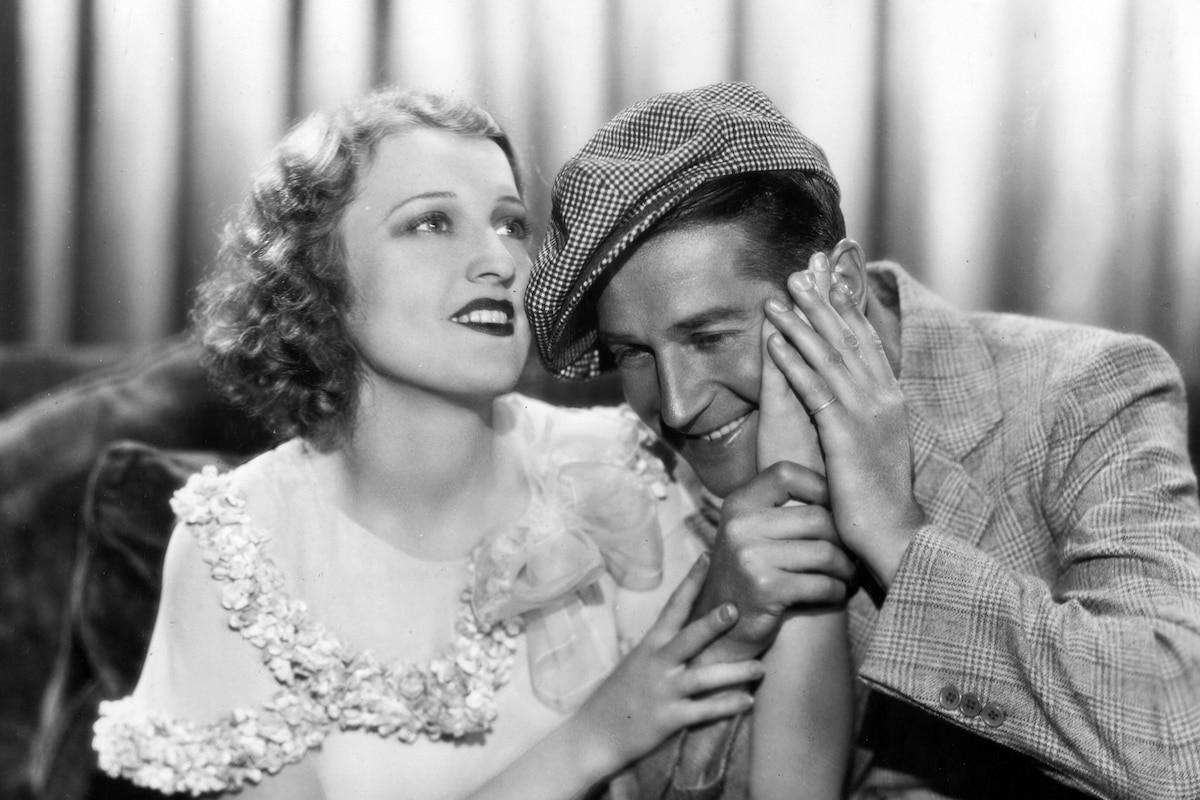
The narrative, unlike Mamoulian's technique, is simple enough. A jovial
Parisian tailor named Maurice (Maurice Chevalier) is forced to approach one
of his customers, the Vicomte de Vareze (Charles Ruggles), for payment of a
bill. When Maurice visits the Count's estate, the Count is embarrassed to
admit that he can't pay him. In an attempt to make it up to Maurice, the
Count introduces the tailor to his royal friends as a Baron. Princess
Jeanette (Jeanette MacDonald), who took no notice of Maurice when he was a
commoner, now finds herself falling for him, and romance ensues. Myrna Loy
is also on hand as a nymphomaniac Countess who delivers an armful of
memorable zingers before everything reaches the expected happy
ending.
The opening sequence that people are still so enamored of consists of two
lengthy songs, and several snatches of dialogue, that introduce a vast array
of characters while simultaneously conveying the environment they inhabit.
Mamoulian's camera journeys from the rooftops of Paris (actually a
remarkable facsimile built on Paramount's backlot) to a crew of workers
paving a street, then on to some shoemakers whose hammers join the symphony
of construction sounds. We then see and hear bums sleeping in the
street, a woman shaking out some bed sheets, and cars with horns that honk
out another counterpoint to the building rhythm. Finally, we come to rest
on Maurice, who's getting dressed for the day. But this virtuoso piece of
filmmaking is only just getting started!
Maurice will begin singing "The Song of Paree" while leaving his
apartment, and several other characters will get introduced. Eventually,
Maurice will have reason to croon Isn't it Romantic, and the song
itself will travel across the city, taking on different arrangements
courtesy of, among others, a platoon of marching soldiers and a gypsy
violinist. Before it's over, MacDonald, Charles Butterworth, and Loy will also be
introduced. This elegant sequence puts today's slash-and-burn style of
storytelling to absolute shame. It's what people mean when they reference
"the magic of movies"- you can only accomplish this kind of thing on
film.
Actually, it's a bit surprising that Mamoulian was so audacious. He made
his name in the musical theater, first with an opera that was produced in
Rochester, New York, then with several successful Broadway shows. But of
all the theater directors who eventually ventured into movies, Mamoulian was
the first to realize cinema's music-related possibilities.
Mamoulian's other groundbreaking move on Love Me Tonight was to
finish the script after Richard Rodgers and Lorenz Hart completed their
songs. In this way, he was able to see to it that the tunes moved the plot
along, rather than simply appearing out of nowhere, as if pasted into a
storyline that could have just as easily existed without them. It worked
like gangbusters, and became one of the central techniques of great
Hollywood musicals. In later years, Mamoulian would bring his talents back
to the stage, where he would direct such legendary musicals as Porgy and
Bess and Oklahoma!.
Though such diverse experts as Kurt Weill and Vincente Minnelli would call
Love Me Tonight the greatest musical ever made, its production wasn't
completely smooth. Mamoulian never really got along with MacDonald, who
found the director to be dry and humorless. And most of the crew agreed
with her. One electrician even dropped a lamp dangerously close to
Mamoulian's head, and a sound man purposely allowed some audio mishaps (like a sneeze) to be recorded on the
soundtrack.
Mamoulian finally approached MacDonald for help, and she told him, "Rouben,
we are supposed to be making a comedy, a gay picture full of laughter. But
it's almost impossible in the funereal atmosphere you're creating."
Mamoulian listened, and soon thereafter saw to it that a more relaxed working environment was in place. It certainly shows in the finished product.
Produced and directed by: Rouben Mamoulian
Screenplay: Samuel Hoffenstein, Waldemar Young, and George Marion, Jr.
Songs: Richard Rodgers and Lorenz Hart
Photography: Victor Milner
Editing: Rouben Mamoulian and William Shea
Art Director: Hans Dreier
Sound: M.M. Paggi
Cast: Maurice Chevalier (Maurice Courtelin), Jeanette MacDonald
(Princess Jeanette), Charles Ruggles (Vicomte de Vareze), Charles
Butterworth (Count de Savignac), C. Aubrey Smith (The Duke), Myrna Loy
(Countess Valentine).
BW-89m.
by Paul Tatara
Love Me Tonight
by Paul Tatara | August 25, 2004
SIGN UP FOR OUR NEWSLETTERS

CONNECT WITH TCM