Evelyn Prentice (1934) is the third of fourteen films William
Powell and Myrna Loy made together. MGM rushed the film into production and into
theaters to capitalize on the success of their second pairing in The Thin
Man (1934), but the two films couldn't be more different. Evelyn
Prentice is a melodrama, so Powell and Loy are not funny. Loy is not
the perfect wife, and Powell is not the perfect husband. He plays a lawyer with
a roving eye. When his wife finds out about his latest affair, she has a retaliatory
affair of her own, which ends in blackmail, murder, a dramatic courtroom confession,
and a surprise twist.
Loy had been playing oriental vamps and other women since the silent era, and had
hoped that when she signed a contract with MGM in 1931, her fortunes would improve.
Her first pairing with Powell, in Manhattan Melodrama (1934),
was the beginning of the turnaround, and also the beginning of her typecasting as
the Perfect Wife. In that film, she first loves bad guy Clark Gable, but marries
his best friend, good guy Powell, who ends up becoming the governor. Loy recalled
that the chemistry between her and Powell was instant, and instinctive. "He
was so naturally witty and outrageous that I stayed somewhat detached, always a
little incredulous. From that very first scene, a curious thing passed between
us, a feeling of rhythm, complete understanding, and instinct for how one could
bring out the best in the other." Their chemistry really exploded in The
Thin Man, and from then on, Powell and Loy were a great screen
team.
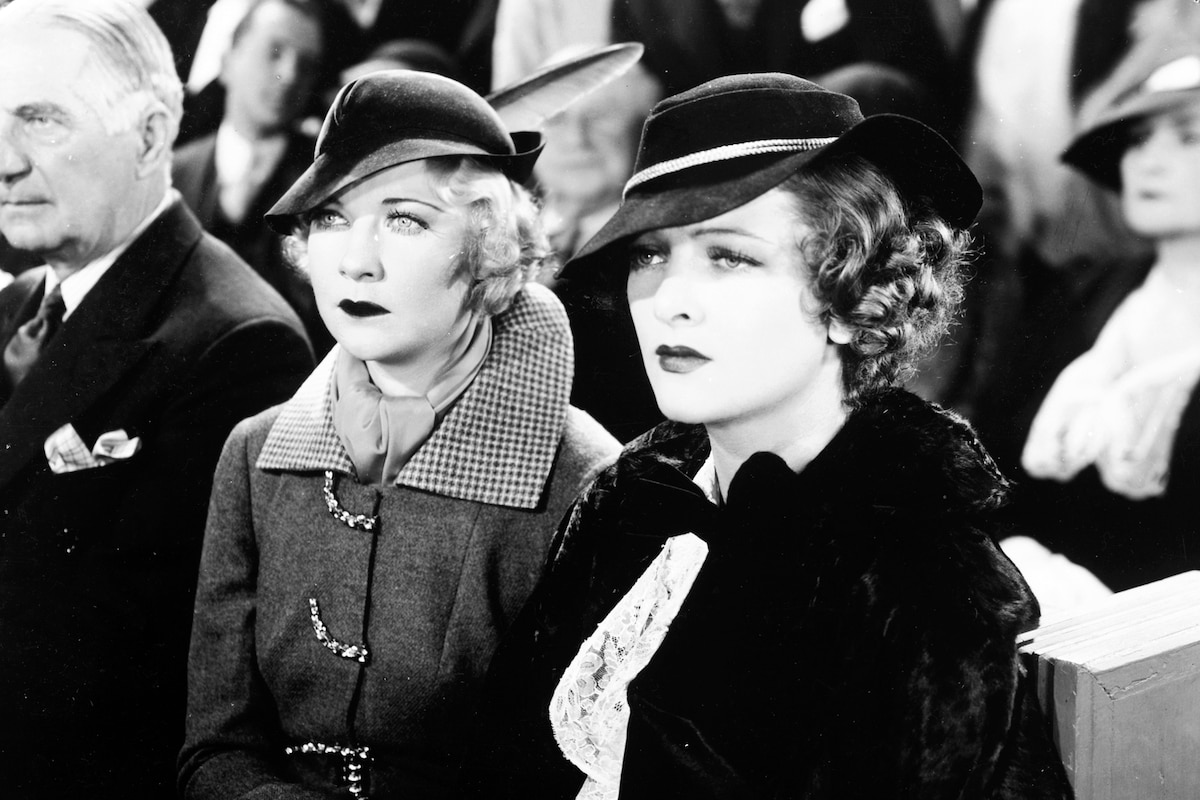
MGM spared no expense in the production of Evelyn Prentice, giving
the film its typical MGM high-gloss look. There was a strong supporting cast, with
dependable veterans like Una Merkel, Jessie Ralph, and Edward Brophy joined by a
newcomer, Rosalind Russell, in her film debut. Russell played a woman with whom
Powell has an affair. Russell became extremely fond of Powell, and grateful to
him for his helpfulness and kindness. In her memoirs, Russell recalls being cast
opposite Powell in Rendezvous (1935). She told Powell she knew
that he'd rather have Loy in the part, and he replied, "I love Myrna, but I
think this is good for you, and I'm glad we're doing it together."
Russell had no scenes with Loy in Evelyn Prentice, but the two
also became good friends. Since they were the same type, MGM would use Russell
as a threat to Loy when Loy was being uncooperative, but it did not affect their
friendship. The two women were neighbors, and once at a party, Russell teased Loy
about getting all her rejected scripts. "You 'd wait until dark, shove 'em
out of your house, and they'd roll down the hill and hit my front door, and that's
the way they were cast." Loy replied, "Well, you must have been out the
night I rolled you Parnell," referring to the infamous 1937
flop in which Loy co-starred with Clark Gable.
Evelyn Prentice was not the disaster Parnell
would be, but critics were not terribly fond of it either. They did, however, take
note of the fine performances by both Powell and Loy, and were particularly impressed
by how well Loy handled her role's heavy emotionalism. It was one of the few times
at this point in her career that Loy was allowed to show that she was a fine dramatic
actress. But after Evelyn Prentice, it was back to comedy and
happy on-screen marriages for one of the most beloved teams in films. William Powell
and Myrna Loy would play husband and wife a total of thirteen times.
Director: William K. Howard
Producer: John W. Considine, Jr.
Screenplay: Lenore J. Coffee, based on the novel by W.E. Woodward
Cinematography: Charles G. Clarke
Editor: Frank Hull
Costume Design: Dolly Tree
Art Direction: Cedric Gibbons
Music: Oscar Raclin
Principal Cast: Myrna Loy (Evelyn Prentice), William Powell (John Prentice), Una
Merkel (Amy Drexel), Harvey Stephens (Lawrence Kennard), Isabel Jewell (Judith
Wilson), Rosalind Russell (Nancy Harrison), Edward Brophy (Eddie Delaney), Cora
Sue Collins (Dorothy Prentice), Jessie Ralph (Mrs. Blake).
BW-79m. Closed captioning.
by Margarita Landazuri
Evelyn Prentice
by Margarita Landazuri | August 25, 2004
SIGN UP FOR OUR NEWSLETTERS

CONNECT WITH TCM