"Hitchcock takes you behind the actual headlines to expose the most explosive
spy scandal of the century!"
Tagline for Topaz.
At the time it was released in 1969, Topaz did indeed stir up
controversy among Alfred Hitchcock fans. First of all, many were puzzled as to why
the director wanted to adapt Leon Uris' popular but sprawling novel to the screen
and more importantly, why he failed to inject it with his trademark suspense. Later
critics have pointed to the film as an experiment in light and color that allowed
the classic director to adjust to new filmmaking styles. In this he was greatly
aided by production designer Henry Bumstead, who carried the master's color ideas
out in ingenious designs for a Harlem hotel, a Cuban mansion and two international
airports. But audiences at the time gave the film a big thumbs down, making it
Hitchcock's third flop in a row.
Topaz wasn't even the film he had wanted to make. Still reeling
from the failures of Marnie (1964) and Torn Curtain
(1966), he was more interested in filming a script he had in development that eventually
would become his comeback picture, Frenzy (1972), but nobody
at Universal Pictures was interested. The studio's head, Lew Wasserman, who had
once been Hitch's agent, wanted to get the master back in form and ordered the story
department to present him with a list of more suitable properties from which the
director chose Uris' novel. What struck him about the story was its realistic depiction
of modern espionage as it told of a French agent working with the CIA to uncover
a double agent and information about Soviet missiles in Cuba in the tense days preceding
the Cuban missile crisis. This fit with Hitch's interest in producing a realistic
James Bond film while hopefully showing audiences that he could adjust to changing
times.
The trouble started with the screenplay. Initially, he hired Uris to adapt his
own novel, but the two never hit it off. Uris didn't care for Hitchcock's eccentric
sense of humor, nor did he appreciate the director's habit of monopolizing all of
his time as they worked through a script. He was also confused by contradictory
demands that he make the film a realistic, modern espionage drama but draw inspiration
from the director's glamorous 1946 spy film, Notorious. For
his part, Hitchcock was disappointed that Uris seemed to ignore his requests to
humanize the story's villains. In his opinion the novel painted them as cardboard
monsters. With only a partial draft completed, Uris left the film.
With location shooting in Copenhagen and Paris set to start in a few months, Hitchcock
had to scramble to find a new writer. The director's assistant, Peggy Robertson,
proposed John Michael Hayes, who had written Rear Window (1954)
and To Catch a Thief (1955), but Hitch nixed the idea. The studio
approached Arthur Laurents, who had scripted Rope (1948), but
he said no. Finally, Hitchcock rushed Samuel Taylor, who had worked on Vertigo (1958), onto the film. For one of the few times in his career, the director went into production without a finished script. Taylor was submitting scenes throughout
the shoot, often the same morning a scene was scheduled to be filmed.
Hitchcock also had trouble with casting. After a bad experience directing established
star Paul Newman in Torn Curtain, the director decided he wanted
to create a star of his own for the film, rejecting suggestions that he hire Sean
Connery or Yves Montand to play the French spy. Instead he hired Frederick Stafford,
a Swiss actor he had seen in a French spy film. He had hoped to turn Stafford into
the new Cary Grant, only to discover the actor was much more limited in his talents.
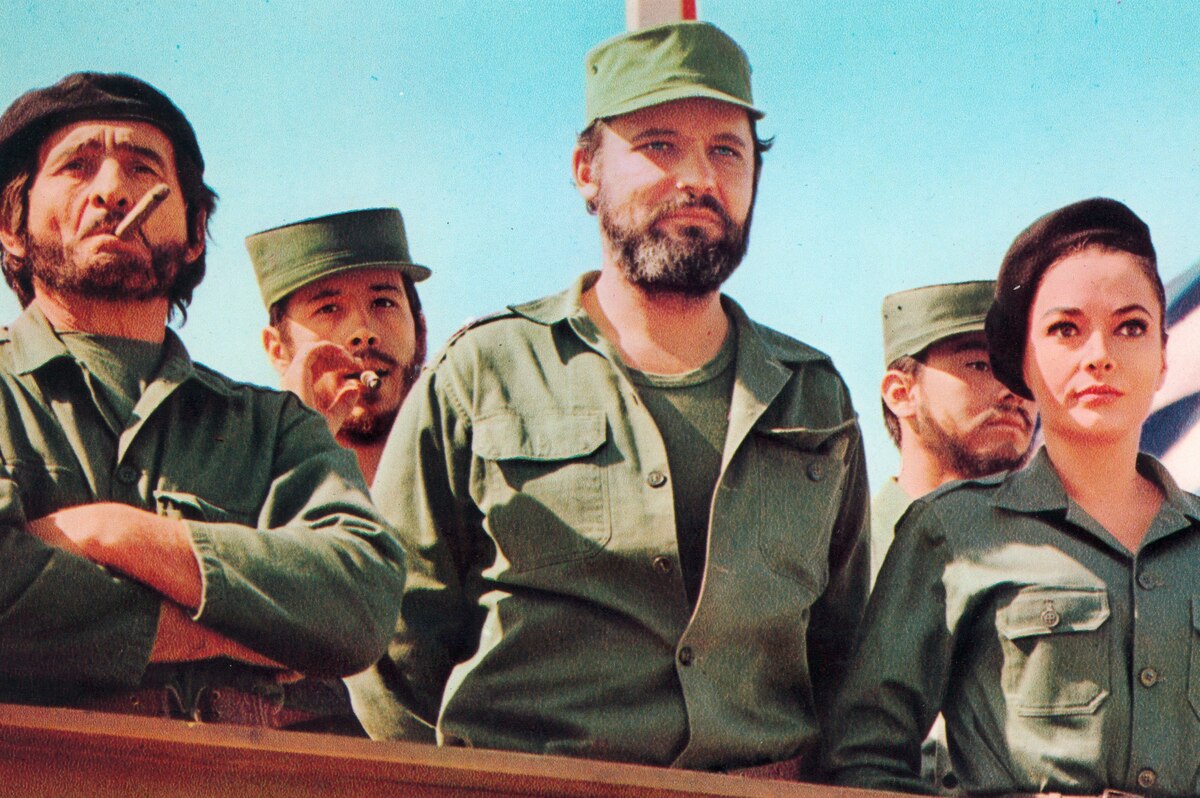
The key role of Stafford's Cuban mistress, a character modeled on Fidel Castro's
sister, was uncast until they returned to Hollywood to shoot on the Universal back
lot. Then Hitch discovered Karin Dor, a German actress who had been a Bond girl
in You Only Live Twice (1967). Although she wasn't one of his
trademark blondes, he lavished attention on her, hoping to turn her into a major
star. But when she resisted his requests to adopt a sexy pose during a photo shoot
and wouldn't do a topless scene because of surgical scars, he lost interest. The
film contained two stand-out performances -- John Vernon, later Dean Wormer in Animal House (1978), as the Cuban leader and Roscoe Lee Browne as an operative infiltrating a Cuban enclave in Harlem -- but they were in supporting roles only
on screen for a small portion of the film's running time.
The one area where the film excelled was in its design. Working with Bumstead,
Hitchcock devised a carefully arranged visual scheme that worked key colors and
floral references throughout the mise en scene to parallel the story's development.
The strongest effect in the film was reserved for the death of Dor's character.
Shot from overhead, the scene showed her purple dress flaring out like a grotesque
flower as she falls dead onto a black tile floor. "Just before John Vernon
kills her," Hitchcock explained (in Alfred Hitchcock: The Dark Side
of Genius by Donald Spoto), "the camera slowly travels up and doesn't
stop until the moment she falls. I had attached to her gown five strands of thread
held by five men off-camera. At the moment she collapses, the men pulled the treads
and her robe splayed out like a flower that was opening up. That was for contrast.
Although it was a death scene, I wanted it to look beautiful."
As shooting drew to a close, more problems developed. As originally scripted, the
film was to end with a spectacular pistol duel between Stafford and the double agent
in a French soccer stadium. But part way through shooting, Hitchcock had to race
back to Los Angeles because his wife had suddenly taken ill. He left his associate
producer, Herbert Coleman, to finish shooting the scene. During test screenings,
audiences laughed at the old-fashioned duel. Bowing to studio pressure, Hitchcock
shot an ending he actually liked better -- a cynical airport scene in which Stafford
allows the mole to escape onto a Moscow-bound jet. This only confused preview audiences, though, so as a compromise he used existing footage to create a new ending in which the double agent commits suicide. Eventually, the studio decided to release different endings in different countries: the suicide in the U.S. and France, the airport
ending in England. The duel was thought lost until after Hitchcock's death, when
his daughter, Patricia, found it in her father's garage and donated it to the Academy
of Motion Picture Arts and Sciences®.
Topaz opened to scathing reviews in most areas, though the French,
long champions of Hitchcock's genius, gave it almost unanimous raves. Although
later critics would reevaluate the film in the context of Hitchcock's entire career
and his comeback with Frenzy three years later, audiences weren't
impressed. Although the film bore the largest budget of any Hitchcock film, $4
million, it only brought in $3 million at the box office.
Producer-Director: Alfred Hitchcock
Screenplay: Samuel Taylor, based on the Novel by Leon Uris
Cinematography: Jack Hildyard
Art Direction: Henry Bumstead
Music: Maurice Jarre
Cast: Frederick Stafford (Andre Devereaux), Dany Robin (Nicole Devereaux), Claude
Jade (Michele Picard), Karin Dor (Juanita de Cordoba), John Vernon (Rico Parra),
Michel Piccoli (Jacques Granville), Philippe Noiret (Henri Jarre), Roscoe Lee Browne
(Philippe Dubois), John Forsythe (Michael Nordstrom).
C-126m. Letterboxed. Closed captioning.
by Frank Miller
Topaz
by Frank Miller | August 25, 2004
SIGN UP FOR OUR NEWSLETTERS

CONNECT WITH TCM