Danish director Carl Theodor Dreyer made a rare foray into comedy with the 1925
silent film, Master of the House. Coming from a director who
specialized in portraying the inner lives of people in a state of crisis, the film
offered a more thoughtful approach to humor, one that gave Dreyer a chance to hone
his personal style. It also gave him a rare box-office hit that would make his
later triumphs possible.
Dreyer had just finished working in Germany (on the 1924 Michael,
starring Walter Slezak), when he returned to his native land to direct a film adaptation
of Svend Rindom's play Tyrannens fald, literally "The Fall
of a Tyrant." With Rindom collaborating on the screenplay, he made few changes
to the original, maintaining its simple tale of a tyrannical husband and father
tamed by his childhood nurse after he's driven his wife to a nervous breakdown.
For its Danish release, Dreyer titled the film Thou Shalt Honor Thy Wife,
offering an echo of the Bible that reflected his personal investment in the material.
Raised in a harsh foster home, Dreyer had developed a strong, almost romanticized
vision of his birth mother which naturally drew him to Master of the House,
with its depiction of a loving, devoted wife and mother driven to desperation.
Some historians have also suggested that his choice of material reflected his support
of the women's rights movement of the day, as would his later focus on women fighting
for a degree of self-determination.
In addition, he was drawn to the play because of its accumulation of detail to reveal
character and plot, something that would be the focus of most of his mature works.
He would write: "What I look for in my films, what I want to do, is to penetrate,
by way of their most subtle expressions, to the deepest thoughts of my actors.
For it is these expressions which reveal the personality of a character, his unconscious
feelings, the secrets hidden deep within his soul (Quoted in Tom Milne, The
Cinema of Carl Dreyer)." Critics have even pointed to Master
of the House as a refocusing of his style, as he combined the psychological
intimacy of his earlier films with a new sense of detail.
To capture that feeling on screen, Dreyer initially wanted to shoot the film in
a real middle-class apartment. Although cinematographer George Schneevoigt talked
him out of that, arguing it would be impossible to film with the cameras of the
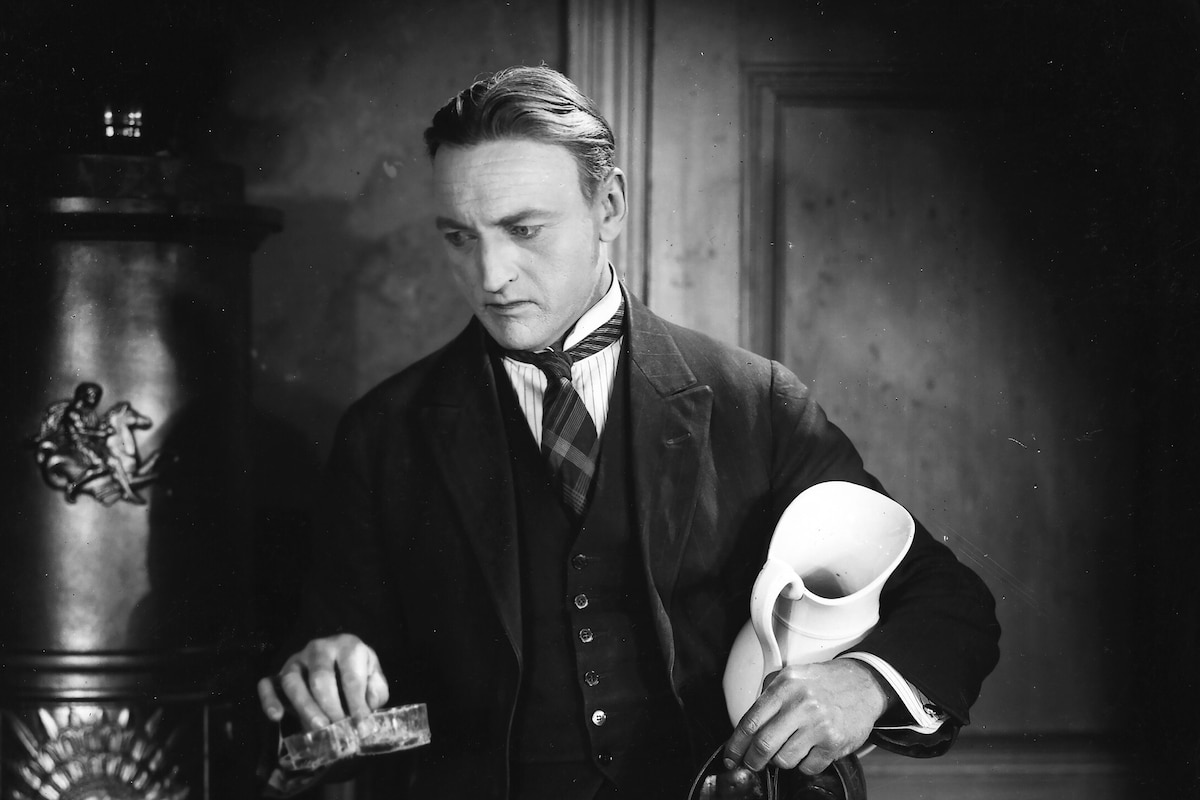
day, Dreyer still had a complete apartment built in the film studio. The set was
fully equipped with electricity, gas lines and running water. Posing a challenge
for Schneevoigt was Dreyer's insistence on shooting the set with four walls. With
no missing wall to give the camera a comfortable home, Schneevoigt had to contort
himself into tight corners or shoot through doorways, to capture the action. But
the effort more than paid off - audiences actually felt that they were inside that
apartment, observing the day-to-day details of the on-screen characters' lives.
Master of the House emerged as the biggest hit of Dreyer's career,
delighting audiences throughout Europe, where it continued to play well into the
sound era. It also provided a boon for the cast, particularly Astrid Holm, who
won glowing reviews for her performance as the wife, and Mathilde Nielsen, who became a popular supporting actress in her sixties as the aged nurse. When the film was
remade in 1942, she would re-create her role.
Later critics have pointed to Master of the House as an influence
on or at least a precursor of both the realistic French comedies of the '30s and
the Italian neo-realism of the '40s and '50s. In France, the film was so popular
it played in 57 theatres in Paris during one three-week period. The film's success
there prompted French investors to bankroll what would become Dreyer's greatest
film, The Passion of Joan of Arc (1928).
Director: Carl Theodor Dreyer
Screenplay: Dreyer, Svend Rindom, based on the Play Tyrannens fald
by Rindom
Cinematography: George Schneevoigt
Art Direction: Dreyer
Cast: Johannes Meyer (Victor Frandsen), Astrid Holm (Ida Frandsen), Karin Nellemose
(Karen Frandsen), Mathilde Nielsen (Old Victor's Wetnurse), Clara Schonfeld (Avilda
Kryger), Johannes Nielsen (Doctor).
BW-96m.
by Frank Miller
Master of the House
by Frank Miller | August 17, 2004
SIGN UP FOR OUR NEWSLETTERS

CONNECT WITH TCM