Gertrud, an opera singer currently married to the politician Gustav Kanning, decides
to leave him when he announces that he will be promoted to a cabinet minister position.
Gertrud complains that Kanning is constantly preoccupied with work, whereas she
wants a man who will put love before everything. "Amor omnia" is her motto:
"Love is all." Erland Jansson, the man for whom she leaves Kanning, is
an accomplished composer whose art is nonetheless hampered by a weakness for carousing with his friends. Gertrud begs him to abandon his dissolute life, but he refuses;
he too is unwilling to put their love before everything. Their relationship is further
called into doubt when the respected poet Gabriel Lidman, a former lover who still
carries a flame for Gertrud, reveals to her during a special dinner in his honor
that Jansson has been bragging about her as his latest "conquest." When
Gertrud's emotional dilemma begins to exact a physical toll, another old friend,
the psychologist Axel Nygren, offers an alternative to her unsatisfying existence.
Gertrud (1964), Carl Theodor Dreyer's final film, is based on
a 1906 play by Hjalmar Soderberg (1869-1941) who is usually regarded as one of
the great Swedish prose stylists of the twentieth century. Soderberg is perhaps
best known for his short stories and the novels Martin Birck's Youth
(1901) and Doctor Glas (1905), realistically detailed portraits
of turn-of-the-century Swedish life shot through with philosophical observations
on topics such as love and religion. While he remained largely faithful to the original
play, Dreyer himself wrote the epilogue, which takes place some thirty years after
the main action, with the approval of Soderberg's daughter.
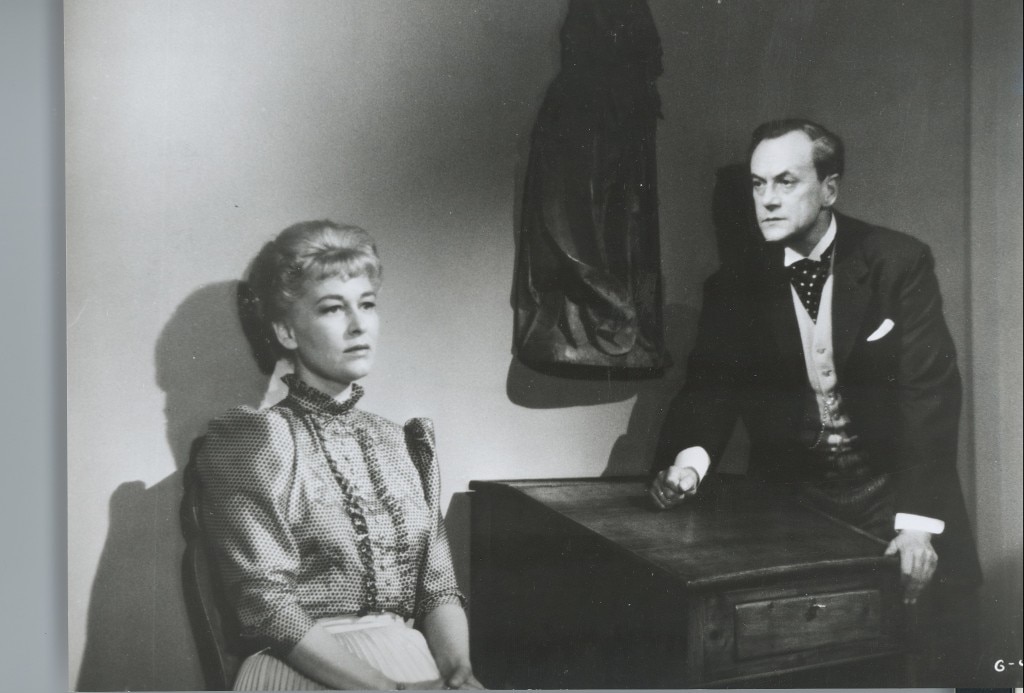
Due to Dreyer's rigorous, deliberately mannered handling of the material, Gertrud is the most controversial of his mature films. The film's radical qualities tend to be obscured by the period costumes, the highly literate (some would say stilted) dialogue, and the highly theatrical acting and blocking. The film has only 89 shots
in its 115-minute running time, with individual shots running several minutes in
length. For example, the shot containing Gabriel Lidman's after-dinner conversation
with Gertrud runs 9 1/2 minutes long. Declaring it to be "a
film about words," Dreyer said of his basic approach to Gertrud:
"What interests me--and this comes before technique--is reproducing the feelings
of the characters in my feelings [...] The important thing [...] is not only to
catch hold of the words they say, but also the thoughts behind the words. What I
seek in my films, what I want to obtain, is a penetration to my actors' profound
thoughts by means of their most subtle expressions. For these are the expressions
[...] that lie in the depths of his soul. This is what interests me above all, not
the technique of the cinema. Gertrud is a film that I made with
my heart."
The film is also noteworthy for Henning Bendtsen's stunning black-and-white cinematography. Pools of light and shadow create atmosphere and define space within the frame; of particular note is the judicious use of overexposure in flashback scenes. Bendtsen, who had worked with Dreyer previously on Ordet (1955), is one
of Denmark's leading cinematographers and has since worked with Lars von Trier on
Epidemic (1988) and Zentropa (1991). In the
1995 documentary Carl Th. Dreyer - My Metier, Bendtsen recalls:
"The special mark of Gertrud was that the script was not
divided into scene numbers. It is continuous. The tracking shots were not rigidly
laid down by Dreyer in advance. We would turn up in the morning and the cast would
come in with no make-up, nor in costume. We would slowly build up the sequence the
way the actors and Dreyer found it natural and accordingly with the lighting options
open to me. Dreyer became so enthusiastic about this technique, that several times
I had to tell him we couldn't stuff any more film stock in the camera and would
have to find somewhere to stop up." For his work on this film, Bendtsen was
awarded a Bodil (the Danish Film Foundation award) for best cinematography.
During its Paris premiere, the film provoked boos and catcalls and was derided by
critics for consisting of nothing but "sofa conversations." Its reception
during its initial U.S. release was also marked by controversy. Stanley Kaufmann,
in his review for the New York Times, savaged Dreyer for being
"out of touch" for his choice of the Soderberg play, which he considered
to be "dated subject matter" and complained that Dreyer's directorial
technique was "the least fluently cinematic of any work of his that I know."
Kaufmann writes: "His tempos have always been deliberate. But here his camera
movement and his editing defy the minimal drama in the script. In dialogue the camera
often travels back and forth from face to face, instead of cutting from one to the
other. 'Direction' frequently consists of characters who rise from one sofa, move
slowly to another, then sink. Nothing that can be done at length is ever suggested."
The critic for Variety was more sympathetic, commenting that
the film, "with echoes of Ibsen, in its social haranguing for female independence,
and Strindberg, in its difficulty in male and female understanding, lends itself
admirably to Dreyer's dry but penetrating style." At the same time, he warned
that "it may skirt banality, tedium and repetition for average audiences."
By the early Seventies, however, the critic Tom Milne would consider it one of Dreyer's
finest works, writing: "Gertrud is the sort of majestic,
necromantic masterpiece that few artists achieve if once in their lifetimes."
In the last few years of his life, Dreyer worked toward realizing a long-cherished
project, a film about Jesus. However, Gertrud would remain his
last cinematic testament, through its idiosyncratic style embodying at once the
challenges and rewards of Dreyer's cinema.
Director: Carl Theodor Dreyer
Producer: Jorgen Nielsen
Screenplay: Dreyer, based on the play by Hjalmar Soderberg
Photography: Henning Bendtsen
Art Director: Kai Rasch
Music: Jorgen Jersild
Song lyrics: Grethe Risbjerg Thomsens
Editor: Edith Schlussel
Principal Cast: Nina Pens Rode (Gertrud Kanning); Bendt Rothe (Gustav Kanning);
Ebbe Rode (Gabriel Lidman); Baard Owe (Erland Jansson); Axel Strobye (Axel Nygren);
Anna Malberg (Gustav's mother); Edouard Mielche (the Vice-Chancellor); Vera Gebuhr (the maid); Karl Gustav Ahlefeldt, Lars Knutzon, William Knoblauch, Valso Holm.
BW-119m. Letterboxed.
by James Steffen
Gertrud
by James Steffen | August 27, 2004
SIGN UP FOR OUR NEWSLETTERS

CONNECT WITH TCM