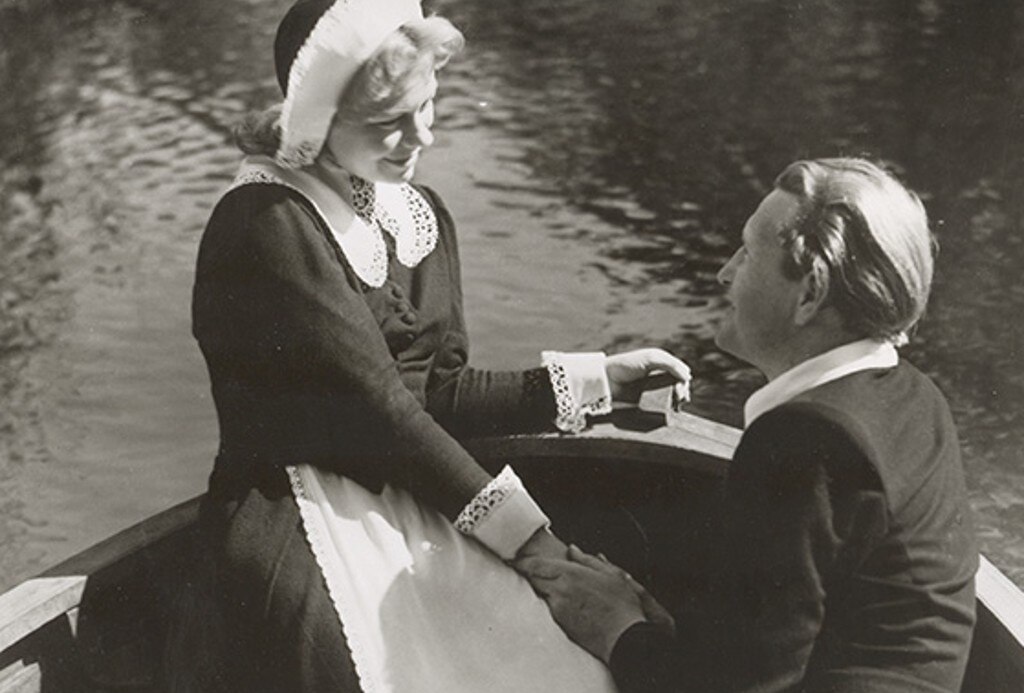
Set in a small village in Denmark in 1623, Day of Wrath (1943)
tells the story of Marthe, the young wife of Pastor Pedersson. Trapped in a loveless
marriage and hated by her mother-in-law, she seeks solace in a love affair with
her stepson Martin. Her indiscretion ultimately seals her fate; Marthe's husband
dies of a heart attack when he learns of her infidelity, Martin deserts her and
the villagers accuse her of witchcraft, a charge which condemns her to be burned
at the stake.
Day of Wrath, Carl Theodor Dreyer's second sound feature, was
based on real events that took place in Bergen, Norway in the sixteenth century
and became the basis for a play by Hans Wiers-Jenssens - Anne Pedersdotter
- written in 1908. It had been eleven years since Dreyer's last feature, Vampyr (1932), which was poorly received in his own country and forced him to seek film opportunities elsewhere. Unfortunately, projects initiated in France, England and even Somalia, all fell through and Dreyer eventually returned to his former profession of journalism, until his interest in making a movie of Anne Pedersdotter spurred
him to return to filmmaking.
From the beginning, Dreyer had very specific qualities he was looking for in his
actors. In the key role of Marthe, he cast Lisbeth Movin, a relatively unknown
stage and screen actress at the time, because he "fell in love with her eyes."
Her remarkable portrayal, comparable in its intensity to Falconetti's performance
in his earlier The Passion of Joan of Arc (1928), is a complex one,
mingling innocence with a suggestion of the sinister. Part of the credit is due
to Dreyer who used "moving key lights, scrims, barn doors, and even objects
in the path of the key lights to throw an ever-changing pattern of shifting brightness
and shadow on her eyes and face." (from Raymond Carney's essay in MaGills
Survey of Cinema).
Equally memorable is Anna Svierkier as Marte Herlof, the elderly peasant woman who
is accused of witchcraft and burned at the stake in the film's harrowing opening.
Nearly eighty years old at the time, the actress was put through quite an arduous
physical ordeal for her part by Dreyer whose perfectionism often bordered on the
sadistic. For one scene, the director recalled (in My Own Great Passion:
The Life and Films of Carl Th. Dreyer by Jean Drum and Dale D. Drum),
"...she was so seized with the part I couldn't get her to move slowly. Then
I remembered she had said she had bought a pair of tight new shoes. So I asked her
to put them on and then ran a number of rehearsals. Her feet became more and more
sore, and after some time she could only move slowly and the scene was quite successful.
She said to me, 'How could you do it?' Afterwards, when she saw the scene, she thanked
me." Another difficult shoot was Marte's death scene when Svierkier was tied
to a ladder and forced to wait until the sun emerged before the cameras could roll.
A fellow crewmember said, "It was terrible for her, and she cried a little
because her back ached terribly. When Dreyer saw this he exclaimed, 'Oh that is
just wonderful, wonderful. Keep that when we are going to shoot."
Dreyer's obsession with the smallest detail in his films is well documented, from
the setting to the props. In one instance, he searched half a year for the right
soap dish for a scene in Day of Wrath. In striving to capture
the period look and appropriate atmosphere for the film, he shot exteriors at the
Frilands Museum, which is located on the outskirts of Copenhagen and features an
open air village composed of 17th and 18th century Danish houses. All of the interiors
for Day of Wrath were shot in the Palladium Studios in Hellerup.
Despite Dreyer's meticulous care in crafting Day of Wrath, the
film received an even worse reception from the Danish critics than his previous
film, Vampyr. Not only was it attacked for its stark, austere
style but some critics accused the film of being a thinly disguised allegory of
the Nazis' persecution of the Jews. It was also released at the height of World
War II in Europe when theatrical distribution for films was extremely limited at
best. It also didn't help matters that Dreyer was approached by the Germans with
an offer to make movies for them. Instead, he fled the country with his wife, relocating
to Sweden and not returning to Copenhagen until after the war.
Today, Day of Wrath is seen as one of Dreyer's undisputed masterworks
and a powerful critique of religious intolerance, superstition and basic human nature.
The film also possesses an intriguing ambiguity in which Marthe behaves at times
as if she might indeed be guilty of certain accusations. Peter Cowie in Eighty
Years of Cinema best summed up the film's greatness when he wrote, "Like
The Passion of Joan of Arc, Day of Wrath is a protest against the bigotry which spread like a shadow across the lives of ordinary people in the middle ages...Practically every composition has the clean, measured proportions of a Flemish painting. The white ruffs contrast sharply with the dark robes of the characters and some of the faces could have been chosen by Rembrandt. The scenes in the presbytery are claustrophobic. Every movement is furtive, and the soundtrack is so discreetly composed that when someone does cry out in terror or anguish, the sound strikes like a dagger. The ponderous narrative is faithful to a state of mind and a way of life at a certain point in history. In Day of Wrath slowness becomes a terrible inevitability."
Producer: Carl Theodor Dreyer, Tage Nielsen
Director: Carl Theodor Dreyer
Screenplay: Carl Theodor Dreyer, Poul Knudsen, Paul La Cour, Mogens Skot-Hansen
Cinematography: Karl Andersson
Film Editing: Anne Marie Petersen, Edith Schlussel
Art Direction: Erik Aaes
Music: Poul Schierbeck
Cast: Thorkild Roose (Rev. Absalom Pedersson), Lisbeth Movin (Anne Pedersdotter),
Sigrid Neiiendam (Meret), Preben Lerdorff Rye (Martin), Anna Svierkier (Herlofs
Marte), Albert Hoeberg (The Bishop).
BW-110m.
by Jeff Stafford
Day of Wrath
by Jeff Stafford | August 27, 2004
SIGN UP FOR OUR NEWSLETTERS

CONNECT WITH TCM