Probably the most resourceful director of the American cinema, Edgar G.
Ulmer carved out a reputation for making stylish, strange and often
innovative films while being shackled to budgets that were, by Hollywood
standards, microscopic. Working outside the major studio system had its
drawbacks but Ulmer accepted the lack of production resources in exchange
for a much greater degree of creative freedom. Ulmer used this freedom to
explore his personal interests and to bend, almost to the breaking point,
the conventions of genre filmmaking.
Produced for Miller-Consolidated Pictures (MCP), a short-lived concern that
hoped to tap into the low-budget drive-in market which thrived on exploitation pictures, The
Amazing Transparent Man (1960) would test the limits of how quickly and
cheaply a film could be made. Ulmer was given a small crew in Dallas,
Texas, and was afforded only eleven days to shoot not one but two
films. One of these films, Beyond the Time Barrier (1960), was a
science fiction spectacle and, by its very nature, consumed the lion's
share of Ulmer's production budget, requiring more sets, costumes, props,
actors and perhaps the most precious commodity of all: time. The
futuristic drama was filmed first, and any remaining time was devoted to the
second feature.
As if matters could not be worse, The Amazing Transparent Man faced
another obstacle when the hotel which housed the cast and crew burned to
the ground after the first day of shooting. But Ulmer was contracted to deliver two films and two films he delivered. One (Time Barrier) is a tidy little sci-fi thriller, laced with
political allegory. The other film is less easily categorized: a remarkable exercise in cinematic thrift and reckless creativity.
"The Amazing Transparent Man got short shrift," remembers Ulmer's
daughter, Arianné Ulmer Cipes. "It didn't get as many days production as
Beyond the Time Barrier and it certainly didn't have as large a
cast.... People talk about how inexpensively he could shoot... well the
contributing factors were that he would utilize two, three, four, five
productions simultaneously in different stages that were cannibalizing from
each other. Costumes, cast, design, writing, musicians -- you could juggle
them all at one time."
There were no illusions about the fate of The Amazing Transparent Man.
The finished film lasts just less than one hour, barely long enough to
qualify as a feature, guaranteeing its place on the lower berth of a
double or triple bill. Ulmer was therefore relieved of the burden of
narrative coherence and deep meaning. He could weave an extemporaneous
thriller that was swift, energetic and perfectly fitting the designation of
"added attraction."
Douglas Kennedy stars as Joey Faust, a hard-boiled bank robber who is
sprung from prison by a seedy mob boss, Krenner (James Griffith), who has
secret plans for the gunman. Krenner takes Faust to his criminal lair -- a
large Victorian farmhouse -- and reveals to him a state-of-the-art
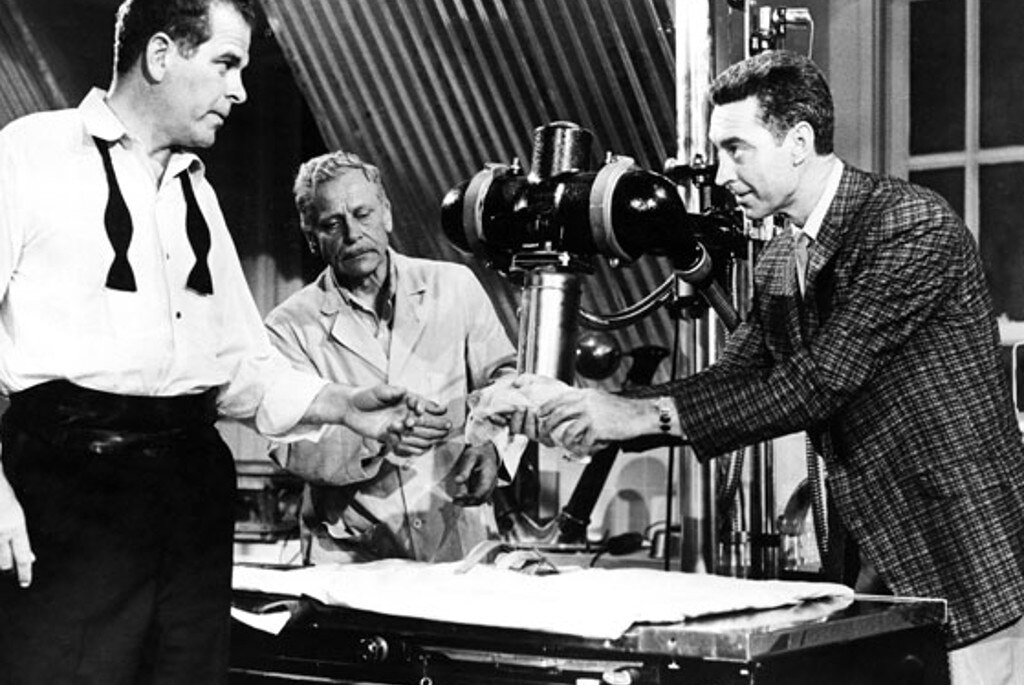
laboratory within. There, Dr. Ulof (Ivan Triesault) is experimenting with
a radical form of radiation therapy that can render living creatures
invisible. Krenner's intention, revealed mid-film, almost as an
afterthought, is to create an army of invisible, anti-American soldiers to
take over the world. The more selfish Faust defies Krenner, teams up with
a tough moll (Marguerite Chapman) and instead uses the power of invisibility
to rob bank vaults. Everyone's plans unravel when the experimental process
begins to fail. Faust is identified during a robbery and returns to the
criminal farmhouse to avenge himself upon neo-Nazi Krenner.
Scripted by Jack Lewis, The Amazing Transparent Man compensates for
its technical shortcomings by sending itself in a half-dozen thematic
directions. On one level it is a modernized retelling of Goethe's
Faust, as the criminal sells his soul for magical powers that
promise wealth, power and love. It is also a Cold War thriller (complete
with stock-footage A-bomb detonation in the final reel). It is a heist
picture. It is social commentary (a German doctor during WWII, Ulof was
forced to experiment on concentration camp victims). It is an homage to
the classic horror film (specifically James Whale's The Invisible
Man, 1933).
But no single film can be all these things. Eventually, the entire plot
explodes and Ulmer abruptly ends the film with the cinematic equivalent of
a question mark: a character, faced with a moral dilemma of monumental
proportions, turns to the camera and says, "What would you do?" Roll
credits.
There is enough material in The Amazing Transparent Man for three
films, but Ulmer compacts it all into a single hour. "You have only a short time to tell a story," Ulmer said, "and therefore...you must have two sides, as in the commedia dell'arte, and
later in our great Western successes as: the man with the white hat, the
man with the black hat."
Corners were cut not only in narrative structure but in the special effects
as well. Only a handful of optical shots were used to depict the
"transparency" of Faust. Instead, Ulmer was satisfied to show doors
opening and closing, objects hanging from wires and, most brilliantly
resourceful of all, to merely focus the camera on empty sets, as if someone
were actually there.
The publicity artists of MCP likewise reaped the value in invisibility, and
released the film with the following warning: "Joey Faust, escaped convict,
The Amazing Transparent Man, has vowed to 'appear' invisibly in
person at every performance of this picture in this theatre.
Police officers are expected to be present in force, but the
management will not be responsible for any unusual or mysterious happenings
while Faust is in the theatre."
Producer: Lester D. Guthrie
Director: Edgar G. Ulmer
Screenplay: Jack Lewis
Cinematography: Meredith M. Nicholson
Production Design: Ernst Fegte
Music: Darrell Calker
Cast: Douglas Kennedy (Joey Faust), Marguerite Chapman (Laura Matson),
James Griffith (Major Paul Krenner), Ivan Triesault (Dr. Peter Ulof).
BW-58m. Letterboxed.
By Bret Wood
The Amazing Transparent Man
by Bret Wood | August 25, 2004
SIGN UP FOR OUR NEWSLETTERS

CONNECT WITH TCM