From the effortless look of them, you'd think that the Bob Hope-Bing Crosby
"road pictures" were destined to work like a charm from day-one. But
Road to Singapore (1940), the first installment in the series, clearly shows
that it wasn't that easy. Though several of the components that audiences
came to know and love are there, including Dorothy Lamour as the romantic
interest, and the apparently free-form repartee between the sarcastic leads,
something is a bit off about the timing. The fact is, Hope and Crosby (and,
almost incidentally, their director, Victor Schertzinger) had no idea where
they were heading with the dialogue, but blindly trusted their instincts -
and their personal joke writers - to invent something worthwhile. Just
how worthwhile (i.e. profitable) these movies would finally become
took everyone involved by complete surprise.
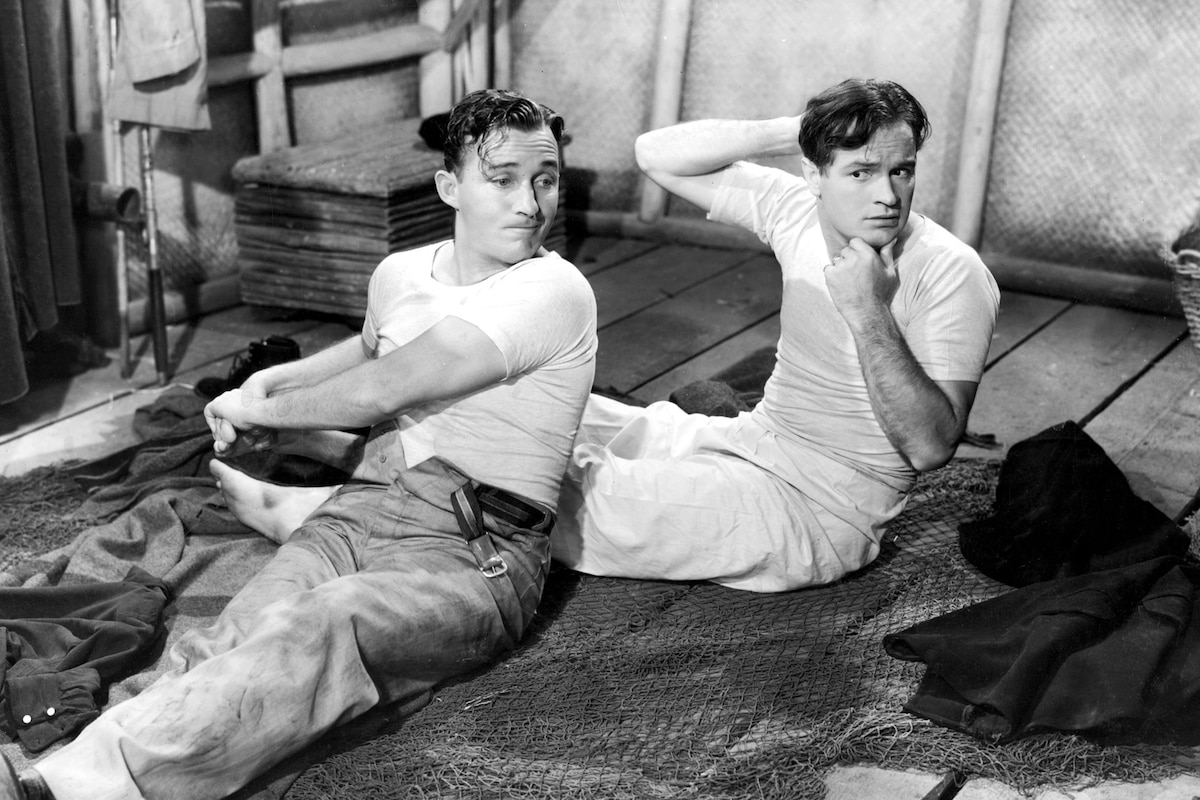
There's a plot to Road to Singapore, in the sense that it features a
lot of things for Bob and Bing to mock. Even so, it's far more traditional
than the rest of the films in the series. Crosby plays Josh, the son of a
wealthy shipping magnate (Charles Coburn). A carefree sort, Josh wants
nothing to do with his father's business, and basically avoids anything else
that requires him to act like a grown-up. He even skips out on his
bride-to-be (Judith Barrett) the day before their wedding, and takes off
with his good buddy, Ace (Hope), to exotic Singapore. There, Josh and Ace
launch an ineffective money-making scam involving an equally ineffective
spot remover.
Eventually, both of the boys fall for a beautiful dancer named Mima
(Lamour), who runs away with them to escape her violently jealous dancing
partner (Anthony Quinn). Mima admits to being in love with
either Josh or Ace, although, for much of the movie, she's strategically
unclear about the particulars. Throw in a few songs, including one
non-legendary ditty entitled "Captain Custard," and everything gets padded
out to feature length. Audiences at the time didn't care about the skimpy
material, though. The movie was a runaway smash, and Paramount quickly set
about duplicating, and perfecting, its newfound formula.
Road to Singapore took such a winding route to the big screen, no one
is really sure how it came into being. The most believable story is that a
Harry Hervey adventure script called The Road to Mandalay was
re-tooled by Paramount into a comedy vehicle for George Burns and Gracie
Allen, who promptly turned it down. Then Fred MacMurray and Jack Okie
supposedly rejected it, although, in later years, neither one of them could
recall that ever happening. Then the title location was changed to
the more exotic-sounding Singapore, and the script was given to Hope and
Crosby. But that leaves out the very important detail of exactly who
decided to team them up in the first place.
In the long run, it doesn't matter. You can bet that executives all over
the Paramount lot were proclaiming their own genius when Road to
Singapore became the highest grossing movie of 1940.
Hope and Crosby's disregard for the film's original shooting script is the
stuff of Hollywood legend. Lamour later wrote in her autobiography that her
first day on the set convinced her that there was simply no point in
memorizing her dialogue- Bob and Bing would say whatever popped into their
heads, or deliver gags that their writers had thought up the night before.
"What I really needed," she said, "was a good night's sleep to be ready for
the next morning's ad-libs. This method provided some very interesting
results on screen. In fact, I used to ask to see the finished rushes to see
what the movie was all about."
She wasn't kidding. One day on the set, Hope actually yelled to
screenwriter Frank Butler, "Hey Frank! If you hear anything that sounds
like one of your lines, just yell 'Bingo!'" Butler reportedly was not
amused, although Schertzinger enjoyed his directing duties, which more or
less consisted of shouting "Stop!" and "Go!"
It's interesting to note that Hope and Crosby were not the loving off-screen
buddies that press releases and carefully orchestrated public outings
implied they were. Though both men knew a major cash-cow when they were
riding one, and thus were able to maintain a façade of deep friendship, they
were highly competitive egotists who never missed an opportunity to belittle
each other. And it wasn't always in good fun.
During the Singapore shoot, Hope took special advantage of Crosby's
self-consciousness about his balding head and somewhat flabby behind, which
generated the endearing nicknames, "Skinhead" and "Mattress Hip." Hope
would also get his writers to secretly come up with zingers that would
cancel out Bing's supposedly off-the-cuff jibes during shooting. Crosby,
for his part, repeatedly called Hope "Ski Snoot" and loved pointing out that
he was by far the better dramatic actor of the two. And he ribbed Hope mercilessly when he won a 1944 Best Actor Oscar® for Going My
Way. So much for a partnership made in heaven.
Producer: Harlan Thompson
Director: Victor Schertzinger
Screenplay: Don Hartman and Frank Butler
Editing: Paul Weatherwax
Cinematography: William C. Mellor
Music Director: Victor Young
Art Design: Hans Dreier and Robert Odell
Choreography: LeRoy Prinz
Principal Cast: Bing Crosby (Josh Mallon), Bob Hope (Ace Lannigan), Dorothy
Lamour (Mima), Charles Coburn (Joshua Mallon IV), Judith Barrett (Gloria
Wycott), Anthony Quinn (Caesar), Jerry Colonna (Achilles Bombanassa), Johnny
Arthur (Timothy Willow), Pierre Watkin (Morgan Wycott), Gaylord "Steve"
Pendleton (Gordon Wycott), Miles Mander (Sir Malcolm Drake), Pedro Regas
(Zato), Greta Granstedt (Babe), Edward Gargan (Bill)
B&W-85m. Closed captioning.
by Paul Tatara
Road to Singapore (1940) - Road to Singapore
by Paul Tatara | July 26, 2004
SIGN UP FOR OUR NEWSLETTERS

CONNECT WITH TCM