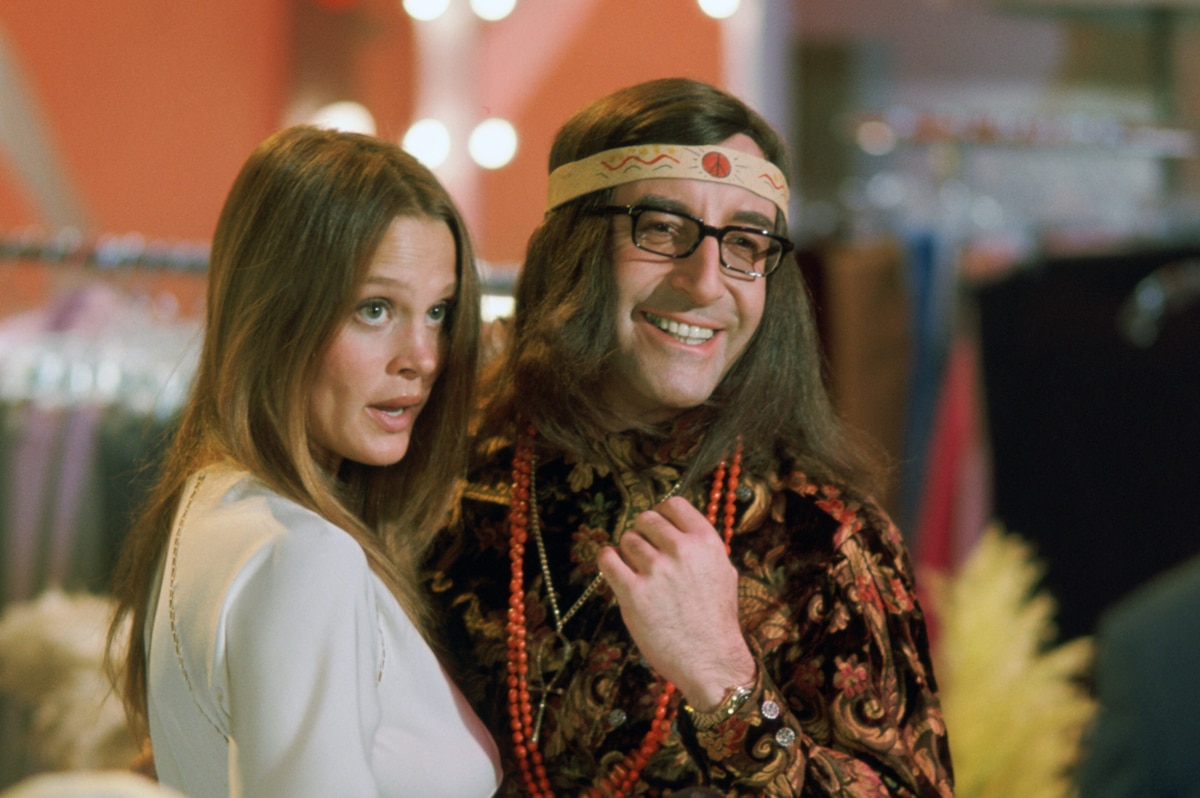
Peter Sellers stars in the wacky Sixties comedy, I Love You, Alice B. Toklas! (1968) as a straight-laced Los Angeles lawyer persuaded to join the hippie counterculture by a beautiful flower child. Hopelessly conservative and unadventurous, Harold Fine (Sellers) is a mother-dominated mensch, sitting passively by as Mrs. Fine (Jo Van Fleet) plans his upcoming wedding to his equally domineering fiancee Joyce (Joyce Van Patten). But when Harold meets the pot smoking, butterfly-tattooed, doe-eyed hippie Nancy (Leigh Taylor-Young), his life changes. Nancy whips up some hash brownies (from a special recipe courtesy of Gertrude Stein's lover Alice B. Toklas), "turns on" the entire bourgeois Fine clan, and before you can say "Magical Mystery Tour," Harold is spouting terms like "groovy" and turning his bachelor apartment into a hippie crash pad. An enthusiastic convert to the peace-and-love way, Harold paints his car in psychedelic colors and takes up residence with Nancy in the back seat.
Though Sellers' brilliant impersonation of a middle-class Jewish lawyer-turned-hippie-drop-out in I Love You, Alice B. Toklas! mocked Harold Fine's transformation from a square to a hipster, ironically enough, Sellers also dabbled in the bohemian arts off-screen. According to biographer Roger Lewis, Sellers was afflicted with his own streak of hippie moodiness and a desire to fit into the counterculture. Sellers reportedly banished a script girl from the Alice B. Toklas set for wearing purple which he said gave him "bad vibes." Sellers' son Michael also saw his father succumb to the influence of an Indian guru, and recalled that Sellers would "go about the house wearing kaftans and chanting the scriptures. He would also burn incense and pray before a picture of Buddha."
A significant portion of I Love You, Alice B. Toklas!'s charm and psychedelic ambiance comes not just from Sellers' peculiar brand of comedy, but is also provided by composer Elmer Bernstein's witty score, with the addition of the flower child generation's favorite instrument, the exotic Indian sitar. A legendary film composer and one of Hollywood's most prolific since entering the business in the Fifties, Bernstein was nominated thirteen times by the Academy of Motion Picture Arts and Sciences for his film scores, and won in 1967 with his composition for Thoroughly Modern Millie (1967). The composer was often referred to as "Bernstein
West" in homage to his film work and to distinguish him from classical composer and "Bernstein East" Leonard Bernstein.
Though he was initially trained to be a concert pianist, Bernstein's successful transition to film composition was clear in the wide range of scores he has since produced, from blockbuster comedies like Animal House (1978) to message films like My Left Foot (1989) and classic Hollywood like The Magnificent Seven (1960) and To Kill A Mockingbird (1962). Bernstein, who trained with renowned composer Aaron Copland built his reputation on innovative uses of all-jazz scores (for The Man With the Golden Arm 1955) in movies, and his early experimentation with electronic music over a career that has included over 100 film and TV scores.
Director: Hy Averback
Producer: Charles Maguire
Screenplay: Paul Mazursky and Larry Tucker
Cinematography: Philip Lathrop
Production Design: Pato Guzman
Music: Elmer Bernstein
Cast: Peter Sellers (Harold Fine), Jo Van Fleet (Mrs. Fine), Leigh Taylor-Young (Nancy), Joyce Van Patten (Joyce), David Arkin (Herbie Fine).
C-94m. Letterboxed.
by Felicia Feaster
