George Bernard Shaw made no secret of the fact that he was unhappy with his
Revolutionary War-based play, The Devil's Disciple. In his preface
to the text, he actually wrote, "The Devil's Disciple does not
contain even a single passably novel incident." Shaw, who apparently was in
no mood to do re-writes, even refused to stage the play in Britain. It
eventually made its public debut in America.
With such ringing non-endorsements from its author, it's surprising that
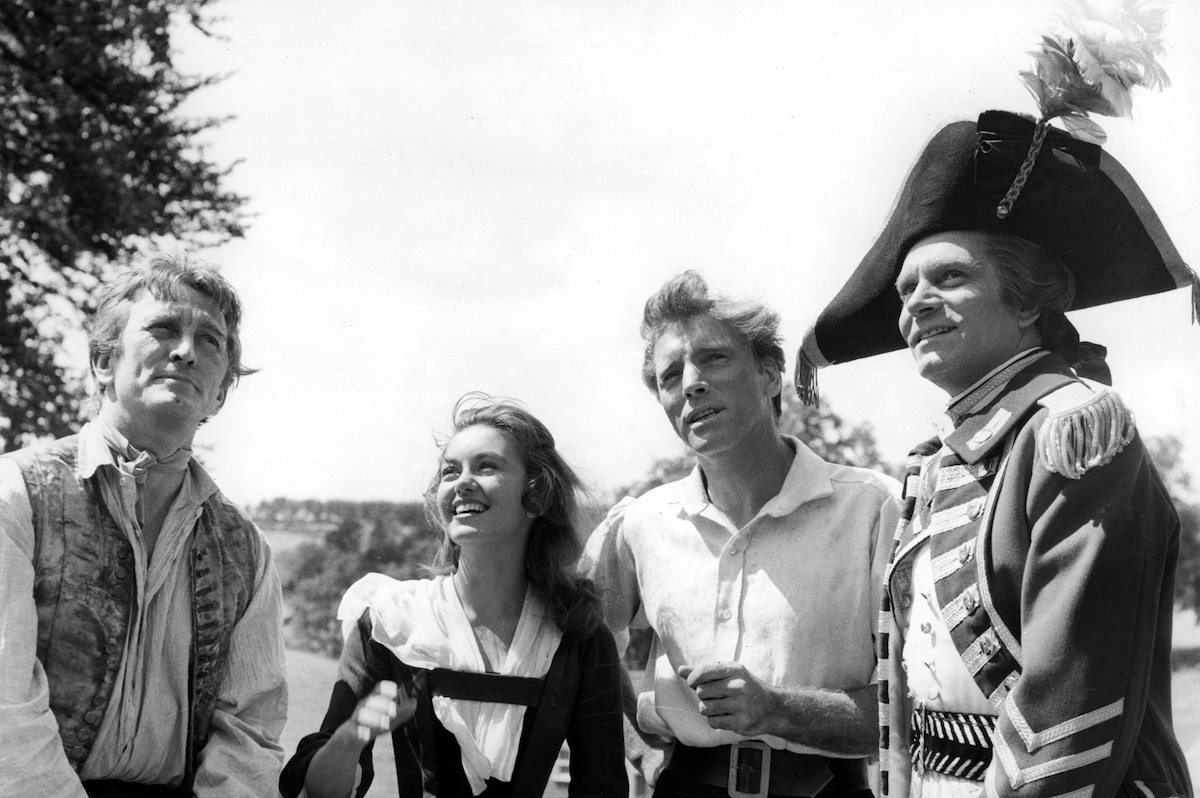
Kirk Douglas and Burt Lancaster decided to produce and co-star in a film
version of The Devil's Disciple (1959). Even with Laurence Olivier in a
glorified supporting role, the resulting picture isn't completely
successful. For once however, something was gained by tinkering with the
work of a brilliant writer. Many critics noted that the depiction of battle
sequences that Shaw only described in his play helped open the story up,
but audiences at the time couldn't be lured to theatres to see it. It probably
didn't help matters that the picture was marketed via the legendarily awful
tag line: "Burt, Kirk and Larry are coming - by George!"
The story takes place in New Hampshire, in 1777. British troops move in
from Canada under the leadership of Gen. John Burgoyne (Olivier.) The
locals, of course, plan to resist, but Burgoyne changes their minds when he publicly hangs a local bigwig named Timothy Dudgeon. But he doesn't count on
the return of the man's son, Richard Dudgeon (Douglas), who vows to take
revenge. Anthony Anderson (Lancaster), the pastor of a nearby village,
understands Dudgeon's position, but is unwilling to join up with him because
he's afraid that his wife (Janette Scott) is falling in love with the young
rebel. Before it's over, a case of mistaken identity will bring the battle
to a violent head.
Shaw, who was Irish, never tired of poking fun at the British, and The
Devil's Disciple is loaded with sarcastic swipes at their perceived
social and military inadequacies. How ironic, then, that Olivier, the Brit,
is so much fun to watch and gets all the best lines. As the critic for
The London Daily Standard wrote at the time, "It is a film to see
just because Laurence Olivier gives the performance of his life. And
because, in his superb self-confidence, he dared to take the third lead,
knowing that he would steal the film from Burt Lancaster and Kirk Douglas,
the two male leads. And he does. Those two able actors look like stupid
oafs."
That's over-stating it considerably, but Olivier seems to be having such a
wonderful time you'd never know that he was miserable while making the
movie. The project he originally planned to work on was his own film
adaptation of Macbeth. Unfortunately, he couldn't get the funding he
needed, so it was with ulterior motives that he agreed to appear in The Devil's Disciple.
For openers, the picture was filming in England, so he wouldn't have to fly
overseas, and he was certainly happy to accept a $200,000 salary. But he
also hoped that Lancaster might be able to get Hollywood interested in a big
Shakespearean production. Olivier's plan was to cast his then-wife, Vivien
Leigh, as Lady Macbeth, and to offer the role of Macduff to Lancaster.
These plans never materialized, however, due to personal problems.
While Olivier was busy filming with Lancaster and Douglas, Leigh, who had
been growing increasingly histrionic, suffered a violent mental collapse.
Leigh had had a long history of psychological problems, and Olivier knew
that this episode put an end to any hopes that she might fully
recover.
It's no wonder, then, that he seemed to lose focus while working on the
The Devil's Disciple. Leigh's condition, of course, was his main
concern. But he was also frustrated that, no matter how he tried, he
couldn't land the money for an English production of a film by a British
playwright, while Burt Lancaster could with no trouble. During
shooting, whether it was an intentional dig at their star status or not,
Olivier consistently reversed Lancaster's and Douglas' names, calling them
"Kirk" and "Burt" respectively. Lancaster, at least, grew increasingly
irritated by this as filming continued.
Olivier later stated that he had never had "such a miserable time on a job," but seen today most admirers of the actor's work will find his performance in The Devil's Disciple simply "irresistible," to quote critic Pauline Kael.
Director: Guy Hamilton
Producer: Harold Hecht
Screenplay: Roland Kibbee and John Dighton (based on the play by George
Bernard Shaw)
Cinematography: Jack Hildyard
Editor: Alan Osbiston
Art Design: Terence Verity and Edward Carrere
Costume Design: Mary Grant
Principal Cast: Burt Lancaster (Anthony Anderson), Kirk Douglas (Richard
Dudgeon), Laurence Olivier (Gen. Burgoyne), Janette Scott (Judith Anderson),
Eva LeGallienne (Mrs. Dudgeon), Mervyn Johns (Rev. Maindeck Parshotter),
David Horne (William), Jenny Jones (Essie), Erik Chitty (Titus.)
BW-84m.
by Paul Tatara
The Devil's Disciple
by Paul Tatara | July 28, 2004
SIGN UP FOR OUR NEWSLETTERS

CONNECT WITH TCM