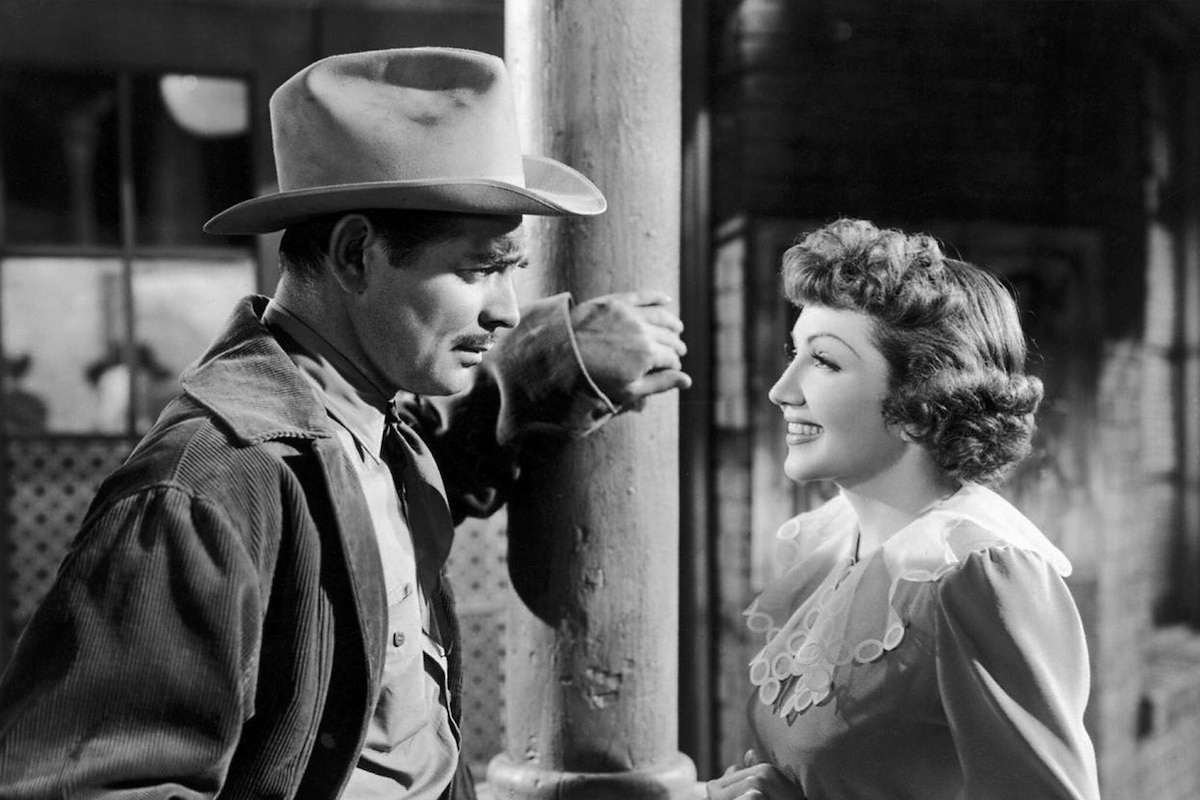
Clark Gable felt right at home while filming Boom Town (1940). As a
teenager he had worked as a rigger in the Oklahoma oil fields with his
wildcatter father, William Gable. In fact, he used his father as a model for the
role of Big John McMasters, the energetic and unforgettable American
Dreamer of Boom Town. McMasters and his pal, "Square John" Sand (Spencer Tracy), are two down-on-their-luck oil wildcatters who get lucky and strike a gusher, making them both rich. However, wealth and power bring their own problems to these two men whose friendship is constantly tested over the next several years through their marital and business relationships.
Boom Town recreates in the purest sense an early twentieth century vision of the American Dream. The idea that two rough and tumble Texas men can recycle poverty and wealth again and again reinforced the prevailing spirit of that dream; one of the film's promotional tag lines was "Men born of the lasting miracle that is America." Whether true or not, the concept that anyone with enough gumption, desire and hard work could break through any form of class structure and eventually reach the top of society, had a strong appeal for a public that was just starting to come out of the Great Depression. When you add the additional subplot
of Spencer Tracy's unrequited love for Claudette Colbert who's stolen
away by Gable, you have the formula for a giant, box office smash. Thrown
into the mix is the alluring Hedy Lamarr as a potential threat to Gable's marriage and an excellent supporting cast including Frank Morgan, Chill Wills and Lionel Atwill. All this,
combined with fast paced action sequences, crisp dialogue and the unadulterated
themes of life long friendships and lasting romantic love, make Boom
Town an enormously entertaining example of MGM's prestige productions of the forties.
In real life Gable and Tracy enjoyed working with one another. With the movies San
Francisco (1936) and Test Pilot (1938) they already had two
successful projects under their belts. And even though Boom Town was
just as profitable as their previous hits, it would be their last film
together - and arguably their best. The duo generates a believable dramatic tension when together on-screen and their fight scenes are particularly effective. When filming one of the latter sequences, Gable insisted on doing his own stunt work. Tracy, however, used a double who accidentally landed a blow to Gable's face, cutting the actor's lip and breaking his dentures which required a break in shooting for a week. After the movie was completed Tracy decided he was tired of playing the best friend who watched while his pal Gable won the girl. He wanted to be a star in his own right.
Tracy had already been brooding about this during the making of Boom Town and was irritable and withdrawn throughout the production. The native Parisian, Claudette
Colbert, didn't like the fact that Tracy called her either "Frenchie" or "Froggie" and distanced
himself from everyone on the set. Moreover, his relationship with Hedy Lamarr, a
combative one in the film, was also an outright hostile pairing in real
life. For example, in one scene the self-sacrificing Tracy is
trying to drive Lamarr off to protect Gable and Colbert's marriage for
Colbert's sake and he aggressively pokes Lamarr in the chest repeatedly. If
you look closely, you'll see that she pushes his hand away at the end of
the scene with a great deal of disdain, each of them giving each other a
stone-cold stare at the scene's fade-out.
For the press and the public, there was a great deal of excitement over the Gable/Colbert reunion, their first in six years after their legendary performances in the seminal romantic comedy It Happened One Night (1934). That film was the first to win all
five major Oscars, including Best Actor and Best Actress for Gable and
Colbert. At the same time there was an equal amount of anticipation surrounding Hedy Lamarr's appearance in Boom Town. Though probably the least known of the four MGM stars today, she was being groomed for superstardom by her studio in the late thirties/early forties. Having jet-black hair and brilliant green eyes in an age of platinum blondes, she stood out as one of the most beautiful women of her era. Even before she portrayed the memorable fourth wheel in Boom Town, she had already gained a certain degree of international fame.
In fact, her life was the stuff from which myths are made.
Born Hedwig Eva Maria Kiesler, in Vienna, the daughter of a banker, she gained worldwide
notoriety when she appeared nude in the Czech film, Ecstasy (1932).
Shortly afterwards she would marry Fritz Mandel, an Austrian munitions
magnate, who would introduce her to such world figures as Mahler, Hitler
and Mussolini. He would also treat her as just another beautiful
possession of his, causing Lamarr to disguise herself as one of her
servants, eventually escaping to Paris. Guided by Louis B. Mayer, she
emigrated to the United States with every intention of becoming a star.
Primarily because the prudish Mayer was embarrassed by Lamarr's nude
appearance in Ecstasy, he changed her name from Kiesler to Lamarr to
avoid any connection with what he considered her risque former life. After her eye-catching performance in the film, Algiers (1938), Mayer declared that she would become the studio's "most important star." To illustrate how popular Hedy Lamarr was during the war years, a kiss from her at fund raising efforts cost the price of a $25,000 bond. However, in a relatively short space of time, she suffered several box office failures, including what
most film aficionados feel is one of the worst movies MGM ever made, I Take This Woman (1939). Part of the problem was that Mayer forced Lamarr to accept roles she didn't want like Lady of the Tropics (1939) plus she wasn't always the best judge of scripts herself. For example, she turned down Laura (1944), as well as two of Ingrid Bergman's biggest hits,
Gaslight (1944) and Saratoga Trunk (1945), among other well
known classics. In her own defense, Lamarr recounted in her autobiography, Ecstasy and Me, how she lobbied hard for the secondary role in Boom Town which she saw as "not big, but gutsy. A perfect vehicle for me to prove my ability." Mayer finally relented and let her take the second female lead. Lamarr wrote, "I was deadly serious all during the making of it. I needed this one and it had to be good. Clark was kind to me all during the film. Spencer was aloof but worked hard. When a picture is going good everyone feels it. We felt all during the filming we had a good one. And it was. The reviews were a smash." Unfortunately, Lamarr's screen successes were few and by the late '50s her career was over.
Interestingly, a piece of information would surface late in Hedy Lamarr's
life that would go against the image of her as just another pretty face on the screen. In 1997 authorities revealed that in 1940 after her emigration to the United States and subsequent stardom, Lamarr used her knowledge of weaponry learned under the auspices of her former husband, Mandel, in a way that would serve as the foundation for today's secure
military communications. Together with the help of composer George
Antheil, she created an anti-jamming device for the Allies in World War
Two. Using paper rolls with perforations that exactly matched the
split-second hops of radio frequencies, the device was an important
contribution to the Allied war effort. That's something to think about
when we watch Lamarr as that slinky woman in gorgeous black and white in
Boom Town. With this film, she proved she could create a fully rounded character who depended on other qualities besides her stunning beauty. It's a character much like herself: sexy, smart and a more substantial person than appearances would have you
believe.
Producer: Sam Zimbalist
Director: Jack Conway
Screenplay: John Lee Mahin
Cinematography: Woody Bredell, Harold Rosson
Costume Design: Adrian, Gile Steele
Film Editing: Paul Landres, Blanche Sewell
Original Music: Daniele Amfitheatrof, Franz Waxman
Cast: Clark Gable (Big John McMasters), Spencer Tracy (Square John Sand), Claudette Colbert (Betsy Bartlett), Hedy Lamarr (Karen Vanmeer).
BW-119m. Closed captioning.
by Joseph D'Onofrio
Boom Town
by Joseph | July 28, 2004
SIGN UP FOR OUR NEWSLETTERS

CONNECT WITH TCM