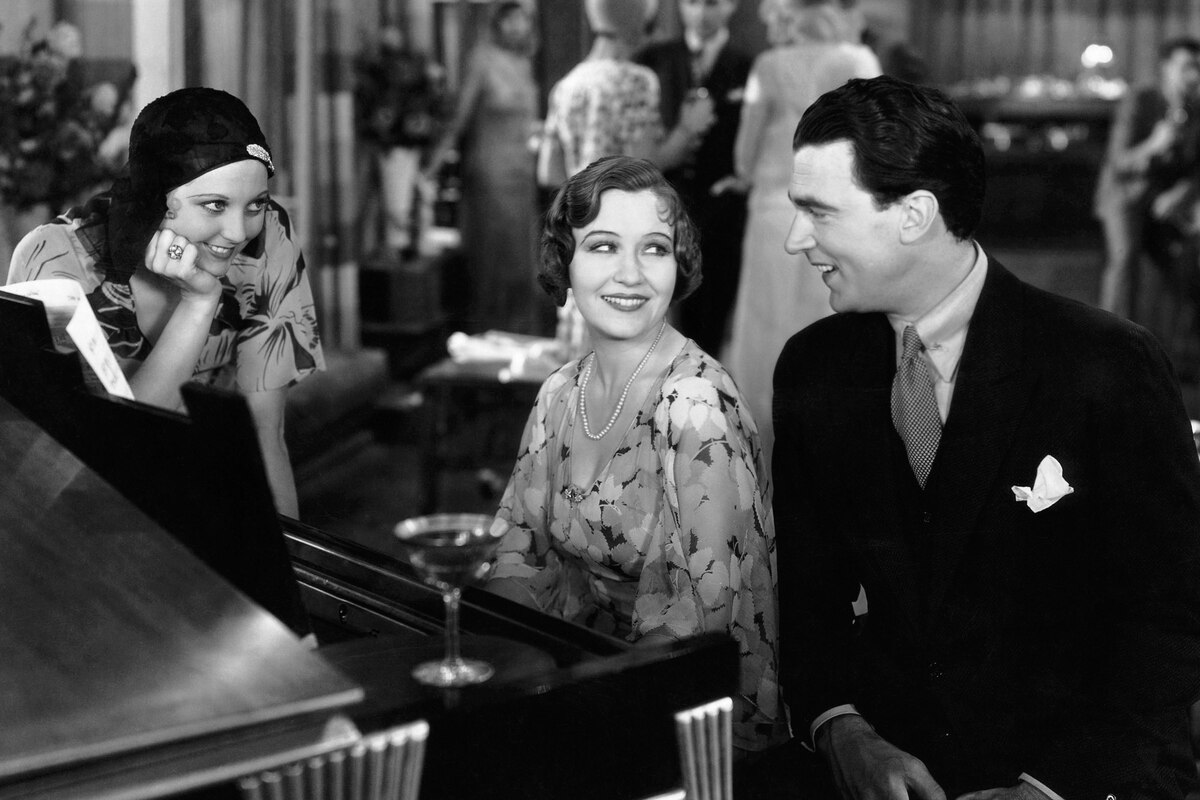
Thelma Todd continued her run of supporting roles in The Hot Heiress, a 1931 semi-musical
(it was billed as an "original musical" until the genre became box office
poison, then released as a comedy). The role was far from large: she was
seventh billed as leading lady Ona Munson's wise-cracking society friend,
and the film's best lines went to another soubrette, cigarette-girl Inez
Courtney. Yet it gave her the distinction of appearing with Mr. and Mrs.
Ben Lyon (the Mrs. was Bebe Daniels) within the same year when Todd took on
the role of sex-starved widow Iva Archer in the first film based on The
Maltese Falcon. In truth, though, The Hot Heiress is probably
most important because of the things its cast would do in other
pictures.
The picture was originally planned as Sweethearts, a vehicle for
Ziegfeld Follies star Marilyn Miller. The plot was an inversion of
her usual rags-to-riches stories. She would have starred as an heiress who
falls for a construction worker and, after first trying to pass him off to
her swank friends as an architect, agrees to live on his salary in the name
of love. Seeking a more reliable vehicle, Miller opted to star in the film
version of her stage hit Sunny instead, so First National Studios
turned to starlet Ona Munson.
Munson certainly had the chops to star in a musical. After an early career
in vaudeville, she had top-lined the Broadway smash No, No Nanette
and introduced the song "You're the Cream in My Coffee." But at the time
she was better known for having recently ditched her husband,
actor-director Eddie Buzzell, for an affair with director Ernst Lubitsch.
Less known was her private predilection for amorous encounters with other
women; she would number Marlene Dietrich, Alla Nazimova, the Countess
Dorothy di Frasso and Mercedes De Acosta among her conquests. Munson never
really hit it big in Hollywood. She got her most famous role when producer
David O. Selznick looked beyond her freckles and bird-like frame to see
that makeup and padding could transform her into Atlanta's most notorious
Madame, Belle Watling, in Gone With the Wind (1939). When that
film's success did little for her standing in Hollywood, Munson switched to
radio, becoming CBS's first female producer. Haunted by professional,
personal and health problems, she would commit suicide in 1955.
More cheery were the futures of leading men Lyon and Walter Pidgeon.
Lyon had started on stage as a teenager and risen to stardom in silent
films. His biggest hit had been the World War I aviation thriller
Hell's Angels (1930), and he was still riding on that success when
he took the lead in The Hot Heiress. But although he sang
serviceably, had great comic timing, and was almost as pretty as his leading
lady, he never scored another big hit in American films. Instead, he and
Daniels moved to London, where they became stars of radio and film playing
themselves, a show-biz couple.
Pidgeon had started his career in musical theatre, where he introduced
Irving Berlin's "What'll I Do?" and "All Alone." After a few silent films,
he had moved into talkies as a musical star, though his role as Munson's
jilted society boyfriend in The Hot Heiress didn't give him a chance
to sing. With the decline of the musical, he returned to the stage until
he could build a new film career in the late '30s as a dependable
leading man at MGM. Fortunately, that put him in the right place for his
most noteworthy screen roles, as Greer Garson's ideal co-star in a series
of eight films including Mrs. Miniver (1942) and Madame Curie
(1943).
With three songs from Richard Rodgers and Lorenz Hart, including the catchy
love duet "Like Ordinary People Do" and the imaginatively staged "Nobody
Loves a Riveter But His Mother," First National expected The Hot
Heiress to be a big hit. The latter made particularly good use of the
potential of talking films, as construction sounds and the song form a
background to various scenes in which people respond to the leading man's
noisy line of work. The songwriters were thrilled with life in Hollywood
and had signed a multi-picture deal with the studio. But the film fell
afoul of the musical's waning popularity and drew weak reviews and weaker
box office. Nor did it help that Rodgers wife, Dorothy, arrived and
decided that Hollywood life just wasn't for her. The team negotiated an
end to their contract and went back to Broadway. They were back within a
year, however, making film musical history at Paramount with Rouben
Mamoulian's Love Me Tonight (1932), starring Maurice Chevalier and
Jeanette MacDonald. Interestingly, that film's famous setting of "Isn't It
Romantic?" would use ideas that had first appeared in The Hot
Heiress.
Director: Clarence G. Badger
Screenplay: Herbert Fields
Cinematography: Sol Polito
Art Direction: Jack Okey
Music: Richard Rodgers, Leon Rosebrook
Principal Cast: Ben Lyon ("Hap" Harrigan), Ona Munson (Juliette Hunter),
Walter Pidgeon (Clay), Tom Dugan (Bill Dugan), Holmes Herbert (Mr. Hunter),
Inez Courtney (Margie), Thelma Todd (Lola).
BW-79m.
by Frank Miller
The Hot Heiress
by Frank Miller | June 29, 2004
SIGN UP FOR OUR NEWSLETTERS

CONNECT WITH TCM