"Children can be nasty, don't you think? "
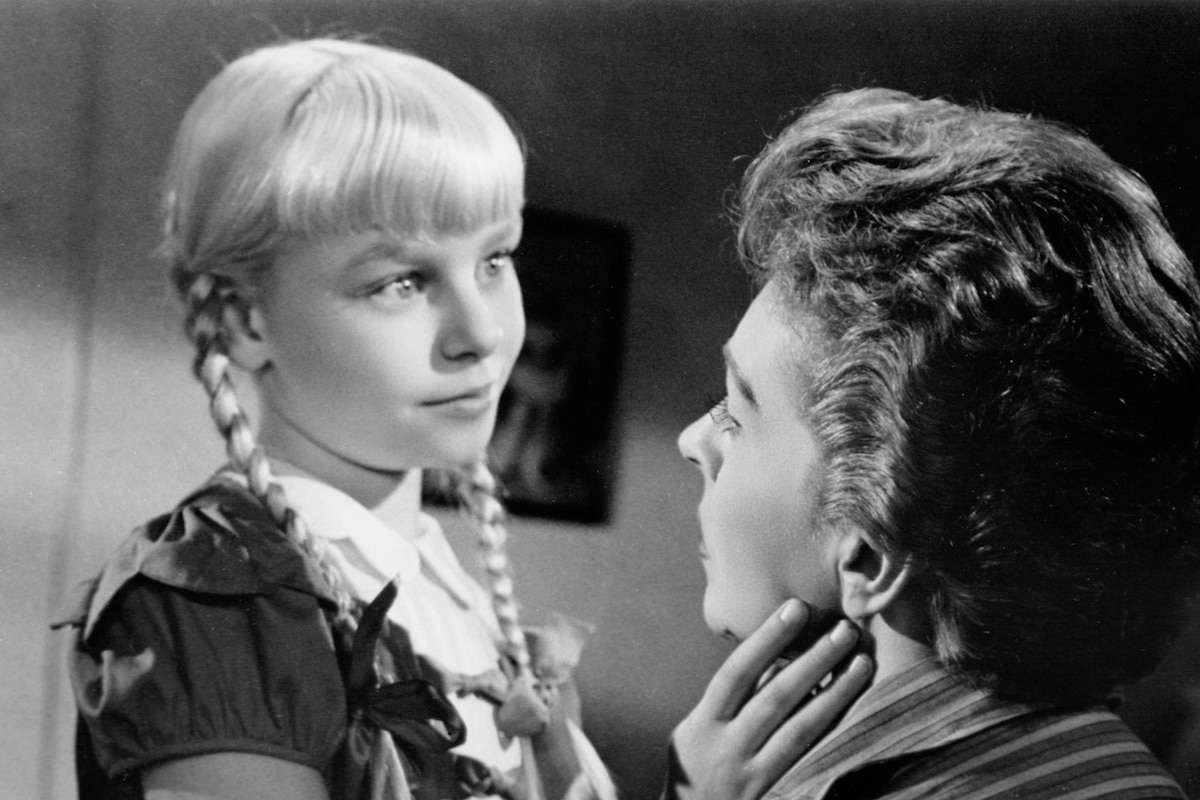
Eileen Heckart as Mrs. Daigle in The Bad Seed
In 1956, Warner Bros. brought the most evil child short of the Anti-Christ
to screen in the person of Rhoda Penmark, a murderous moppet so cold she
could practice her piano lessons methodically while her latest victim was
burning to death in the basement below. As embodied by eleven-year-old
Patty McCormack, Rhoda was a character with no precedent in film history
(so much so that the censors tried to keep her off the screen). Her
distinct presence coupled with the intensely emotional playing of the
film's adult stars have made the film a cult favorite, with contemporary
audiences see-sawing between laughter at the histrionics and stunned disbelief
at Rhoda's evil ways.
Rhoda Penmark was the brainchild of writer William March, who drew on
the '50s debate over whether or not evil and mental illness were hereditary
to paint his portrait of a child unconsciously following in the footsteps
of her serial killer grandmother. Playwright Maxwell Anderson, best known
for such historical verse tragedies as Anne of the Thousand Days and
Elizabeth the Queen, turned the story into a hit play that won Nancy
Kelly Broadway's Tony Award for playing Rhoda's mother and started
McCormack on the road to becoming a household name.
Originally director-writer Billy Wilder wanted to make the film version as
an independent production, but he ran into trouble when he submitted the
script to the industry's own self-censorship organization, the Production
Code Administration. One of the Production Code's rules forbade "Pictures
dealing with criminal activities, in which minors participate , or to which
minors are related." Although juvenile delinquency had been a film
subject since the '30s, when the Dead End Kids first hit the screen,
Rhoda's criminal doings and the script's extended discussion of heredity
were considered too strong for the screen. The implication that she wasn't
really responsible for her crimes because she was, as the title suggested,
a bad seed, was deemed a bad influence on the youth of America. Wilder
dropped the project, only to learn that Warner Bros. had gotten approval
for the material simply by offering to create a new ending in which Rhoda
would be punished for her crimes. The real difference, in his view, was
that Warners was a big studio while he was just an independent producer, a
conclusion that led to his decision to ignore the Production Code when
choosing properties in the future. Ironically, the film he chose to make
instead of the The Bad Seed, The Spirit of St. Louis (1957),
would be released by Warners.
Warner Bros. gave producer-director Mervyn LeRoy the chance to bring The Bad
Seed to the screen. Initially, they objected to his plan to cast the
play's leading players -- including Kelly, McCormack, Eileen Heckart and
Henry Jones -- in place of established box-office names like Bette Davis,
who had expressed an interest in the film's leading role. He also decided
to stick closely to Anderson's original screenplay, working with
cinematographer Harold Rosson to open the film up primarily by moving the
camera around. The choice paid off by visually isolating and trapping
Rhoda's mother as she discovered her little girl was a cold-hearted killer.
LeRoy also decided to use a theatrical curtain call at the film's end. He
recorded a voiceover introducing the film's cast and, as had been the case
when the play was performed, followed the bows by having Kelly take
McCormack over her knee for a good spanking. After the horror of the
film's subject matter, this served to let '50s audiences off-the-hook,
while adding to the film's word-of-mouth appeal.
In another move to appease the censors, Warner Bros. added an "adults only"
tag to the film's advertising. As a result, the film became one of their
biggest hits of the year, grossing $4.1 million (an impressive figure for
the time) and landing in the year's top 20 at the box office. The film
also landed Oscar® nominations for Rosson, Kelly, McCormack and
Heckart, with the latter winning the Golden Globe for Best Supporting
Actress.
Over time, The Bad Seed has continued to wield its influence. It
was re-made in Turkey in the '60s, then turned into a mediocre
television movie starring Blair Brown in 1985. Australian singer-actor
Nick Cave even named his band, The Bad Seeds, for it. None of the re-makes
ever came up with a young actress who could match McCormack.
Unfortunately, the child actress never came up with a performance that
could match her turn as Rhoda. Although still active in the business,
McCormack never got to capitalize on her child stardom. She moved into troubled
teen roles in the '60s -- most ludicrously in 1968's The Mini-Skirt
Mob -- moved into the soaps and currently plays character roles. Her
most notable later assignments include two low-budget thrillers,
Mommy (1995) and Mommy II: Mommy's Day (1997) in which she
plays a character who could easily be a grown-up Rhoda, a mother who
murders anyone who makes her daughter unhappy.
Producer-Director: Mervyn LeRoy
Screenplay: John Lee Mahin
Based on the Play by Maxwell Anderson and the novel by William March
Cinematography: Harold Rosson
Art Direction: Jack Bechman, Ralph S. Hurst
Music: Alex North
Cast: Nancy Kelly (Christine Penmark), Patty McCormack (Rhoda
Penmark), Henry Jones (LeRoy), Eileen Heckart (Mrs. Daigle), Evelyn Varden
(Monica Breedlove), William Hopper (Kenneth Penmark), Paul Fix (Bravo),
Jesse White (Emory), Frank Cady (Mr. Daigle).
BW-130m. Closed Captioning.
by Frank Miller
The Bad Seed (1956)
by Frank Miller | June 28, 2004
SIGN UP FOR OUR NEWSLETTERS

CONNECT WITH TCM