You'd be hard-pressed to find a less likely big name star than Edward G.
Robinson. Robinson knew full well that he wasn't blessed with the physical
attributes of, say, a Clark Gable or a Gary Cooper. But after establishing
himself in a string of impressive performances on Broadway, he also knew
that he had a natural ability to deliver powerful, undiluted emotions to an
audience. Eventually, he made his way to Hollywood in search of more fame
and fortune.
Like so many actors who ply their trade for decades, Robinson's career
heated up and cooled off several times over, and the quality of the material
he was offered varied. But his performances were never less than committed.
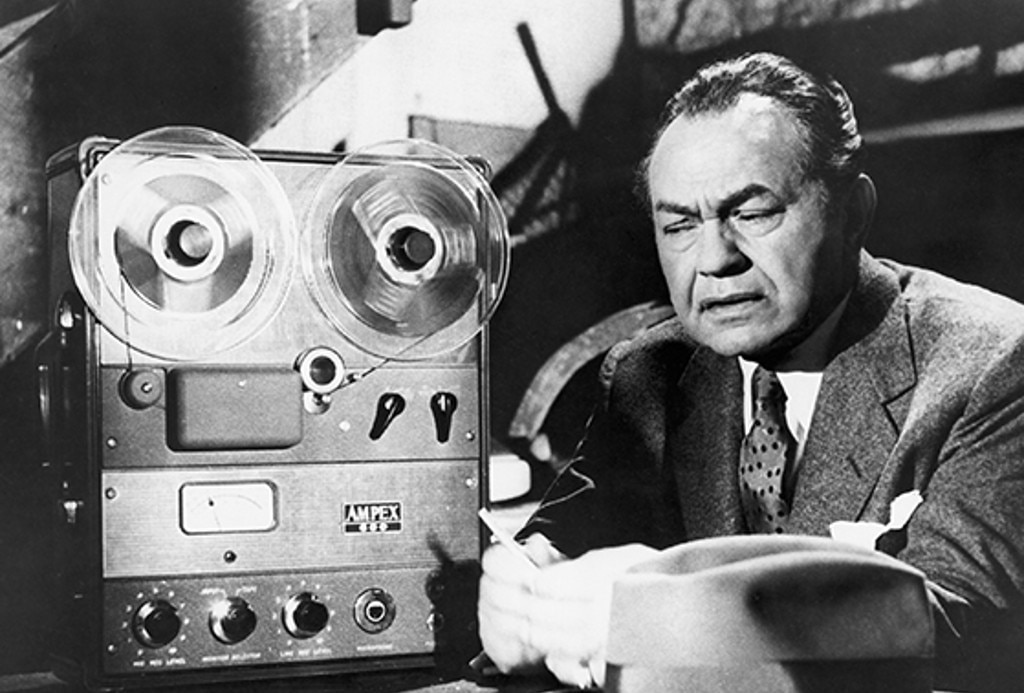
Maxwell Shane's Nightmare (1956), a re-make of Shane's more successful 1947
melodrama, Fear in the Night, is a tautly paced little programmer in which
Robinson and co-star Kevin McCarthy do the best they can with a contrived, patently
unbelievable narrative. Robinson, in particular, imbues what he's doing
with a stern dignity, even though the screenwriter (director Shane, in this
case) doesn't provide him with top notch material.
McCarthy (who you probably remember from Don Siegel's original film version of Invasion
of the Body Snatchers, 1956) plays Stan, a New Orleans jazz musician who can't
shake the feeling that he's killed somebody. A very realistic dream, in
which he stabs a man and stashes the body behind a mirrored door, haunts
him. He also woke up with blood on his wrist and thumbprints on his throat,
which you don't usually get from simply catching a few Z's.
When Stan's sister, Gina (Connie Russell), and detective brother-in-law,
Rene (Robinson), take him on a picnic to get his mind off of things, they
stumble upon a mansion that exactly matches the location of the killing in
Stan's dream. When a body is later found in the house, Rene tells Stan to
high-tail it before he reports the crime to the authorities. The ultimate
"solution" to all of this was already getting hoary back in 1956, and is
downright ridiculous now.
Nightmare didn't do much business when it first came out, although
Milton Esterow, a critic at The New York Times, called the
performances "crooked but neat." Actually, if you stop
to think about it, most of Robinson's work could be described with that phrase.
That's part of its appeal.
Even Robinson could never quite grasp why he became such an iconic
big-screen figure. It all started, quite suddenly, with his performance in
Little Caesar (1931), the response to which he wrote about in his
autobiography: "Warner's insisted I come in from the coast to attend the
premiere. My plan was to present myself at the Winter Garden, buy a ticket,
and have a look. But from my arrival at Grand Central Station, I knew that
something incredible and cataclysmic had happened to my life. After 40
plays and a couple of movies, I had always been able to walk into an A&P or
Macy's or stroll the art galleries on 57th Street with no one bothering me,
no one looking at me, no one having the faintest notion who I was. But
today was different. I was surrounded by autograph hunters, redcaps,
crowds, people shoving me, pushing me, stealing my handkerchief, and tearing
off my shirt buttons. I'd never known anything like it; I was frightened,
and, deep inside, a little excited."
Call it star power, and he never lost it.
Directed by: Maxwell Shane
Written by: Maxwell Shane
Produced by: William C. Thomas and William H. Pine
Photography: Joseph F. Biroc
Editing: George A. Gittens
Art Direction: Frank Sylos
Music: Herschel Burke Gilbert
Sound: Jack Solomon and Paul Wolf
Principal Cast: Edward G. Robinson (Rene Bressard), Kevin McCarthy (Stan
Grayson), Connie Russell (Gina), Virginia Christine (Sue Bressard), Rhys
Williams (Torrence)
B&W-89m.
by Paul Tatara
Nightmare (1956)
by Paul Tatara | June 25, 2004
SIGN UP FOR OUR NEWSLETTERS

CONNECT WITH TCM