In the fall of 1940, with the Draft Bill freshly signed into law by FDR, the Hollywood studios were scrambling to develop screenplays centered on the selective service. Amongst those houses was Universal, which opted to roll the dice and place their project square on the shoulders of a pair of burlesque comics who had only appeared in supporting roles in one previous movie, the unmemorable musical revue One Night in the Tropics (1940). The end result, Buck Privates (1941), launched Bud Abbott and Lou Costello as the dominant draws of WWII-era show business and spawned numerous imitations (Caught in the Draft (1941) with Bob Hope, Tramp, Tramp, Tramp (1942) starring Jackie Gleason, and others). The film also grossed $4.7 million in a time when tickets cost a quarter, and outdrew such prestigious contemporary productions as Citizen Kane, How Green Was My Valley, Sergeant York and Here Comes Mr. Jordan.
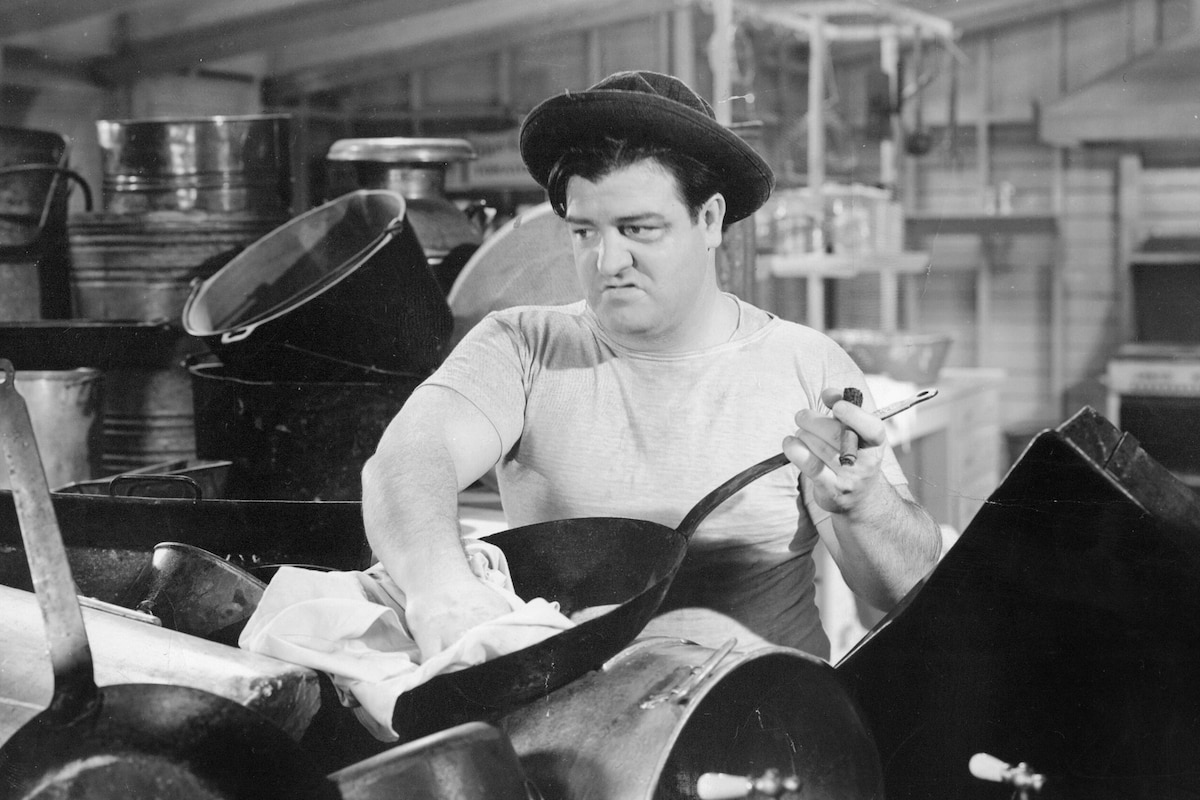
What passes for a plot in Buck Privates would set the formula for Abbott & Costello's run in Hollywood, providing just enough story to give the gifted clowns of patter a setting to perform their stage-honed shtick. Sidewalk hucksters Slicker Smith (Bud) and Herbie Brown (Lou) are rousted from their attempts to earn a marginally honest living by an angry cop (Nat Pendleton), and duck into a busy theater in hopes of escape. They wind up realizing too late that the movie house has been converted into an enlistment center, and that the "prize drawing" they signed for was a stint with Uncle Sam. Things get even worse when they report to boot camp, and discover that Pendleton is their master sergeant.
Basic training lent a contemporary context for A&C's brand of comedy, and audiences of the day responded enthusiastically. This was best demonstrated in the sequence where Bud attempts to guide the hapless Lou through drill ("Throw your chest out!" "I'm not done with it!"), which necessitated a dozen takes because Costello kept cracking up director Arthur Lubin. Editor Phil Cahn was under orders to preserve every foot of it, and the end result of his cobbling is brilliant. Lubin recounted for Bob Furmanek and Ron Palumbo's Abbott and Costello in Hollywood (Perigee) how the stage veterans had some initial trouble adjusting to their new medium. "They played to the people on the set instead of the camera. They were used to having a live audience and missed getting laughs. But they learned quickly and we had a lot of fun on that picture." From Abbott's attempts to fleece the alleged novice Costello at craps, to goading him to blast the radio in defiance of Pendleton's orders, their interplay is captured in peak form.
Beyond A&C's foible-filled escapades in basic training, the story presents a romantic triangle between a pretty camp hostess (Jane Frazee), an arrogant playboy (Lee Bowman) certain that his father's pull will get him out of service, and his pushed-to-the-limit former valet (Alan Curtis). Frazee's support staff includes the singing Andrews Sisters, who use their multiple interludes to deliver such hits of the period as Boogie Woogie Bugle Boy from Company B, Bounce Me Brother With a Solid Four and I'll Be With You in Apple Blossom Time. In structure, Buck Privates feels like a filmed vaudeville revue, alternating comedy skits with musical numbers. The film's perky soundtrack would net its only Oscar® nominations for score (Charles Previn) and song (Boogie Woogie Bugle Boy).
Alex Gottlieb, the producer who shepherded A&C's film career during their peak at Universal, recounted how the studio drafted him from its screenwriting ranks for Furmanek and Palumbo's work. Milton Feld, the Universal executive who had earlier given Gottlieb his start in the industry, told him that he was "the twenty-seventh writer I've talked to. Everyone else turned it down. They all want to be producers, too. But they all said that these are a couple of cheap burlesque comics who will never get anywhere." Gottlieb, who had seen the pair in their popular Broadway success Streets of Paris, was convinced of the breadth of their appeal. He responded to the challenge by declaring that "I will be the star producer on your lot, I will make Universal rich, and I will make stars out of Abbott and Costello."
The whole enterprise was budgeted at around $200,000. Universal had originally offered A&C $50,000 per picture to sign with the studio for seven years; the comics countered for either $60,000 or $50 G plus 10% of the gross. Universal confidently took the latter option, and the studio heads must have had reason to wince after the blockbuster success of Buck Privates. In light of what Abbott & Costello would come to mean for the studio's fortunes over the war years, though, they came out well ahead of the game.
Producer: Alex Gottlieb
Director: Arthur Lubin
Screenplay: Arthur T. Horman, John Grant
Cinematography: Milton Krasner, Jerry Ash
Film Editing: Philip Cahn
Art Direction: Jack Otterson
Music: Sonny Burke, Hugh Prince, Don Raye, Vic Schoen, Frank Skinner, Charles Previn
Cast: Lee Bowman (Randolph Parker III), Alan Curtis (Bob Martin), Bud Abbott (Slicker Smith), Lou Costello (Herbie Brown), Jane Frazee (Judy Gray), The Andrews Sisters (Themselves).
BW-85m. Closed Captioning.
by Jay S. Steinberg
Buck Privates
by Jay S. Steinberg | June 29, 2004
SIGN UP FOR OUR NEWSLETTERS

CONNECT WITH TCM