"So Full of Spectacle and Glory it Had to be Made in Technicolor!" screamed
the ads for Captains of the Clouds (1942), and sure enough, James
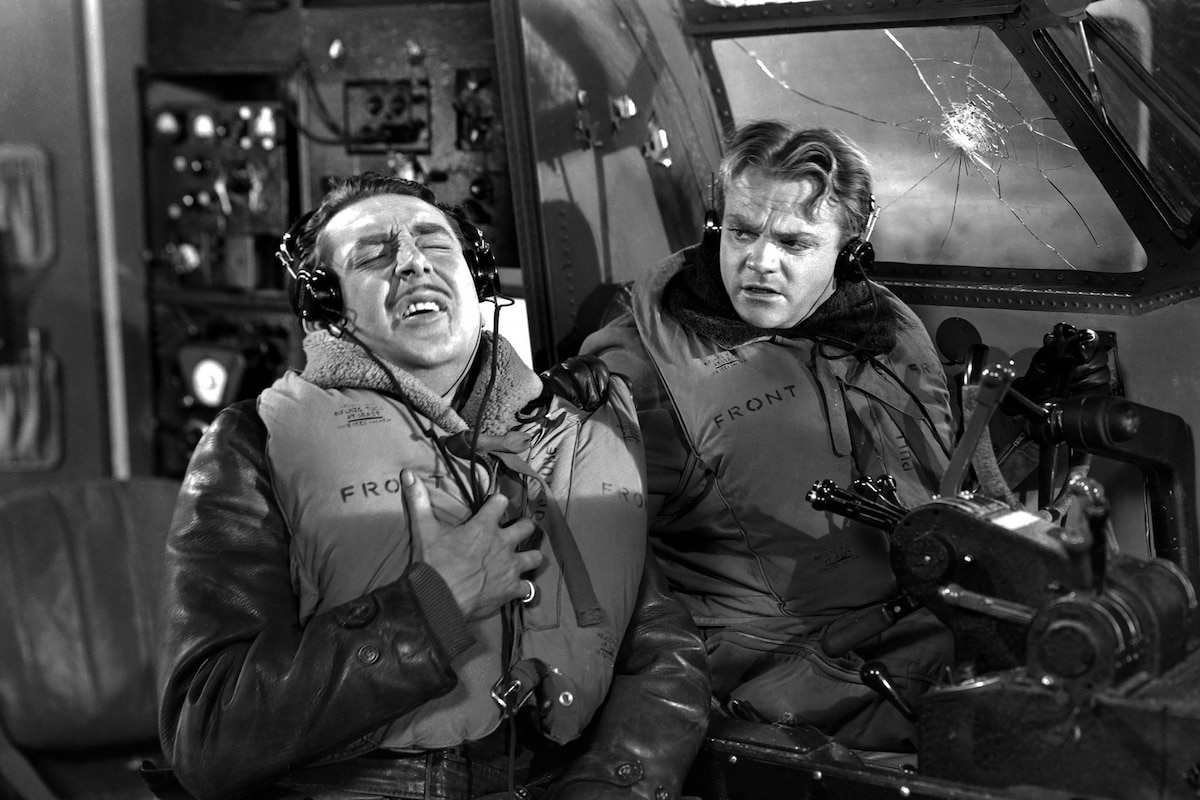
Cagney's first color movie boasts some spectacular aerial sequences. The story
follows a group of Canadian bush pilots who decide to join the Royal Canadian Air
Force when WWII breaks out. Cagney plays a fiercely independent, brash flyer who
must learn to turn himself into a team player.
It sounds simple enough, but the truth is that Captains of the Clouds
was an exceptionally challenging and difficult picture to make. Warner Bros. producer
Hal Wallis wrote in his memoirs that the film "proved to be by far the most
extensive and difficult venture in location work undertaken by Warners since the
silent period." Most of the film was shot in and around Ottawa. With difficult
wartime conditions, every hotel in the area was booked, and the crew had to be housed
in an army camp - with army food. "They grumbled loud and long," recalled
Wallis, "and twice we came close to a strike on the picture."
One day, Cagney suffered a concussion during a stunt in which his character gets
knocked into the water by a propeller. Afterwards, Wallis and director Michael
Curtiz were informed by their technical adviser that in such a situation "the
propeller would normally have been turned off, and we had gone through this experience
for nothing." Other problems included truck crashes, plane crashes, various
on-set injuries and even lightning, which one afternoon struck a camera reloading
shed "and burned it to the ground."
But the single hardest sequence to shoot was the elaborate "wings" ceremony,
in which Air Marshal Billy Bishop's speech to the ranks on an airstrip is interrupted
by Cagney's daredevil flying maneuvers. The scene took forever to nail down. Just
getting the timing right was a major logistical challenge which required many attempts,
but there were other problems: A sudden rainstorm. Engine trouble. Not enough sunlight.
Malfunctioning cameras. The air marshal showing up late. After a week, wrote Wallis,
"Rain, technical mishaps, and problems of every kind continued to dog us. We
finally had to piece together fragments of footage from the many days of shooting
in order to achieve a finished result. In the picture, however, it looks as if the
whole sequence was shot at high noon in optimum sunny conditions."
Captains of the Clouds sprang from a magazine story called "Bush
Pilots" which Canadian actor Raymond Massey had brought to Wallis's attention.
Cagney wasn't crazy about the script but was persuaded to do the film by Jack Warner,
who told him that he would be contributing to the war effort by accepting the role.
Cagney relented, but only on the condition that his brother Bill be the line producer.
In his memoirs, Cagney also remembered the film as one of his most grueling, but
he added, "the one consolation for all the hard work was the kind of person
you worked with. Alan Hale, that big, wonderful guy we all loved. Always in a good
humor. Dennis Morgan, also a nice, nice guy. As the years wear on, I look back
at those people and think about them. When they were around, I really enjoyed them,
but now I realize that I could have enjoyed them more. The picture business has
always been such a hysterical one and the demands on attention so great that one
didn't have time to savor everything to the fullest - particularly your friends.
That is one of my regrets."
Reviews were mixed, but critics raved over the sensational aerial scenes. Time
said, "Although Cagney is much better than his thankless role, the real heroes
of Captains are director Michael Curtiz and his five cameramen,
who caught the matchless greens and browns of Canada's infinite north-country."
The Motion Picture Academy thought so, too, nominating Sol Polito for a Best Cinematography
Oscar®. (He lost to Fox's The Black Swan, shot by Leon
Shamroy.) Ironically, Polito almost didn't make it to the set. As an Italian, he
had serious trouble getting across the Canadian border since Canada was already
at war with Italy. He also suffered a heart attack during production.
Captains of the Clouds was completed before Pearl Harbor and
released in January 1942. In hindsight, the picture is an interesting precursor
to the WWII combat film genre that would soon get underway. As film historian Jeanine
Basinger has written, it begins as a typical Warner Bros. adventure, becomes a military
training story with an almost documentary feel, and ends in combat. Furthermore,
"it demonstrates that the skills [the pilots] need to live and work and fly
the wilderness are those they'll already have honed for war." As they train,
the "bush pilots become teachers and are seen flying in formation. This image,
contrasted with the earlier flights we have seen of their rolls and dives, free
and easy, over the Canadian wilderness, explains more about WWII movies than anything
else in the film. From freedom to conformity. From the individual to the group."
Basinger also points out that Billy Bishop, who plays himself as the air marshal
in the "wings" ceremony, was a famous Canadian flying ace who shot down
72 planes in WWI and was a maverick flyer of that war - just the type of flyer that
Cagney and his friends start out as, and from which they must evolve to be more
disciplined team players. According to Basinger, "showing Bishop endorsing
the change was a powerful thing at the time" of the film's release.
Producer: Hal B. Wallis
Director: Michael Curtiz
Screenplay: Arthur T. Horman, Richard Macaulay, Norman Reilly Raine, Roland Gillett
(also story)
Cinematography: Wilfred M. Cline, Sol Polito
Film Editing: George J. Amy
Art Direction: Ted Smith
Music: Harold Arlen, Max Steiner
Cast: James Cagney (Brian MacLean), Dennis Morgan (Johnny Dutton), Brenda Marshall
(Emily Foster), Alan Hale (Tiny Murphy), George Tobias (Blimp Lebec), Reginald Gardiner
(Scrounger Harris).
C-114m. Closed captioning.
by Jeremy Arnold
Captains of the Clouds
by Jeremy Arnold | June 22, 2004
SIGN UP FOR OUR NEWSLETTERS

CONNECT WITH TCM