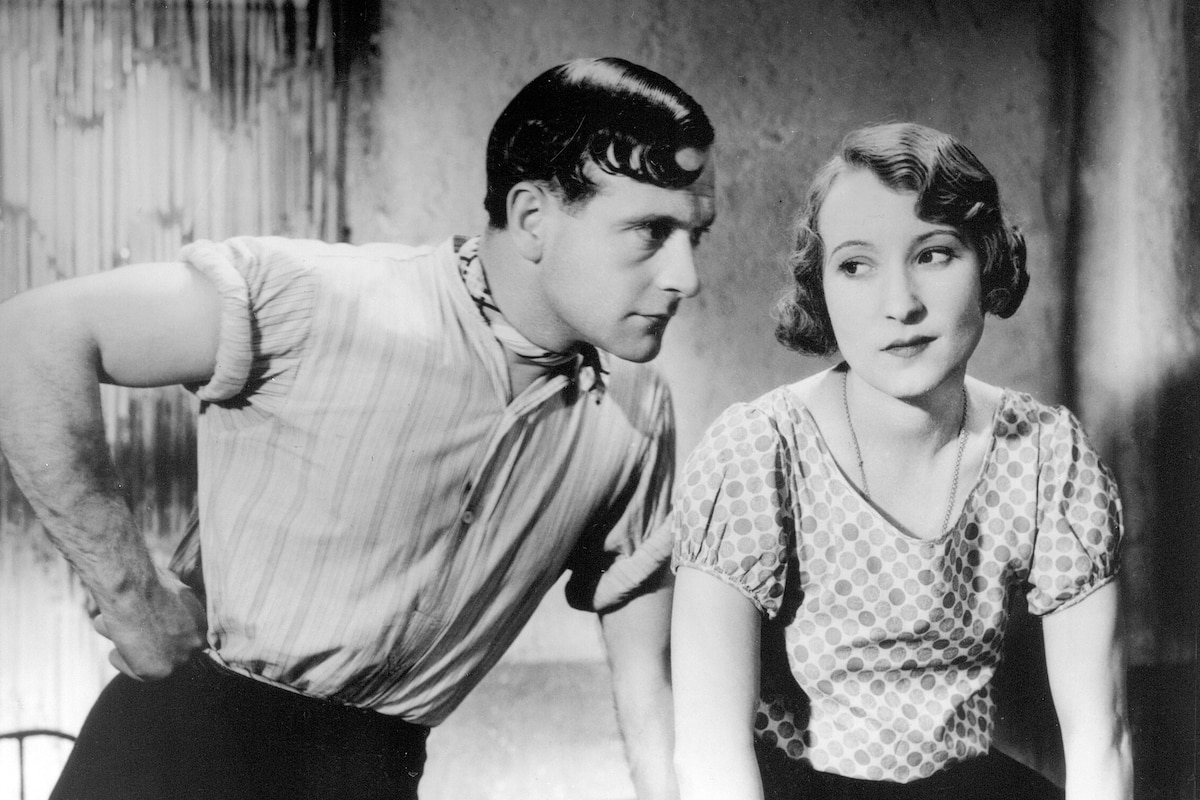
Marcel Pagnol's "Marseilles Trilogy"--here dubbed The Fanny Trilogy on Kino's new 4-disc DVD box set--is a key work of French cinema. It has inspired a number of remakes and adaptations: German and Italian versions in the early Thirties, James Whale's Port of Seven Seas (1938), and Joshua Logan's Fanny (1961), the latter developed from a Broadway musical. Most recently, the entire trilogy was filmed again for French television in 2000. However, thanks to its unforgettable cast, most of whom originated the roles on stage--especially Raimu (Cesar), Pierre Fresnay (Marius), Orane Demazis (Fanny) Charpin (Monsieur Panisse) and Alida Rouffe (Honorine)--Pagnol's film trilogy towers above its imitators.
The multitalented Pagnol (1895-1974) began his a career as a playwright and turned to film directing only in 1934; a member of the Academie Francaise, he was also noted for his novels and memoirs. His best work tends to be set in the south of France, particularly around Marseilles where he was born and grew up. Marius premiered as a play in 1929 and Fanny in 1931; Caesar, in contrast, originated as the film. Together with Pagnol's satire Topaze, which opened less than a year earlier, Marius was one of the greatest box-office successes of the French stage. In particular, the card game scene in Marius has become an indelible part of French popular culture. Part of the immense appeal of the original plays comes from Pagnol's engaging and authentic use of the Marseilles dialect and southern character types, which was a novelty on the Parisian stage of that era.
At the same time, The Fanny Trilogy transcends local color to present full-blooded characters and dramatic situations that arise organically from the characters' basic traits and values, giving the stories universal appeal. It is deeply touching to see, for example, how Panisse pretends not to know that Fanny's child is not his, both in order to preserve his dignity and to keep questions from arising about the child's legitimacy. Here there are no outright villains, and we come to appreciate all the major characters' motives for their actions even if we don't necessarily approve of them. Moreover, even the seemingly throwaway moments in the scripts serve to build up a real sense of rapport both among the characters and with the audience. Pagnol's humanist vision, very much on display in these films, has rightly earned the admiration of directors such as Jean Renoir, Orson Welles and the Italian Neorealists.
In Marius (dir. Alexander Korda, 1931), the first installment of the trilogy, Pagnol introduces us to a close-knit group of characters in the Old Port of Marseilles: Cesar, the strong-headed bar owner; Marius, his restless son; Fanny, the fish-peddler with whom Marius falls in love; Honorine, Fanny's mother; Panisse, the pompous but kind-hearted owner of a sail shop; Escartefigue, the genial ferryboat captain and cuckold; and Mr. Brun, the Lyonnais. The basic conflict arises when both Panisse and Marius express romantic interest in Fanny. While Fanny is in love with Marius, the future of their relationship remains in doubt because of Marius' lifelong fascination with the sea and his ambition to become a sailor.
In Fanny (dir. Marc Allegret, 1932), Marius is already at sea when Fanny learns that she is pregnant. Although Panisse offers to marry her, she is torn because of her pregnancy out of wedlock. The widower Panisse, who has been longing for a child of his own, nonetheless agrees to marry her on the condition that the child be recognized solely as his. Cesar, on the other hand, wants the child to be recognized as the offspring of Marius. Matters are complicated when, several months later, Marius returns.
In Cesar (dir. Marcel Pagnol, 1936), we meet up again with the characters twenty years later. When Panisse dies, the son Cesariot--now a young man--discovers the truth about his real father, Marius, and decides seek him out. Fanny, in turn, must face up to her long-suppressed feelings for Marius and decide whether to resume their relationship. By the time Pagnol himself directed the last film in the trilogy, he had already made several films and had formulated his basic stylistic approach as a filmmaker. While Cesar is the loosest of the three both in terms of directorial style and dramatic structure, it remains a striking example of Pagnol's keenness for authenticity of setting. Not only was most of the film shot on location, giving us lovely views of Marseilles and its surroundings, but Pagnol's insistence on live sound--even if it means considerable background noise--is remarkably forward-looking. The organic relationship between the use of natural locations and the film's style should put to rest any notion that as a film director Pagnol was overly dependent on theatrical models.
In terms of the video transfer, Marius looks very good for a French film of the era, displaying strong detail and contrast. The print of Fanny has more flaws than Marius, including some out-of-focus shots, but they appear to be inherent to the surviving materials or the original photography. On the whole, the sharpness and contrast still look solid. At the same time, the shot compositions in the first two films sometimes seem a little tight around the edges. It is possible that, as early sound films, they originally had the square-ish aspect ratio of 1.19:1 and thus should look more like the Criterion Collection's edition The Testament of Dr. Mabuse (1933); here they are presented in the standard 1.33:1 aspect ratio. The print used for Cesar has weaker contrast and looks washed out compared to the first two films, with especially thin black levels, though the image is still workable. Certainly, these transfers look far better than any versions I've seen on home video before.
The films' soundtracks appear to have been cleaned up digitally to remove excess noise; in principle, this is not a bad idea considering the quality of sound reproduction during the early Thirties and in France in particular. However, one of my friends pointed out that some of the sound effects in Marius appear to have been re-recorded, since they are too "clean" and have more presence than the dialogue and music. When I compared the DVD of Fanny to the older Interama version on videocassette, the beginning of the DVD soundtrack had seagull sounds that were not audible at all on the videocassette soundtrack. If sound effects were in fact added or re-recorded, it is not indicated anywhere on the packaging. While I am mostly in favor of applying digital restoration technology to older film soundtracks, there is a danger that remixed or re-recorded soundtracks can give a misleading picture of film history, for the artistic identity of a film is intimately tied with the technology of the era in which it was made. While the aforementioned possible changes are relatively minor and don't detract from the films' overall dramatic impact, if the soundtracks were in fact changed then the persons responsible should have been more forthcoming about it. Incidentally, one should keep in mind that Kino licensed the titles from Compagnie Mediterraneenne des Films in France and that it is they who may have supplied Kino with the transfers ready-made rather than Kino doing the transfers in-house. At any rate, it is unlikely that Kino, a relatively small distribution label, would have engaged in extensive audio restoration on its own because of the cost involved.
The special features include an essay insert by Bertrand Tavernier, theatrical trailers, and galleries of stills, posters and other promotional materials. A fourth disc contains a 75-minute documentary called "About the Trilogy" (actually, several shorter segments stitched together), consisting mainly of observations by various Pagnol experts. While their basic approach is scholarly, their insights are genuinely interesting. For me, the most welcome extra was the subtitled audio essay by Pagnol, spread out over the first three discs. In it he talks about the genesis of the project, his friendship with Raimu and conflicts among the cast and producer. Pagnol is a great storyteller, and it's a pleasure just to hear him speak. The DVD case, which incorporates original poster artwork, is attractively designed. All three installments of Marcel Pagnol's "Fanny Trilogy" are wonderfully written and acted films that hold up to repeat viewings. Despite reservations about the authenticity of the soundtracks, this set is very much recommended. Now let's hope that we get to see DVDs of Pagnol's Angele (1934), Harvest (1937), The Baker's Wife (1938), and the original 1952 version of Manon des Sources. This director's work deserves a much wider audience.
For more information about The Fanny Trilogy, visit Kino International. To order The Fanny Trilogy, go to
TCM Shopping.
by James Steffen
The Fanny Trilogy on DVD
by James Steffen | August 27, 2004
SIGN UP FOR OUR NEWSLETTERS

CONNECT WITH TCM