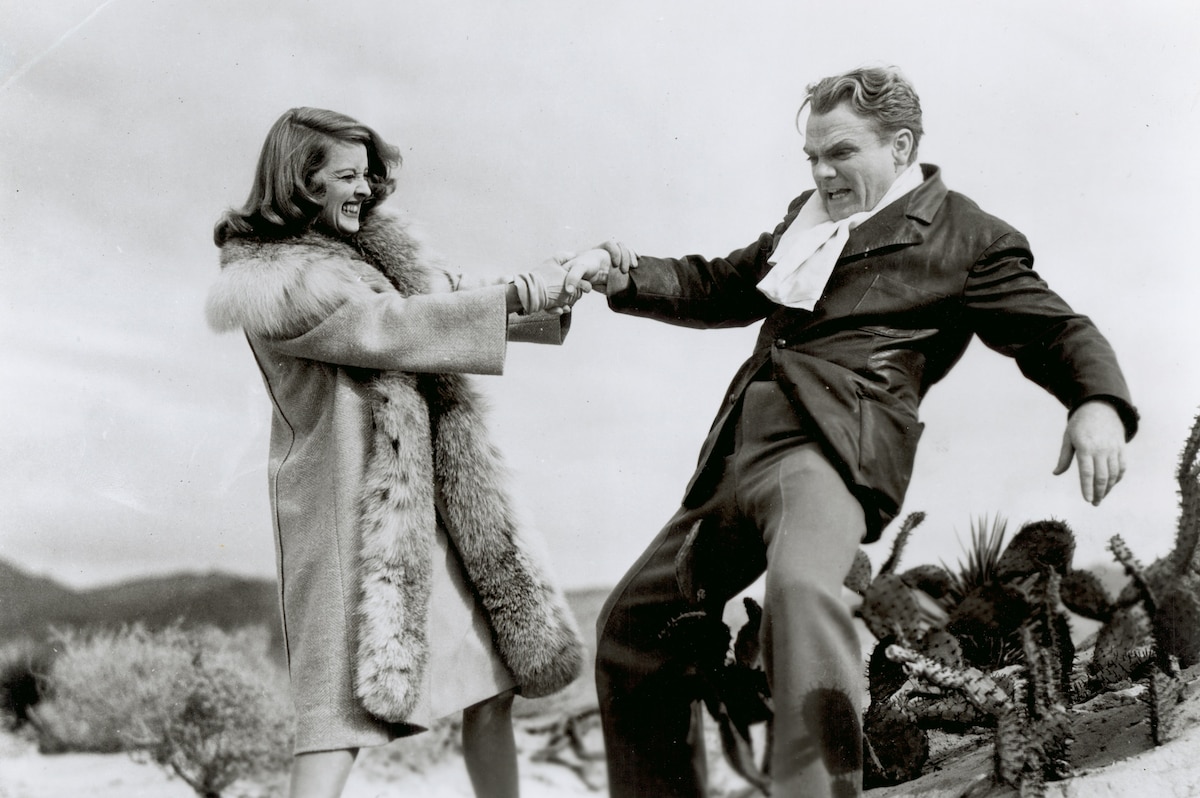
Bette Davis and James Cagney went for a change of pace in The Bride Came C.O.D. (1941), a
slapstick comedy about a runaway heiress kept from marrying a band leader
when her father (Eugene Pallette) hires Cagney to kidnap her. They got the
hit they were hoping for -- it was one of the year's top 20 box-office
films -- but a year later the studio gave them the bird, quite literally,
when Chuck Jones spoofed their film in the Conrad Cat cartoon "The Bird
Came C.O.D." For Davis' part, she would later complain that all she got
out of the film was a derriere full of cactus quills.
Warner Bros. had developed the project for Cagney, who was gradually moving
away from gangster roles. He was making the romantic comedy The
Strawberry Blonde (1941), and advance word on the film was quite good,
so another comedy seemed the perfect choice. Cagney was eager to break
into independent production at the time, so he insisted that his brother,
William, who was set to be his partner once he went independent, serve as
associate producer.
Originally the studio considered a number of established comedic actresses for
the female lead. They bypassed the likes of Ann Sheridan, Ginger Rogers
and Rosalind Russell, however, in favor of rising star Olivia de Havilland.
Then Davis expressed an interest in the part, and Hal Wallis went to bat for
her. Both had read critics' complaints that she needed a break from
serious dramatic roles. In addition, she was eager to re-team with Cagney,
who like her had a history of battles with the Warner Bros. management.
They had not worked together since 1934, when they teamed for the minor
comedy Jimmy the Gent. Some biographers have suggested that the
studio was punishing her with the film because of her notorious
temperament, while others have suggested she may have wanted to emulate
Katharine Hepburn, who had been equally successful in serious and comic
roles. Also possible is that she was drawn to the film's obvious
similarities to It Happened One Night (1934), another tale of a
runaway heiress saved from a bad marriage by the love of a simple working
guy. Director Frank Capra had tried to cast Davis in that film, but
Warners didn't want to loan her to another studio on the heels of her
loan-out to RKO for Of Human Bondage (1934). Instead, the role had
gone to Claudette Colbert, who ended up winning the Best Actress Oscar®
most critics think should have gone to Davis for the RKO film.
Any hopes of scoring another It Happened One Night were dashed,
however, when production started and the promised re-writes from twin
writing partners Julius and Philip Epstein did little to improve the
script. Director William Keighley described the atmosphere on the set as
funereal. "You should have seen the long faces just before I called
'action' and the sighs of relief when I called 'cut!'" (Keighley quoted in
Lawrence J. Quirk, Fasten Your Seatbelts) Nor were matters helped by
ten days of location shooting in Death Valley in January. When Cagney
complained about the heat, with temperatures climbing to 100 degrees each
day, Keighley could only console him that they hadn't shot during the
summer, when the highs hit 130.
As for the cactus quills, studio publicity claimed that Davis actually got
them by accident when she was told to jump out of Cagney's downed plane
into a sand dune that concealed the offending flora. The incident was then
added to the script. By other accounts, there was a stunt woman on hand to
perform the bit, but when Davis got into the cactus patch for the next part
of the scene, she got "quilled" nonetheless. A doctor had to be brought in
to remove 45 of the things from the star's stern. Her painful situation
got worse a few days later when the script called for Cagney to fire a
sling shot at the injured body part.
Although most critics welcomed the comic about face for Davis and Cagney,
some were quick to point out that the property itself was hardly up to
their talents. The New York Times dismissed it as "a serviceable
romp," while Archer Winston in The New York Post pleaded "Okay,
Jimmie and Bette. You've had your fling. Now go back to work." More
recent fans have looked on the film as one of the low points in both stars'
careers, though acknowledging that their first love scene, set in a mine
shaft, is a standout for both. Davis would fare better the following year
in the more sophisticated comedy of The Man Who Came to Dinner, also
written for the screen by the Epstein brothers, while Cagney would have a much better role
as a flyer in the wartime drama Captains of the Clouds (also
1942).
Producer: William Cagney, Hall B. Wallis
Director: William Keighley
Screenplay: Julius J. Epstein & Philip G. Epstein
Based on a story by Kenneth Earland & M.M. Musselman
Cinematography: Ernest Haller
Art Direction: Ted Smith
Music: Max Steiner
Principal Cast: James Cagney (Steve Collins), Bette Davis (Joan Winfield),
Stuart Erwin (Tommy Keenan), Jack Carson (Allen Bruce), George Tobias
(Peewee), Eugene Pallette (Lucius K. Winfield), Harry Davenport (Pop
Tolliver), William Frawley (Sheriff McGee), Edward Brophy (Hinkle), William
Hopper (Keenan's Pilot).
BW-92m. Closed captioning.
by Frank Miller
The Bride Came C.O.D.
by Frank Miller | May 25, 2004
SIGN UP FOR OUR NEWSLETTERS

CONNECT WITH TCM