During the studio era, when scores of motion pictures were cranked out on a
weekly basis, many performers wound up being typecast in particular kinds of
roles. It was the nature of the assembly-line beast. Bigger talents, for
the most part, had no problem with this, since they were able to
occasionally move between their accepted personas and other types of
characters. But lesser actors were often forced to inhabit exactly the same
character over and over again, throughout their careers. Their public
practically demanded it.
Johnny Weissmuller is the best example of this. All anybody knew about him
when he was cast as Tarzan, King of the Jungle, was that he was a champion
amateur swimmer, was strikingly handsome, and couldn't act a lick. And that
was all anybody knew about him 12 movies and 16 years later, when he finally
quit playing Tarzan and took on the less-heralded role of Jungle Jim.
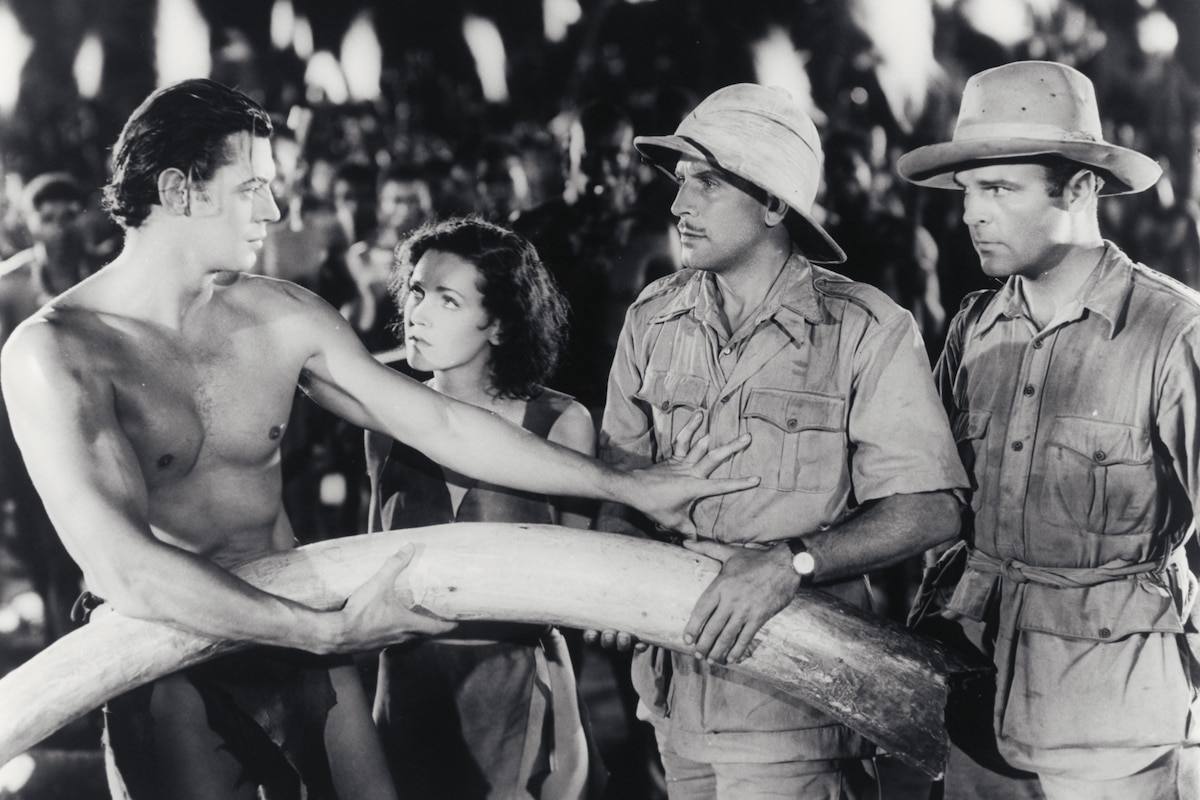
Tarzan and His Mate (1934) was the second, and easily the most memorable, of
Weissmuller's Tarzan pictures. It's briskly paced, beautifully
photographed, and features a racy swimming sequence that was censored at the
time of the movie's release. All that, and you get to see Tarzan wrestle a
rubber alligator!
This time around, Harry Holt (Neil Hamilton), who visited the jungle in the
first movie, returns to Africa looking for ivory. He's accompanied by his
friend, Martin Arlington (Paul Cavanagh). Holt also intends to bring Jane
back to "civilization" with him, not that she's particularly interested in
returning. Tarzan, for his part, will eventually try to stop Holt's
expedition from plundering ivory from the sacred elephant burial grounds,
and will confront an assortment of wild animals in the process. It's not
exactly War and Peace, but it didn't need to be.
Back in 1934, the scene that caused all the commotion was available in three
different versions that were edited by MGM to meet the standards of
particular markets. However, the original one was restored when Ted Turner
issued Tarzan and His Mate on video in 1991. In it, Tarzan and Jane
(in this instance, O'Sullivan's swimming double, Josephine McKim) dance a
graceful underwater ballet...and Jane is completely nude! Then, when she
rises out of the water, O'Sullivan (now re-assuming the role) flashes a bare
breast. Such big-screen impropriety was virtually unheard of at the time,
and the Production Code Office had a fit. O'Sullivan's scant costume, when
coupled with her utterly inescapable sexual charisma, was bad enough.
Censors certainly didn't need her, or anyone else, stripping off on-screen before they
went swimming.
Who knows how or why MGM thought it could get away with such a move. The
sequence may well have made it as far as it did due to the confusion
surrounding the entire production. Less than a month into shooting, the
original director, Cedric Gibbons, was replaced by Jack Conway, although
there's no record of exactly why this happened. Then Rod La Rocque was
replaced by Paul Cavanagh. William Stack and Desmond Roberts also stepped
in, taking over roles that had originally been cast with other
actors.
When filming was finished, Gibbons promptly went back to his old job as an
MGM art director. He worked on literally hundreds of pictures between 1924
and the late 1950s, but, for whatever forgotten reason, Tarzan and His
Mate was the only one he ever directed. In later years, to confuse
things even further, O'Sullivan insisted that most of the film was actually
directed by James C. McKay! She also, according to her actress daughter,
Mia Farrow, used to refer to her ornery cast mate, Cheetah the
chimpanzee, as "that bastard."
Whatever the production's problems - whether human or monkey-related -
Weissmuller certainly wasn't among them. He knew he was a limited
performer, and was willing to throw himself into any sequence, even going so
far as to briefly ride a rhinoceros, a move that didn't exactly please his
wife, actress Lupe Velez. However, Alfred Codona doubled for Weissmuller
when Tarzan was required to swing through the trees, and a man named Bert
Nelson wrestled the lions. Weissmuller may have been enthusiastic, but he
certainly wasn't an idiot.
As time goes on, people may remember that Weissmuller was a multiple Olympic
gold medal winner, but they probably don't realize just how gifted he was.
Before Mark Spitz shattered several world records at the 1972 Olympics,
Weissmuller was considered the greatest swimmer who ever lived. You don't
get nicknames like "The Human Hydroplane," "The Prince of Waves," and "The
Aquatic Wonder" for nothing.
From the moment Weissmuller entered competitive swimming in 1921, until he
retired seven years later, he never lost a race. Never. During the 1920s,
he racked up 36 individual AAU championships and 67 world championships. He
was also the first swimmer to break the one-minute mark in the 100 meters,
and eventually held 51 world records and 94 American records. After a
career like that, playing Tarzan was almost a step down, although
Weissmuller was paid handsomely to do it.
Producer: Bernard H. Hyman
Director: Jack Conway, Cedric Gibbons
Screenplay: Leon Gordon, James K. McGuinness, Howard Emmett Rogers
Cinematography: Charles G. Clarke, Clyde De Vinna
Film Editing: Tom Held
Art Direction: A. Arnold Gillespie
Music: William Axt, Paul Marquardt, George Richelavie, Fritz Stahlberg
Cast: Johnny Weissmuller (Tarzan), Maureen O'Sullivan (Jane Parker), Paul Cavanagh (Martin Arlington), Forrester Harvey (Beamish), Nathan Curry (Saidi), William Stack (Pierce).
BW-91m.
by Paul Tatara
Tarzan and His Mate
by Paul Tatara | May 24, 2004
SIGN UP FOR OUR NEWSLETTERS

CONNECT WITH TCM