"A side of life you never expected to see on the screen!"
Tag line for Walk on the Wild Side
What side of life that was is open to debate. Certainly when
agent-turned-producer Charles K. Feldman brought Nelson Algren's novel to
the screen in 1962, he intended to introduce new subject matter --
including prostitution and lesbianism -- only recently allowed on screen
after revisions to the Production Code. But by the time his fleet of
writers was finished transforming Algren's slice-of-life novel into a
screenplay, it bore little resemblance to human experience. The best part
of the film was Saul Bass's ingenious credits sequence, during which a
black cat meanders through a series of back alleys. If Feldman had wanted to take advantage of the screen's new
permissiveness, he would have done better to have director Edward Dmytryk
film the off-screen action involving the cast and production team.
Director Edward Dmytryk hadn't had a hit in years, and hadn't directed
since the mega-flop of his 1959 remake of The Blue Angel starring May Britt. He had
hoped for a comeback directing Clark Gable in an adaptation of Michael
Barrett's novel Appointment at Zahrain, but the actor's sudden death
had put an end to that project. Feldman, who was also Dmytryk's agent, had
been after him to direct Walk on the Wild Side for some time, but
scheduling problems had kept him from agreeing. Now, he not only had the
opening, he needed a hit. He even signed a seven-year representation deal
to get the job.
Another factor delaying production was finding financing, which wouldn't be
forthcoming until Feldman came up with a script that could pass the
Production Code. He went through six writers, including noted playwright
Clifford Odets. Finally, Production Code changes in response to studio
pressure to pass The Children's Hour (1961) and other films hinting
at homosexuality, made it a little easier to come up with a script. Even
then, there were re-writes. Dmytryk spent two weeks with one of the
industry's most acclaimed script doctors, Ben Hecht, who polished the
dialogue but received no credit. Unfortunately, the re-writes continued
during shooting, with Feldman trying to sneak back in everything that had
been cut for the censors. The scenes he sent Dmytryk were basically soft core
porn, and the director routinely discarded them, with the cast's full
approval.
Of course, the cast was another part of the problem. Feldman had filled it
largely with actors he represented, so that he would get an agent's
commission along with his share of any profits. Eventually, the Screen
Actors Guild would forbid agents to produce while still actively
representing talent, a rule largely inspired by Feldman's behavior. Before
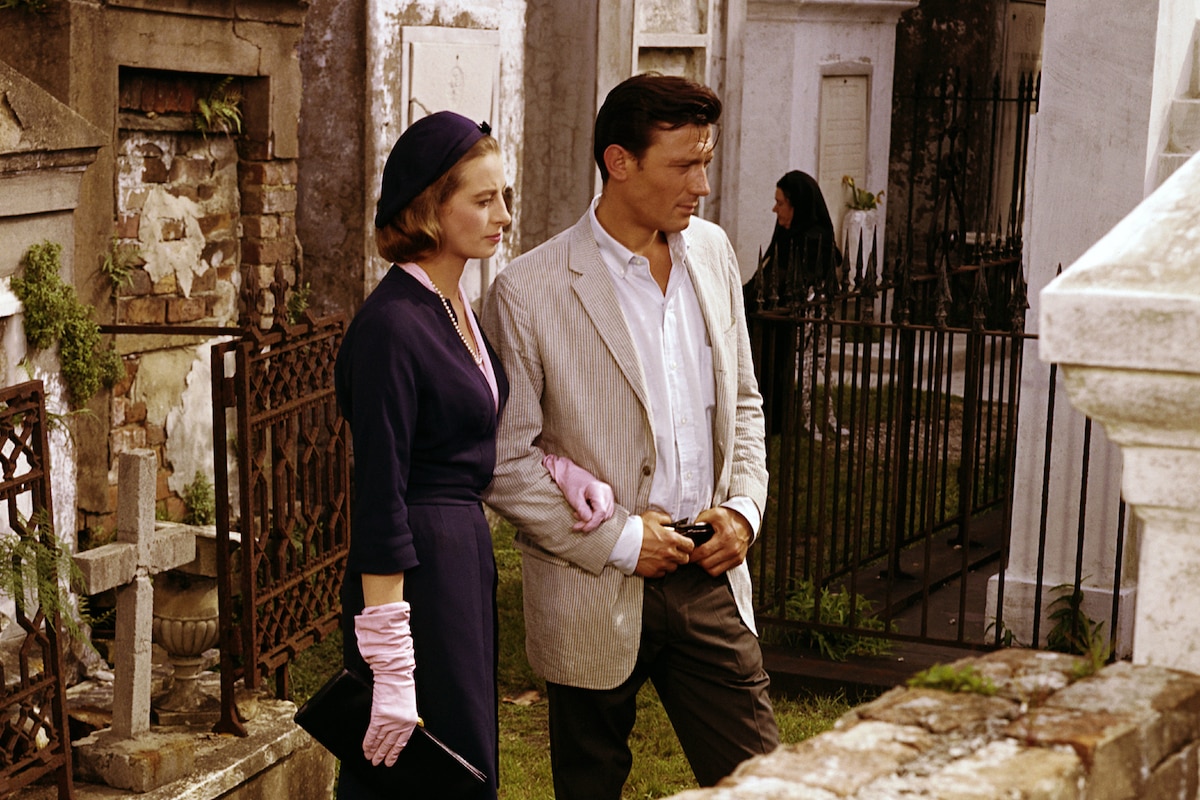
that, however, Feldman cast 35-year-old Englishman Laurence Harvey as a
Southern farm boy, French model Capucine as his lost love turned prostitute
(what part of the farm did she grow up on?), and American actress Anne
Baxter as a Mexican cantina owner. It didn't hurt that Harvey was involved
in an affair with Harry Cohn's widow, Joan, who owned Columbia Pictures,
which backed the film. And Capucine was Feldman's protégée and frequent
date (she would deny ever having an affair with him). Baxter was only
sleeping with her husband, but that could have gotten her out of the film,
as she found out she was pregnant shortly before shooting started. She
didn't tell anybody, for fear of losing the job, but counted on her
character's full skirts to hide her condition. She was seven-months
pregnant when they finally stopped filming.
Jane Fonda's love life created some problems for the production, too. At the
time, she was living with Greek acting teacher Andreas Voutsinas. Since
Dmytryk refused to allow acting coaches on his sets, she dubbed Voutsinas
her "secretary," so she could have him around. But it was obvious that he
was coaching her on the sly. Although they usually worked in her dressing
room, the director occasionally caught him talking to Fonda and touching
her in ways Dmytryk said "gave him the creeps" (in Peter Collier, The
Fondas: A Hollywood Dynasty). Yet, his influence had a positive effect
on her work. After failing in her first attempt to break into the movies
as an ingénue in the Doris Day mold, Fonda scored her first personal
success on screen with a sex-charged performance as a
thief-turned-prostitute.
Barbara Stanwyck did her best to maintain a professional calm as the film's
most daring character, a lesbian madam. The old-guard star had shocked
Hollywood by agreeing to play a lesbian on
screen, even though it meant flying in the face of decades of rumors
suggesting she was herself gay (ironically, nobody at the time suspected
that her co-star Capucine actually preferred women; she would come out in
interviews late in her life). When gossip columnist Louella Parsons told
Stanwyck she was shocked that she had agreed to play the role, the star
shot back, "What do you want them to do, get a real madam and a real
lesbian?" (in Axel Madsen, Stanwyck).
Needless to say, the shoot was something of a pitched battle. Feldman had
promised Dmytryk that he would leave the country during filming so that he
wouldn't interfere. Then he hung around anyway, sending in his unwanted
script revisions and insisting that Capucine be dressed in the latest
Pierre Cardin designs, even though the film was set and costumed in the
'30s. Harvey quarreled with Dmytryk incessantly. When the actor stalked
off the set and held up production for over an hour, Stanwyck tore into him
so vehemently, he was never late again. At least they both could agree on
their dislike of Capucine. When the former model complained that Harvey's
kisses weren't manly enough for her, he countered, "Perhaps if you were
more of a woman, I would be more of a man. Honey, kissing you is like
kissing the side of a beer bottle."
Everything came to a head the day Dmytryk shot the big showdown during
which Capucine's character is shot. They had blocked it out the day before
with no problems. The next day, however, Capucine had a new idea for how
to play it. She then demonstrated a death scene that would have been more
fitting for a bad ballet parody than a supposedly realistic drama.
The argument got more and more heated until Dmytryk was forced to clear
the set. He then laid down new rules for the production, barring Voutsinas
from the set along with an art director who had been encouraging Feldman
and Capucine's dissatisfaction with the production. Things resumed in
tense but quiet fashion, though the producer eventually brought in Blake
Edwards, without credit, to shoot some additional scenes.
Surprisingly, Walk on the Wild Side made money, helped greatly by
the popular title song recorded by Brook Benton. Dmytryk wound up losing
cash on the deal, however. He was so disgusted with Feldman that he
sacrificed $70,000 in deferred fees to buy himself out of his seven-year
representation contract with him.
Producer: Charles K. Feldman
Director: Edward Dmytryk
Screenplay: John Fante, Edmund Morris & (uncredited) Ben Hecht & Clifford
Odets
Based on the Novel by Nelson Algren
Cinematography: Joseph MacDonald
Art Direction: Richard Sylbert
Music: Elmer Bernstein
Principal Cast: Laurence Harvey (David Linkhorn), Capucine (Hallie), Jane
Fonda (Kitty Twist), Anne Baxter (Teresina Vidarverri), Barbara Stanwyck
(Jo Courtney), Joanna Cook Moore (Miss Precious), Richard Rust (Oliver),
Karl Swenson (Schmidt), Donald "Red" Barry (Dockery), Juanita Moore (Mama),
John Anderson (Preacher).
BW-114m.
by Frank Miller
Walk on the Wild Side
by Frank Miller | May 25, 2004
SIGN UP FOR OUR NEWSLETTERS

CONNECT WITH TCM