Robert Taylor was extremely popular with female moviegoers in the early 1940's but
men did not care for him much. You know what they say about guys that are overly
vain about their appearance, don't you? It was whispers like that which led Taylor
to take the part of one of America's most notorious outlaws.
The trouble really began when MGM publicist Howard Strickling set up a press conference
for Taylor onboard the ship on which he was returning to America after shooting
A Yank at Oxford (1938). Taylor tried to put to rest charges
that he was only a pretty boy by declaring he "had hair on his chest."
When the reporters insisted he bare his chest to prove it, Taylor refused the indignity
which started the rumor mill churning. Those rumors did not die out after Taylor
did bare his sufficiently hirsute chest in Three Comrades (1938)
or when he married Barbara Stanwyck in 1939. The next logical step was to put him
out west for some two-gun action.
There were other reasons for MGM to make a Billy the Kid picture at this time. For
one, the Hollywood press was closely watching a new Howard Hughes production called
The Outlaw (1943). Although Hughes was hampered by trouble with his
director Howard Hawks, The Outlaw, which was also about Billy
the Kid, was expected to complete shooting in early 1941. No one had any idea that
it would take Hughes two more years to complete it. In addition, all the studios
were turning to Westerns which played well in the American heartland now that World
War II, then raging in Europe, had temporarily shut down the European market.
MGM owned the rights to the most popular book about the famous desperado, Walter
Noble Burns' The Saga of Billy the Kid (1926), and had filmed
it before in the early sound era with Johnny Mack Brown as the Kid and King Vidor
behind the camera. The script was dusted off, revised, and the production announced
in mid-December 1940 with Taylor in the lead, Maureen O'Sullivan as the love interest
and two-time Academy Award winning director Frank Borzage in charge. Cast and crew
set off for Flagstaff, Arizona for exteriors, returning before Christmas to shoot
interiors on the lot.
With the New Year, Borzage and crew left for Tucson for more location shooting.
Then on January 13, The Hollywood Reporter announced that Borzage
had been taken off the production and David Miller sent to Tucson to complete the
film. The official reason was that Borzage was required to shoot "Bombay
Nights" with Joan Crawford, a picture that was either never made or released,
and then to direct her in A Woman's Face (1941), a movie ultimately
directed by George Cukor. Another odd thing about the switch is that David Miller,
who had won awards for his Pete Smith Specialty shorts, had never directed a feature
film and was now being handed on short notice an expensive A-list Technicolor Western.
Miller's contribution to the film was evidently substantial and may have been the
result of a script re-write. O'Sullivan was now out, replaced by Mary Howard in
a much-smaller role. Shooting went on until March with more location shooting in
Monument Valley, Utah.
The final results were released at the end of May. Most of the reviewers of the
time praised the scenery and color photography, which garnered an Academy Award
nomination, but made backhanded comments about Taylor's masculinity. Bosley Crowther
in The New York Times cattily remarked that, "The magnificence
of Robert Taylor, which is always something special to behold, falls into pale inconsequence
alongside the glories of the great outdoors in Metro's flashy technicolored Western."
However, Taylor was to find vindication in the saddle. After the war, Taylor, looking
tougher and more mature, would play convincing Western heroes in such movies as Westward
the Women (1951) and The Law and Jake Wade (1958).
By then, no one doubted that the actor had hair on his chest.
Director: David Miller, Frank Borzage
Producer: Irving Asher
Screenplay: Gene Fowler, based on the novel The Saga of Billy the Kid by Walter Noble Burns and the story by Howard Emmett Rogers and Bradbury Foote
Cinematography: William V. Skall, Leonard Smith
Set Decoration: Edwin B. Willis
Music: David Snell
Editing: Robert J. Kern
Cast: Robert Taylor (Billy the Kid), Brian Donlevy (Jim Sherwood), Ian Hunter (Eric
Keating), Mary Howard (Edith Keating), Gene Lockhart (Dan Hickey), Lon Chaney, Jr.
(Spike Hudson), Henry O'Neill (Tim Ward), Frank Puglia (Pedro Gonzales).
C-94 min. Closed captioning.
by Brian Cady
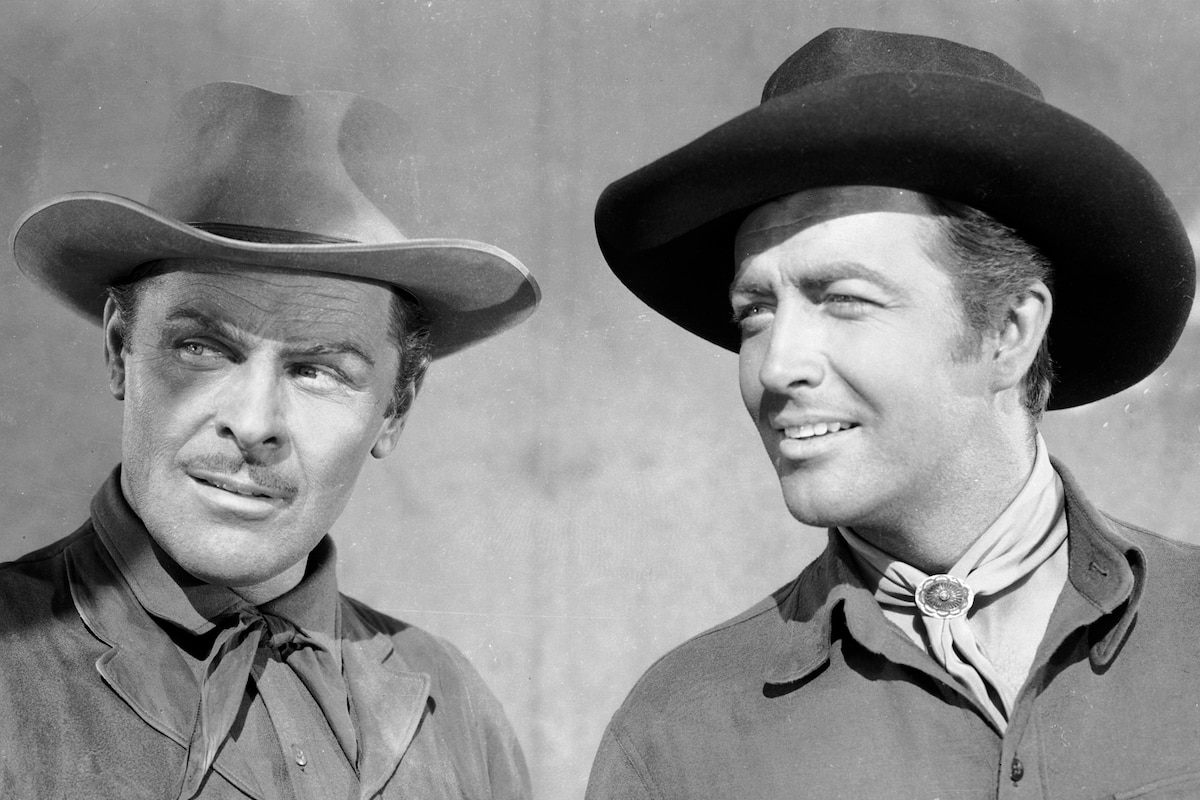
Billy the Kid (1941)
by Brian Cady | May 24, 2004
SIGN UP FOR OUR NEWSLETTERS

CONNECT WITH TCM