Viewers who think British cinema's "angry young man" trend began with
Look Back in Anger in 1958 are far too trusting of textbooks. Lewis
Gilbert's moody film noir, The Good Die Young, reveals that post-WW
II male angst was alive and kicking on England's screens at least as early
as 1954. The story of four buddies who come to tragic ends via a badly
botched post office robbery, Gilbert's picture is loaded with desperate
characters whose hopes and dreams have become distant memories. As Laurence
Harvey, who plays the well-heeled monster of the bunch, states at one point:
"All the good boys were killed in the war, or should have been. The good
die young. The rest survived and came back, and nobody wants us. The law
prevents our opportunity." You can't get much angrier than that.
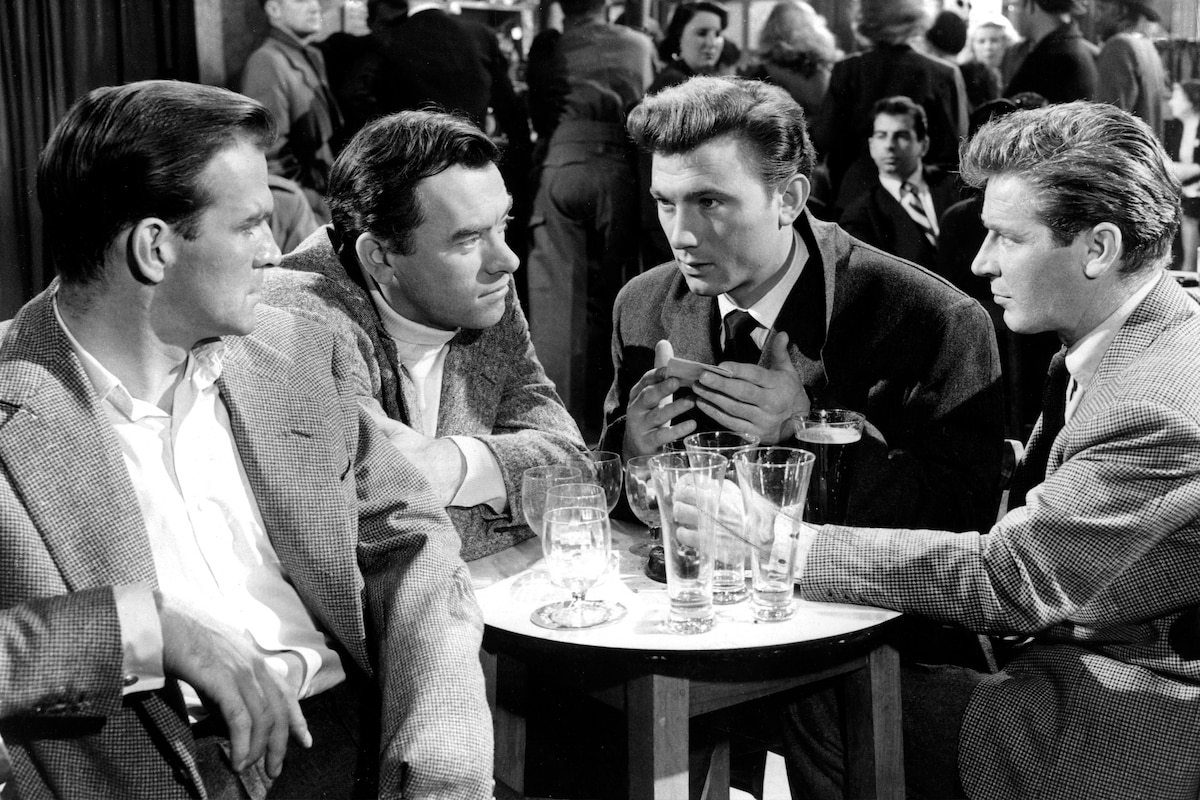
Each character has a reason to fall into crime, not that they're any good at
the mechanics of it. Richard Basehart is Joe, an American who wants to take
his cut of the money and escape to the States with his stunning British wife
(21 year-old Joan Collins). Mike (Stanley Baker) is a hulking boxer who had
to quit the ring after breaking his hand, then had his entire life's savings
stolen by his shifty brother-in-law. An American soldier named Eddie (John Ireland) is on the run from the military after discovering that his floozy wife (Gloria
Grahame) has been sleeping with another man. And 'Rave' (Harvey)
is a would-be class-act - and the theoretical 'brains' behind the operation
- whose wife (Margaret Leighton) has a gambling problem. He's also
stark-raving bonkers.
Evocative lighting, of course, is a staple of any good film noir, and
cinematographer Jack Asher deserves special credit for his work on The
Good Die Young. He appears well-versed in German Expressionism, but
never lets stylized shadows overwhelm the gritty reality of the storyline.
He and Gilbert are in fine form during the sharply constructed robbery
sequence, which includes a street shootout and a close-call with a speeding
subway train.
It's a wonder, though, that they could generate any intensity at all.
British censors did a number on the screenplay's American source novel,
which is why the gang is attempting to rob a post office, rather than the
more obvious source of cash- a bank. Gilbert was also forced to tack on
some clunky voice-over preaching at the end of the film because, at one
point, a Bobbie gets shot. Apparently, it's more acceptable to audiences
when armed American cops take a bullet.
Though the cast is uniformly terrific, Gilbert had his hands full with
Grahame, who had a reputation as something of a character. Producer James
Wolfe had been impressed with Grahame's performance in The Bad and the
Beautiful (1952) and was convinced that she was perfect for the comic relief
role of Denise, so Gilbert had little choice in the matter. But he did come
to enjoy Grahame's histrionics, and always looked back fondly on their time
together. For instance, while in makeup before her first day of shooting,
Grahame actually asked the director whether England had any psychiatrists,
then pulled out a large box of brightly-colored pills that she was afraid
she might not be able to get overseas.
Gilbert felt the display of pharmaceuticals was simply Grahame's way of
saying that she was incredibly nervous, so he spent a lot of time from there
on out telling her how beautiful and talented she was. It must have worked,
as her performance is one of the highlights of the film. Grahame, however,
may not have been completely convinced of her looks- during shooting, she
managed to charge a pile of dental work to the production, which didn't
endear her to the money men. Years later, Gilbert said of her: "It wasn't
that she was a great star or a great actress; I don't think she could have
played the great roles in the theater. Her epitaph is that she is
remembered in films because she had an extraordinary style as an actress,
more so than many great stars. Most actresses dissolve away in the distant
past, but somehow or other one always remembers her."
Director: Lewis Gilbert
Producer: James Wolfe
Associate Producer: Jack Clayton
Screenplay: Lewis Gilbert
Cinematography: Jack Asher
Editing: Ralph Kemplen
Music: Georges Auric
Art Director: Bernard Robinson
Costume Design: Rahvis
Sound: Red Law and Bert Ross
Cast: Laurence Harvey (Miles "Rave" Ravenscourt), Gloria Grahame
(Denise), Richard Basehart (Joe), Joan Collins (Mary), John Ireland (Eddie),
Rene Ray (Angela), Stanley Baker (Mike), Margaret Leighton (Eve
Ravenscourt), Robert Morley (Sir Francis Ravenscourt), Freda Jackson (Mrs.
Freeman), Lee Patterson (Todd Maslin), Walter Hudd (Dr. Reed).
B&W-110m.
by Paul Tatara
The Good Die Young
by Paul Tatara | April 27, 2004
SIGN UP FOR OUR NEWSLETTERS

CONNECT WITH TCM