Edgar G. Ulmer's directorial career started impressively enough, as one of several
directors of the classic semi-documentary Menschen am Sonntag
(1930), which launched the careers of Curt and Robert Siodmak, Fred Zinnemann and
Billy Wilder. Prior to that, he was the set designer (often uncredited) for a number
of notable Fritz Lang films, including Metropolis (1927), and
also served as an assistant to F.W. Murnau. His Hollywood career showed early promise
with the Boris Karloff-Bela Lugosi vehicle The Black Cat (1934),
often considered one of the best of Universal's horror cycle. But Ulmer was not
cut out to be a team player in the studio system. He soon found himself on "Poverty
Row" where, working with almost no budgets, no time, and often starting with
nothing more than a title, he found the kind of freedom he preferred. With little
or no recognition and resources, he managed to stamp a personal artistic signature
on his work, noticed by the French auteurist critics of the 1950s and 60s. Since
then, he has come to be regarded as an artist of a unique, if offbeat, vision, and
has helmed several influential films including the minimalist noir thriller Detour
(1945).
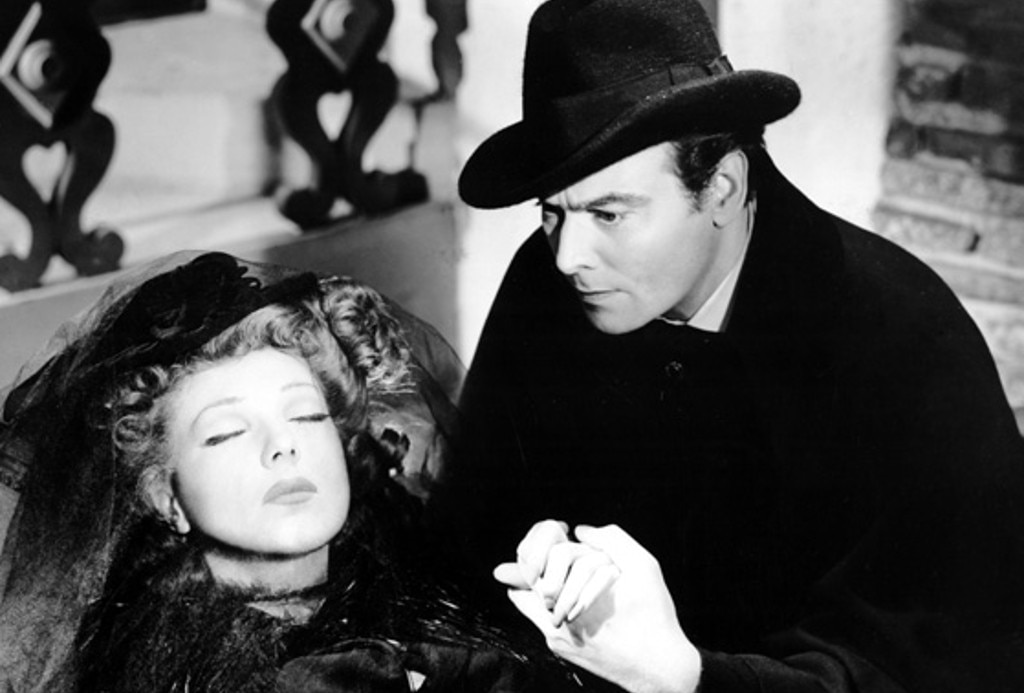
Bluebeard (1944) is considered one of Ulmer's best pictures.
Originally intended as a follow-up to his macabre classic The Black Cat, Ulmer had to wait a decade and work with John Carradine instead of Boris
Karloff as planned. Carradine, however, came through with probably his best performance
as a painter and puppeteer who has the nasty habit of killing his models.
Ulmer was his own set designer for this movie, recreating his beloved Paris on the
lot of Poverty Row studio PRC. Although shot in only six days, it displays a high
level of acting and camera work and contains a particularly notable and effective
sequence, a puppet show version of the Faust legend. Although he said PRC was unhappy
with the finished product, Ulmer was proud of his "lovely picture," which,
he later told admirer Peter Bogdanovich, "earned tremendous money in France."
The legend of the murderous Bluebeard had already been a folktale by the time it
was written down by Charles Perrault in 1697. The cautionary tale of the dangerous
husband/lover, purportedly based on a real-life serial killer of the 15th century,
took many forms over the years. In films, the character has been everything from
a deranged World War I pilot (Richard Burton in a 1972 version) to a loving Parisian
father who seduces and kills women in order to feed his brood (Charles Denner in
Claude Chabrol's Landru, 1963). Charles Chaplin directed and
played in a version of the legend in Monsieur Verdoux (1947)
and Ernst Lubitsch spoofed it in Bluebeard's Eighth Wife (1938),
starring Gary Cooper and Claudette Colbert.
His role in this film is reportedly John Carradine's personal favorite. A prolific
player whose career spanned hundreds of films over about 60 years, Carradine rarely
got the chance to carry a film as he does here, although he received praise for
a number of classical stage roles, such as Hamlet and Malvolio. On screen, he was
always a quirky, often unconventional character lurking in the background of many
fine films. Part of John Ford's stock company, he appeared in 11 of that director's
pictures, as well as a large number of other Westerns, enough to earn him induction
into the Hall of Great Western Performers of the National Cowboy and Western Heritage
Museum in 2003. But despite his range and talents, he is most often - and rather
unfairly - associated with the horror genre, mostly because of his gaunt looks and
distinctive voice. He is the father of actors Keith, David and Robert Carradine.
Much of the cast will be familiar to connoisseurs of character actors and supporting
players. Nils Asther (LeFevre), a Dane often cast in more ethnically "exotic"
roles, was the title character in the Frank Capra-directed Barbara Stanwyck film
The Bitter Tea of General Yen (1933) and in the 1920s and early
30s also played leading man to Garbo, Crawford, Pola Negri and others. Early in
her career, Jean Parker (Lucille) had a promising start as Beth, the doomed sister in Little
Women (1933) opposite Katharine Hepburn. While she never achieved top
stardom, she worked in film and on stage into the 1970s and was also an accomplished
clothes designer. Iris Adrian (Mimi) was one of Hollywood's busiest character actors
and bit players. The year before this movie she played one of the smart-talking
strippers in the Stanwyck mystery-comedy Lady of Burlesque (1943).
Late in her career, she turned up in a string of Disney hits, including The
Love Bug (1968) and Freaky Friday (1976). Austrian-born
Ludwig Stossel (Lamarte) had a 30-plus-year career in film and television playing a range
of Germanic characters for everyone from Fritz Lang to George Cukor and turning
up in such films as Casablanca (1942), The Merry Widow
(1952) and Elvis Presley's G.I. Blues (1960), Stossel's last
picture.
Director: Edgar G. Ulmer
Producer: Leon Fromkess
Screenplay: Pierre Gendron, based on a story by Werner H. Furst and Arnold Phillips
Cinematography: Jockey Arthur Feindel
Editing: Carl Pierson
Art Direction: Paul Palmentola. Angelo Scibetta
Original Music: Leo Erdody
Cast: John Carradine (Gaston Morrell), Jean Parker (Lucille), Nils Asther (Inspector
LeFevre), Ludwig Stossel (Jean Lamarte), Iris Adrian (Mimi), Henry Kolker (Deschamps).
BW-70m.
by Rob Nixon
Bluebeard (1944)
by Rob Nixon | April 27, 2004
SIGN UP FOR OUR NEWSLETTERS

CONNECT WITH TCM