In Party Girl (1958), an unusual blend of film noir and musical,
Robert Taylor plays a crooked lawyer loosely based on real-life Dixie Davis, the
lawyer for mob boss Dutch Schultz who later turned informant. In the film, Taylor
has become rich from getting gangster Lee J. Cobb's hoodlums out of murder raps.
He likes to exploit his crippled leg as a way of gaining juries' sympathies. He
is also in an unhappy marriage with a wife who is repulsed by him. He meets a showgirl,
gorgeous Cyd Charisse, and they fall in love. When she convinces him to go straight,
she's captured by Cobb, who threatens to hurt her unless Taylor continues to do
his bidding.
For MGM, producing Party Girl was mostly a way of justifying
the expensive salaries of Taylor and Charisse, the last two contract stars at the
studio. After this film, both were released from their contracts (though Taylor
would later make two more pictures for the studio under an options clause.) The
gangster story script was fairly ordinary, but the inclusion of two sultry musical
numbers and director Nicholas Ray's visual imagination lifted the final picture
to something memorable.
Taylor was now 47 and had been at MGM for 24 years. (Only actor Lewis Stone was
there longer, for 29 years.) Taylor's career had begun with playing vapid romantic
leads to stars like Greta Garbo, but by the 1950s he had matured into a superb actor.
Taylor was nonchalant about it all: "I was a punk kid from Nebraska who's had
an awful lot of the world's good things dumped in his lap," he said. Director
Nick Ray was certainly impressed with Taylor's commitment. "[He worked] for
me like a true Method actor," said Ray, who remembered Taylor going to an osteologist,
poring over X-rays and asking probing questions so that he would have an understanding
of where in his body the pain would be from his character's crippled leg.
Cyd Charisse, whom Fred Astaire once called "beautiful dynamite," was
a victim of timing. A stunning and talented dancer, she was sensational in every
one of her MGM musicals that were steadily going out of fashion. She took the news
of her contract release hard. "MGM felt like home to me after 14 years,"
she wrote. "And when they said they no longer wanted me, it was as though they
had said, 'Get out and never darken my doorstep again.' Looking back on it now,
I wish it had happened sooner. The studio had over-protected me.'"
Charisse was born Tula Ellice Finklea. If ever there was a name that Hollywood bosses
would have wanted to change, this was it, but she acquired the nickname "Sid"
when her little brother couldn't pronounce "Sis." Then she gave it the
more glamorous spelling "Cyd." Later she married her ballet teacher Nico
Charisse and kept his last name after they divorced. Soon thereafter she married
crooner Tony Martin, and they remain married today. (An uncredited Tony Martin also
sings the theme song to Party Girl.)
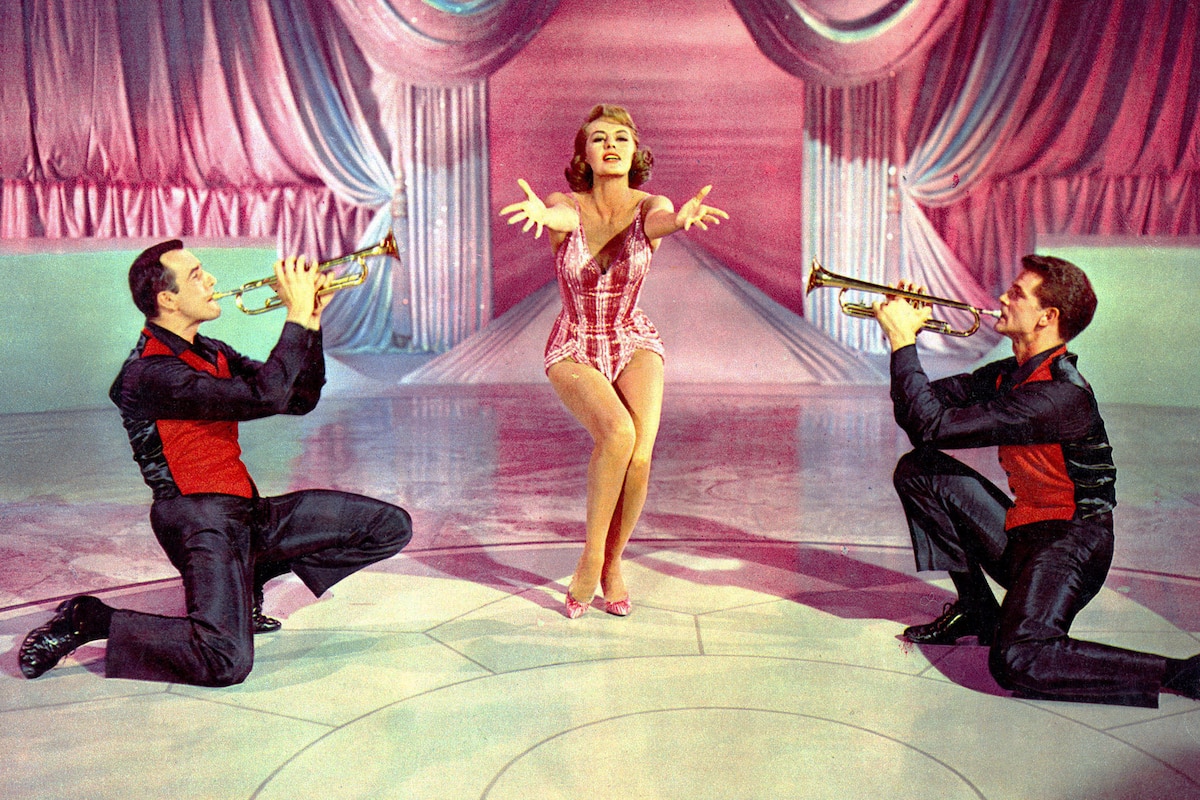
Although Charisse's casting here is somewhat against type, she does perform a couple
of sensuous numbers and her musical persona certainly allows the audience to accept
her in the role right off the bat. Filming those numbers was a challenge because
of a music strike. Dance director Robert Sidney rehearsed the numbers in Mexico
with doubles, and for the actual filming Charisse danced to a prerecorded drum track
for one number and to fake, miming musicians for the other. Once the strike was
over, Andre Previn composed the score uncredited. According to Charisse, director
Ray wasn't too involved in these musical interludes: "Nick Ray was a fine director,"
she later wrote, "but he knew very little about dancing or musicals, and freely
admitted to it. He had the good sense to leave that up to Bob Sidney and the studio
music department."
Ray, one of the great American directors, had by this point helmed such classics
as Rebel Without a Cause (1955), In a Lonely Place (1950),
On Dangerous Ground (1952), and Johnny Guitar (1954). His
ability to combine violent action scenes with sequences of deep tenderness had become
something of a trademark, and while this was much in evidence in Party
Girl, the movie was not a happy experience for him. Ray had problems
with the independent producers of his last two films, Wind Across the Everglades (1958)
and Bitter Victory (1957, a superb WWII film), and it's likely he was
in the mood for the security of a big studio picture. Party Girl
was also attractive to Ray because he had lived in Chicago during Prohibition and
was eager to recapture the feeling and the music of the era. But when he signed
on, he found that the script had already been finished and he was unable to make
significant changes. Furthermore, MGM said "no" to the use of period music
because they felt it might limit the film's appeal. Three days of location work
were planned in Chicago but then canceled when the film went over schedule. It was
a studio assignment, nothing more, and Ray had little creative input.
Still, he invested himself in the film and filled it with many stylistic flourishes,
such as the droplets of water glistening on Charisse's skin after she buries her
face in flowers, or the moment where Charisse drops her fur coat on the floor while
walking toward Taylor. Expressive use of camera movement, symbolism and most of
all color, abounds. As Ray once said of the film, "When I couldn't contribute
as much as I wanted to the script, I tried to do the next best thing in color and
performance, to [capture] the kind of bizarre reality [of the time], which permitted
people who lived that life to believe that theirs was the only reality."
Producer: Joe Pasternak
Director: Nicholas Ray
Screenplay: George Wells, Leo Katcher (story)
Cinematography: Robert J. Bronner
Film Editing: John McSweeney, Jr.
Art Direction: Randall Duell, William A. Horning
Music: Jeff Alexander, Nicholas Brodszky, Andre Previn
Cast: Robert Taylor (Thomas Farrell), Cyd Charisse (Vicki Gaye), Lee J. Cobb (Rico
Angelo), John Ireland (Louis Canetto), Kent Smith (Jeffrey Stewart), Corey Allen
(Cookie La Motte).
C-99m. Letterboxed. Closed captioning.
by Jeremy Arnold
Party Girl (1958)
by Jeremy Arnold | April 27, 2004
SIGN UP FOR OUR NEWSLETTERS

CONNECT WITH TCM