Robert Lord won his first producing credit for Gold Diggers of 1933 (1933),
an all-singing,
all-dancing follow-up to Warner Bros.' 1932 smash
Forty-Second Street, the film that sparked the trend in screen
musicals during the thirties. Warners knew they had a hit before the earlier film
had even opened, so they had this production in the works while the rest of
Hollywood was scrambling to catch up.
For their new musical extravaganza they turned to Avery Hopwood's hit
Broadway play Gold Diggers of Broadway, which they had filmed
twice
before -- as a silent in 1923 and with sound and songs in 1929. Lord had
even worked on the script for the 1929 tale of chorus girls mixed up with
society types when a young blue-blood tries to break into show business.
For the third version, they pulled out all the stops, with new star Ruby
Keeler joining studio stalwarts Joan Blondell and Aline MacMahon as a trio
of chorus girls on the make for stardom. And Busby Berkeley, who had
scored a hit with the lavish numbers for Forty-Second Street,
was
given more money and more control for this feature.
Berkeley staged four big numbers this time around, each with his trademark
geometric arrangements of dancers and dream-like story elements. The film
opened with "We're in the Money," a gift to Depression-weary Americans
as
Ginger Rogers and chorus girls dressed in gold coins cavorted. Rogers even
delivered a chorus in pig Latin, a fad of the time added at the last minute
when Berkeley and director Mervyn LeRoy (and anybody else who's tried to
take credit for the decision over the years) caught her singing the song
that way; she was just kidding around after a hard day of rehearsals.
For "Petting in the Park," Dick Powell led the male chorus in a risque
come-on to
the female chorus on an elaborate Central Park set. The number takes a
risque turn when the women get caught in a rainstorm and retreat behind a
flimsy screen to remove their wet clothes (these were the days before
Hollywood censored itself). They re-emerge in metal costumes designed to
hold the men at bay -- until a lecherous baby (played by midget actor Billy
Barty) hands Powell a can-opener. The number was cut from the film when it
was re-issued after the arrival of strict Production Code enforcement in
1935 and was also deleted from the first prints available for television.
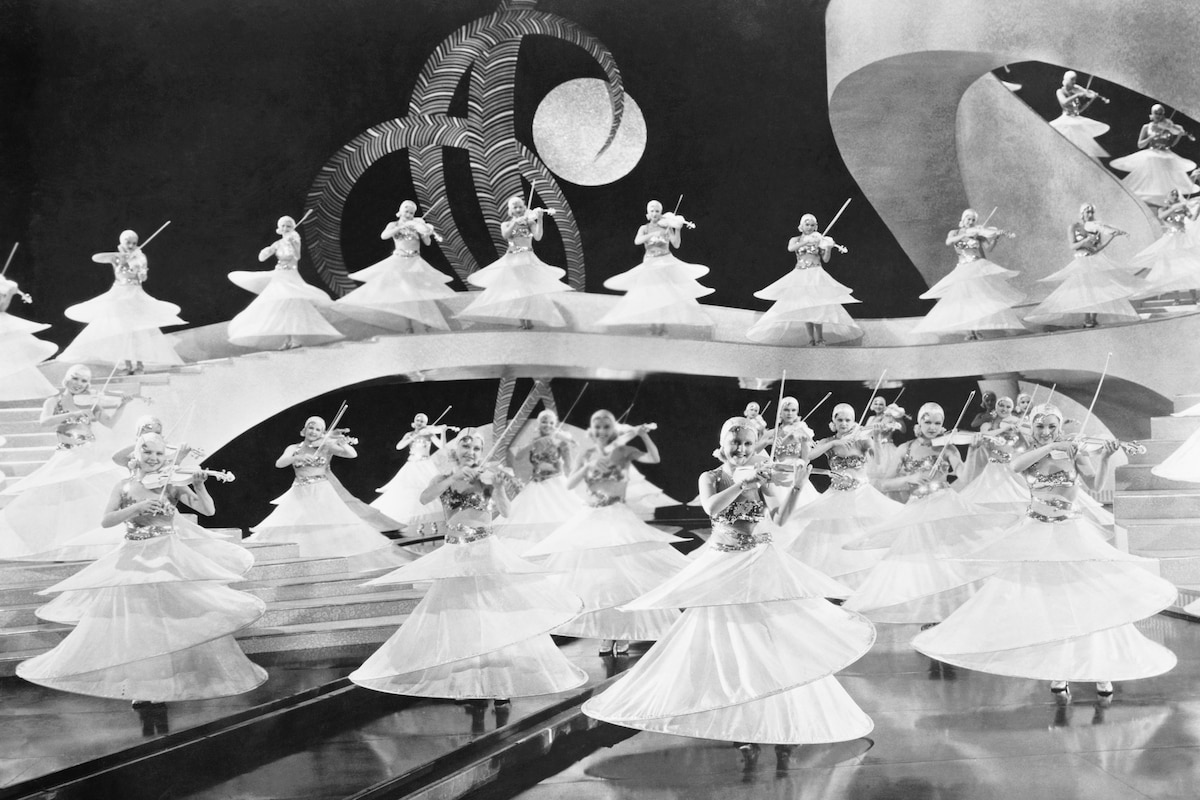
Berkeley had gotten the idea for "The Shadow Waltz" years earlier when
he
saw a vaudeville act in which a beautiful woman danced while playing the
violin. He filed the idea away for later use, bringing it back for Gold
Diggers of 1933 on a grand scale. In The Busby Berkeley Book,
the director recalled that "I had no less than sixty girls at my disposal,
so I ordered sixty white violins and a huge curving staircase for them to dance
on. Once I had them go through the dance, it occurred to me that the number would
be even more spectacular if the violins were all neon-lighted. The electricians
fixed up each girl with wires and batteries and we were able to get some effective
footage with the girls waltzing in the dark." During
filming, Los Angeles was hit by an earthquake that caused a blackout and
short-circuited some of the dancing violins. Berkeley was almost thrown
from the camera boom, dangling by one hand until he could pull himself back
up. He yelled for the girls, many of whom were on a 30-foot-high platform,
to sit down until technicians could get the soundstage doors open and let
in some light.
Inspired by the war veterans' march on Washington in May 1932, Berkeley
developed the idea for "Remember My Forgotten Man," in which Joan Blondell
(dressed as a streetwalker), addresses the
forgotten veterans who have been forced from the front lines to the
breadlines. Ending with Blondell backed by the silhouettes of men in
uniform while the unemployed reach for her, it was a powerful number.
But studio head Jack Warner and production chief Darryl F. Zanuck were so
impressed with the song they decided to make it the film's finale,
replacing "Petting in the Park," which was moved to earlier in the film.
If
you look closely at the scenes just before the film's finale, you'll see
Keeler and other chorus girls in the dresses they wore at the start of the
earlier number. You'll also catch Berkeley, in a rare screen appearance,
as the callboy shouting "Everybody on stage for the 'Forgotten Man'
number." He filmed the line the day before the studio was due to close for
inventory. Rather than hire any actors, Warner had ordered him to shoot
some pick-up lines with the secretaries and technicians already on the lot.
Berkeley's was the only one of those lines that stayed in the film, to the
surprised delight of the cast, who didn't know about it until they saw the
picture's premiere.
Gold Diggers of 1933 gave prominent spots to two women destined
for
bigger things. Ginger Rogers, who had scored a small hit in
Forty-Second Street, was still free-lancing in Hollywood when
her
boyfriend, director Mervyn LeRoy, got her cast in this film and prominently
featured her in the opening number. The relationship didn't last the
production shoot, and her other song, "I've Got to Sing a Torch Song,"
was
largely cut. But her appearance was still enough to get her noticed at
other studios and lead to her casting in RKO's Flying Down to Rio
(1933), the first film to team her with Fred Astaire.
Doing the real singing during the "Remember My Forgotten Man" was Etta
Moten (the number is often mistakenly credited to Marion Anderson), a black
actress-singer who would make her greatest achievements off-screen. In
1933, she became the first African-American entertainer invited to sing for
a U.S. president (Franklin Roosevelt) at the White House. In 1942, she was
cast as Bess in the hit tour of George Gershwin's opera Porgy and
Bess. When she objected to the libretto's racist language, Ira
Gershwin even re-wrote her lyrics for her. Years later, she would
distinguish herself as a radio interviewer and journalist at WMAQ Chicago,
reporting on the birth of the civil rights movement in the '50s. By the
time of her death in 2004, at the age of 102, she had been honored with a
Living Legend Award from the National Black Arts Festival and a place in
the Black Film-Makers Hall of Fame, the latter on the basis of this one
film.
With all of the excellent musical talent on display in Gold Diggers of
1933, it's surprising that the movie didn't garner any Oscar®
nominations in that category; the only recognition it received was an Academy Award®
nomination for Best Sound.
Producer: Robert Lord
Director: Mervyn LeRoy
Screenplay: Erwin S. Gelsey, James Seymour, David Boehm, Ben Markson
Based on the Play Gold Diggers of Broadway by Avery Hopwood
Cinematography: Sol Polito
Art Direction: Anton Grot
Music: Leo F. Forbstein, Harry Warren
Principal Cast: Warren William (J. Lawrence Bradford), Joan Blondell (Carol
King), Aline MacMahon (Trixie Lorraine), Ruby Keeler (Polly Parker), Dick
Powell (Brad Roberts/Robert Treat Bradford), Guy Kibbee (Faneuil H.
Peabody), Ned Sparks (Barney Hopkins), Ginger Rogers (Fay Fortune),
Sterling Holloway (Messenger Boy), Ferdinand Gottschalk (Clubman), Billy
Barty (Baby), Hobart Cavanaugh (Dog Salesman), Dennis O'Keefe (Extra),
Busby Berkeley (Call Boy), Etta Moten ("Forgotten Man" Singer).
BW-98m. Closed captioning.
by Frank Miller
Gold Diggers of 1933
by Frank Miller | April 23, 2004
SIGN UP FOR OUR NEWSLETTERS

CONNECT WITH TCM