It's no secret that Ernest Hemingway could be an ornery cuss when he wanted
to, and he had little use for people who made their living in the film industry. So it's hardly
a shock that he openly despised Frank Borzage's entertaining but bowdlerized
version of his war novel, A Farewell to Arms. It is
surprising, though, that he developed a longtime allegiance to the film's
broad-shouldered star, Gary Cooper. Hemingway was known for discarding, or,
worse yet, alienating even his closest friends. But he and Cooper became
buddies a few years after A Farewell to Arms (1932) was released, and they
stayed that way for nearly 20 years.
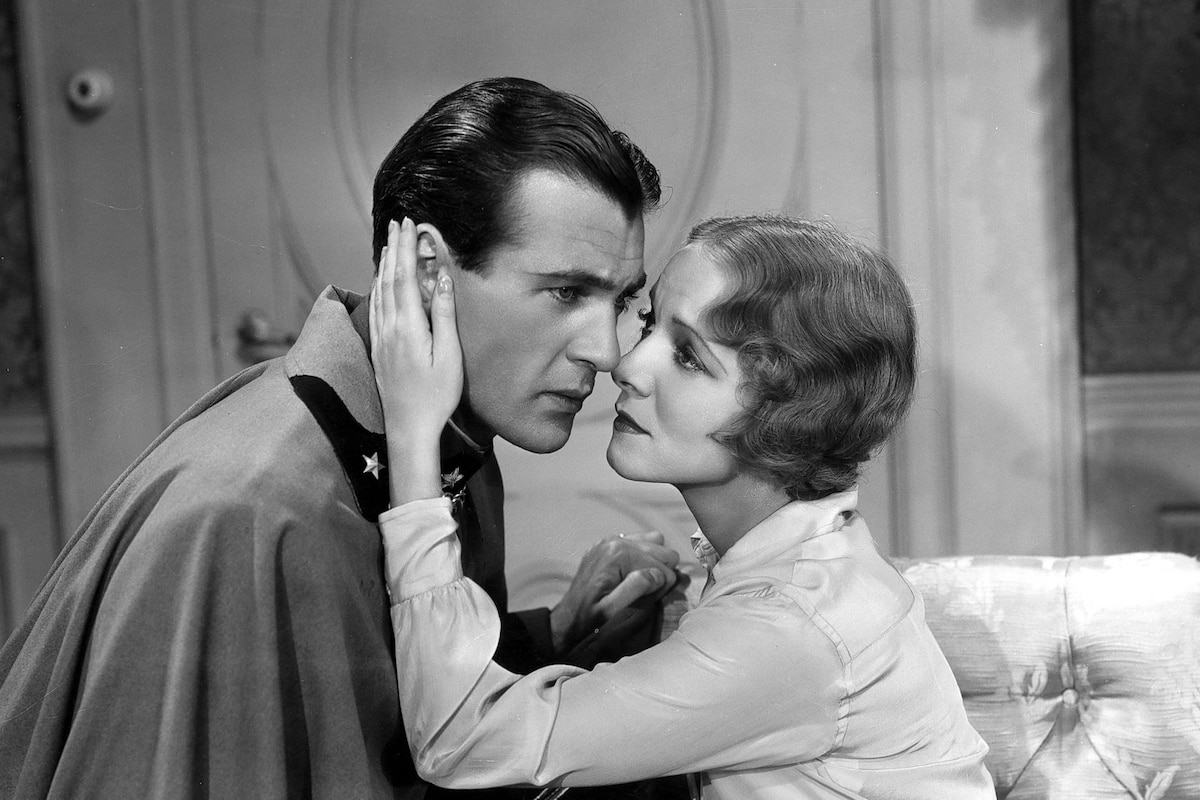
Cooper stars as Lt. Frederick Henry, a World War I officer whose world is
turned upside down when he falls for a British nurse named Catherine Barkley
(Helen Hayes.) Henry and Catherine are made for each other, but Henry's
friend, Major Rinaldi (Adolphe Menjou) grows jealous of them, and has Helen
transferred to Milan. Then, as luck would
have it, Henry is wounded and ends up in the very hospital where Catherine
works. Henry quickly heals, and is sent back into battle, but not before
Catherine is carrying their love child. Though Catherine tries to contact
Henry to tell him the news, she can't reach him due to even more treacherous
maneuvers by Rinaldi.
Eventually, there's a happy or ambiguous finale, depending on which print of
the film you see. Paramount actually made both endings available to theater
owners, telling them to use the one that they thought would work best for
their particular audience. Hemingway was less than enchanted with the idea
of projectionists randomly deciding how his hard-hitting story should end,
and he was livid over several other instances in which the screenplay
softened his hard-hitting vision. But the $24,000 he received for A
Farewell to Arms' film rights encouraged him to sell several more
properties to Hollywood in the ensuing years.
The movie's love scenes, by the way, were no problem at all for Hayes.
Although she was happily married at the time, she harbored an intense crush
on Cooper. She freely admitted as much in her autobiography, when, among
other Cooper-related confessions, she wrote: "My leading man was Gary
Cooper, and like half the women in the world, I was, in the words of the
Noel Coward song, "Mad about the boy."
Hayes was right- pretty much everyone seemed to have a crush on Cooper,
even Hemingway, in a testosterone-driven way. "Cooper is a fine man,"
Hemingway once wrote, "as honest and straight and friendly and unspoiled as
he looks...Cooper is a very fine rifle shot and a good wing shot. I can
shoot a little better than he can with a shotgun but not nearly as good with
a rifle, due I guess to drinking too much for too many years." Both men
liked to compare the African safari adventures they experienced before
meeting each other in 1940. For the record, Cooper had 60 kills in five
months, including two lions. On a two-month safari, Hemingway bagged a
buffalo, three lions, and 27 other unfortunate animals.
The two spent many competitive vacations together, hunting, fishing, and
drinking in the resort town of Sun Valley, Idaho. Cooper, however, was no fool. No matter how much Hemingway insisted, he flatly refused to put on boxing gloves and climb into the ring. Cooper knew that his fine bone
structure was a key element of his screen charisma, and he didn't intend to
ruin it through pointless macho rough-housing. Hemingway, after all, didn't
type with his cheekbones.
Director: Frank Borzage
Screenplay: Oliver H.P. Garrett, and Benjamin Glazer (Based on the novel by
Ernest Hemingway)
Cinematography: Charles Lang
Editing: Otho Lovering
Art Direction: Roland Anderson and Hans Dreier
Sound: Franklin Hansen and Harold Lewis
Principal Cast: Helen Hayes (Catherine Barkley), Gary Cooper (Lt. Frederick
Henry), Adolphe Menjou (Major Rinaldi), Mary Phillips (Helen Ferguson), Jack
La Rue (The Priest), Blanche Friderici (Head Nurse), Mary Forbes (Miss Van
Campen), Gilbert Emery (British Major).
B&W-89m.
by Paul Tatara
A Farewell to Arms (1932)
by Paul Tatara | April 23, 2004
SIGN UP FOR OUR NEWSLETTERS

CONNECT WITH TCM