If ever a picture was aptly named, it's Hearts of the West, Howard
Zieff's valentine to the fondly remembered B-movie Westerns of the 1930s.
Whereas most films that examine the movie industry inevitably turn into
indictments, screenwriter Robert E. Thompson takes a much gentler approach.
You get egotism and backstabbing in Hearts of the West, but it's all
delivered by such likable characters, and with such a gentle nudge, you're
charmed rather than appalled. No wonder the movie has developed a cult
following over the years.
Jeff Bridges stars as Lewis Tater, a guileless Midwesterner who dreams of
becoming a writer of Western novels. Against his father's wishes, Lewis
journeys to Nevada, where he plans to attend a writers' correspondence
school. Unfortunately, the "school" turns out to be a series of post office
boxes, and the owners (Anthony James and veteran character actor Richard B.
Shull) never expected any applicants to show up in person. After all, it's
a correspondence course. When the two shysters try to rob Lewis in his
cheap hotel room, he takes off with their car, which (though he doesn't know
it yet) contains the money they've swindled from would-be students.
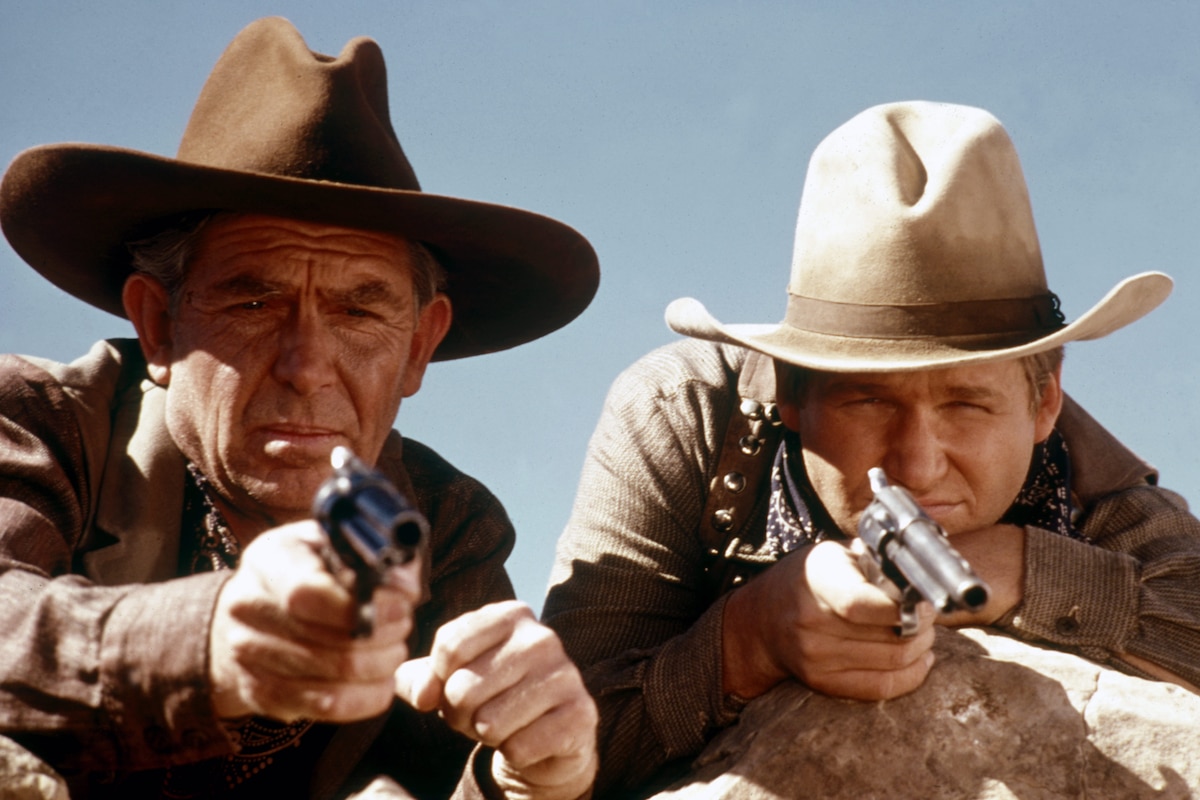
Lewis soon ends up wandering the desert, where he's picked up on horseback
by Howard Pike (Andy Griffith), an actor in low-budget Westerns. Howard
takes Lewis to the set of the picture he's working on. There, Lewis watches
an arrogant director named Kessler (Alan Arkin) inexpertly stage a fight
scene. He also meets Miss Trout (Blythe Danner) a sexy script supervisor
who finds his sweetness endearing. Things are finally looking up for
Lewis.
Upon returning with the crew to Los Angeles, Lewis lands a job as a stunt
man with the production company. His journey into a romance with Miss
Trout, a friendship with Howard, and growing success as a third-tier cowboy
star will occasionally be interrupted by the crooks, who are still after him
for their money. He also writes his first novel, a purple prose melodrama
called Hearts of the West. This all leads to a satisfying, if
contrived ending that unashamedly pulls some heart strings. Still, you can't help
but like this sweet little movie, that avoids broad slapstick while serving up a subtler brand of humor.
Though Hearts of the West barely made a dent at the box office, the
film, and Bridges in particular, received excellent reviews. That's always
been the case for Bridges, who's become one of the most consistently
effective actors in American movies while seldom appearing in a major hit.
It's somewhat astonishing to look back at how many great performances he's
given: Fat City (1972), Bad Company (1972), Thunderbolt and
Lightfoot (1974), which earned him a Best Supporting Actor Oscar nomination, Cutter's Way (1981), Starman (1984) - his first Best Actor Oscar nomination, The Big Lebowski (1998)...the list goes on as he enters his 32nd year as a lead actor. Don't be surprised if Hollywood one day wises up and gives him a lifetime achievement Oscar.
Bridges, of course, knew a great deal about the film industry before he ever
became a leading man. The son of Lloyd and the brother of Beau, he made his
screen debut at age four months in The Company She Keeps (1950). He later made several appearances on his father's hugely popular 1960s TV show, Sea Hunt.
Though he was nominated for an Oscar straight out of high school for his
turn in Peter Bogdanovich's The Last Picture Show (1971), he claims
it wasn't until he appeared in a film version of Eugene O'Neill's The
Iceman Cometh (1973) that he began to take acting seriously.
Hearts of the West producer Tony Bill had also been around for a
while by the time the picture started shooting in 1974. He began his career
as an actor, appearing in such films as Come Blow Your Horn (1963),
You're a Big Boy Now (1966), and Ice Station Zebra (1968). He
never quite reached leading man status, however, and wound up having greater
success as a producer. He even won an Oscar for Best Picture for The
Sting (1973). Hearts of the West, the follow-up to that classic
film, may not have walked away with any awards, but it's a genuine "sleeper" that certainly compliments Bill's resume.
Directed by: Howard Zieff
Screenplay: Robert E. Thompson
Producer: Tony Bill
Art Direction: Robert Luthardt
Cinematography: Mario Tosi
Editing: Edward Warschilka
Music: Ken Lauber
Costume Design: Patrick Cummings
Principal Cast: Jeff Bridges (Lewis Tater), Andy Griffith (Howard Pike),
Blythe Danner (Miss Trout), Alan Arkin (Kessler), Donald Pleasence (A.J.
Nietz), Richard B. Shull (Fat Man), Anthony James (Thin Man), Frank Cady (Pa
Tater).
C-102m.
by Paul Tatara
Hearts of the West
by Paul Tatara | April 21, 2004
SIGN UP FOR OUR NEWSLETTERS

CONNECT WITH TCM