Marie Curie was a Polish physicist working in France when she, along with her husband
and partner Pierre, discovered the scientific element radium. The discovery opened
up the science of radioactivity. Radium proved key in the development of many scientific
technologies from wartime bombs to medical breakthroughs such as using radiation
to treat cancer. Marie Curie was the first woman in France to receive a Ph.D.,
the first woman ever to receive a Nobel Prize, and the first person ever to receive
two Nobel Prizes.
Curie's daughter Eve published a well-received book on her extraordinary mother's
life in 1937 called Madame Curie: A Biography. Hollywood's
interest was peaked, and Universal Studios quickly bought the rights with Irene
Dunne in mind to play Marie. Dunne traveled to Europe and met with Eve Curie to
discuss the project, but nothing ever came of the meeting. A few years later Universal
sold the property to MGM, who wanted it for their star Greta Garbo. Writers such
as Aldous Huxley and F. Scott Fitzgerald took a stab at adapting the screenplay
for Garbo, but the project again was shelved when Garbo left MGM in 1941 and the
country was thrown into World War II.
Meanwhile at MGM actors Greer Garson and Walter Pidgeon had been making names for
themselves as a popular onscreen duo. Audiences loved them together in such hits
as Blossoms in the Dust (1941) and Mrs. Miniver
(1942). MGM resuscitated the Madame Curie project for them with
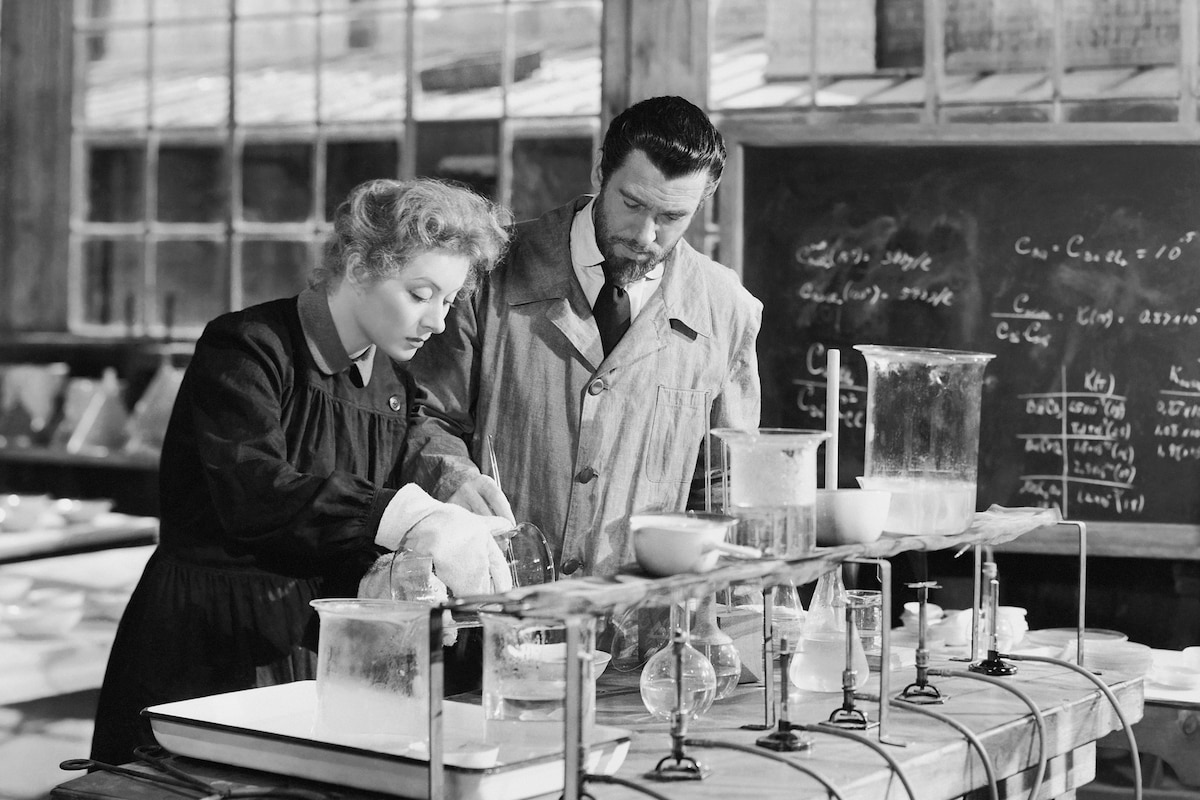
Garson as Marie and Pidgeon as her husband Pierre. This was the fourth onscreen
pairing of the duo. Mervyn LeRoy, who had directed them in their first movie together
Blossoms in the Dust, was named director with Sidney Franklin,
who had produced Mrs. Miniver, producing. Franklin very much
wanted to keep the events in the film as historically and scientifically accurate
as possible. To do this he brought in Dr. Rudolph Langer, a physicist from Cal
Tech, as an official technical advisor. In addition to providing input on the script,
Dr. Langer also contributed by re-creating some of the Curies' experiments for the
screenwriters to observe.
The biggest challenge for making a movie of Madame Curie was
in making the unlikely subject of the discovery of radium interesting and entertaining
for audiences. The film managed to adhere to the facts more than most biopics of
the 1930s and 40s, and it also took time to develop the sweet romance between Marie
and Pierre, two shy scientists fiercely dedicated to their work. This balance between
showing the Curies' personal lives and scientific work was key to its success.
Director Mervyn LeRoy, who considered Madame Curie to be among
his personal favorites, was careful to keep the complicated scientific material
easy to follow. "I didn't let a scene go by unless I understood it myself," Mervyn
LeRoy said in his 1974 autobiography Mervyn LeRoy: Take One.
The science meets Hollywood strategy worked, and audiences and critics alike loved
Madame Curie. Bosley Crowther of the New York Times
said, "It has made their (the Curies') absorption as comprehensible as the urge
to read good books. Greer Garson and Walter Pidgeon are ideal in the leading roles."
Eve Curie even wrote a letter of approval to Mervyn LeRoy saying how much she had
liked his film adaptation of her book. Madame Curie was honored
with seven Academy Award® nominations including Best Picture, Best Actor
and Best Actress. Ultimately, however, it took home none, losing out to Casablanca
(1942) for Best Picture.
In some ways, Madame Curie was a mixed blessing for Garson who,
prior to playing the role, was quoted as saying, "Here am I, possibly the only
natural redhead in Hollywood, mildewing away the years in shawls, shrouds, and chignons
in unrelieved black and white. I hope that Madame Curie will
be my last heavy dramatic role I shall play for some time." (from Michael Troyan's
biography, A Rose For Mrs. Miniver: The Life of Greer Garson).
Garson was equally concerned about audiences "believing" her transition
from youth to old age in the course of the film. "When I'm 62, they'll probably
cast me as an ingenue. At 70, I'll be in pigtails. Anyway I can dream can't I?"
After Madame Curie, Greer Garson and Walter Pidgeon went on to
make five more features together; they were teamed on the screen a total of nine
times. Also included in the cast of Madame Curie are Robert
Walker as a young lab assistant, Van Johnson as a cub reporter, and Margaret O'Brien
as the Curies' daughter Irene.
Producer: Sidney A. Franklin
Director: Mervyn LeRoy
Screenplay: Paul Osborn, Paul H. Rameau
Cinematography: Joseph Ruttenberg
Film Editing: Harold F. Kress
Art Direction: Cedric Gibbons
Music: Herbert Stothart
Cast: Greer Garson (Mme. Marie Curie), Walter Pidgeon (Pierre Curie), Robert Walker
(David LeGros), Van Johnson (Reporter), Albert Bassermann (Prof. Jean Perot), Henry
Travers (Eugene Curie), C. Aubrey Smith (Lord Kelvin).
BW-124m. Closed captioning. Descriptive Video.
by Andrea Passafiume
Madame Curie
by Andrea Passafiume | September 25, 2007
SIGN UP FOR OUR NEWSLETTERS

CONNECT WITH TCM