"Once you find the way, you'll be bound. It'll obsess you. But believe
me, it'll be a magnificent obsession."
Paul Cavanagh in Magnificent Obsession
For most of the audience that viewed Magnificent Obsession on its
initial release in 1954 it was the height of inspirational drama -- the
story of a reckless playboy who redeems himself through selfless, anonymous
devotion to good works. For most of the audience seeking it out today,
it's high camp -- a satirical look at the spiritual pretensions of upwardly
mobile Americans in the '50s. That one film could inspire two such
divergent interpretations suggests one characteristic common to cult films,
their ability to exist on several often mutually exclusive levels.
The saga of Magnificent Obsession started in 1929, when Lutheran
pastor Lloyd Douglas published his first novel, an attempt to make
fiction out of his most cherished beliefs. The novel was a runaway best
seller, leading to a series of similar works from Douglas, most notably his
epic of ancient Rome, The Robe, filmed with Richard Burton and Jean
Simmons in 1953.
Magnificent Obsession first reached the screen in 1935 as one of
Universal Studios' premier productions for the year. Irene Dunne, still
thought of primarily as a romantic leading lady, starred as the widow whose
life is ruined then saved by the leading man, a role that helped establish
Robert Taylor as a star. With John M. Stahl directing, the film maintained
a sincere attitude toward its subject, making it one of the most profitable
films of 1935.
With the success of the original version, a remake, although inevitable,
seemed highly superfluous. But that wasn't reckoning with a major
directing talent waiting in the wings. It's not that Danish-born Douglas
Sirk had never made a major film before. After leaving his career in
theatre to direct films for UFA in Germany, he produced a series of
melodramas, rarely seen in the U.S., in which he developed many of the
themes he would later draw on for his American films. The film's
middle-class characters were confined and often smothered by their chic
possessions, as their repressed passions burst forth in surprising, often
destructive ways.
Fleeing the Nazis in the late '30s, he re-settled in
Hollywood, where he started a long climb back to prominence. After a
decade of low-budget films, he hooked up with his ideal producer, Ross
Hunter, to take on the second film version of a novel he hadn't been able
to read all the way through, Magnificent Obsession. The result was
equal parts unapologetic schmaltz and social satire. Sirk placed his
characters in a world of haute couture and modernist architecture, then
imbued them with intense, primal emotions like figures in a modern morality
play. Serious critics at the time were flabbergasted, particularly when
the picture became one of the year's top moneymakers, but by the '70s, his
films were being re-evaluated, often hailed as the most trenchant social
criticism of the '50s.
Helping tremendously were the film's leading players. After years as a
glorified chorus girl at Warner Bros., Jane Wyman had emerged as a dramatic
star with performances as a hard-nosed farm woman in The Yearling
(1946) and a deaf mute in Johnny Belinda (1948), the latter bringing
her an Oscar® for Best Actress. Her performance as a nurse caring for
unwanted children in The Blue Veil (1951) established her as the
screen's reigning soap opera queen. Working with Sirk on Magnificent
Obsession and its 1956 follow-up, All That Heaven Allows, she
emerged as the genre's patron saint. Little wonder she would move
effortlessly in later years into the prime-time television soap Falcon
Crest.
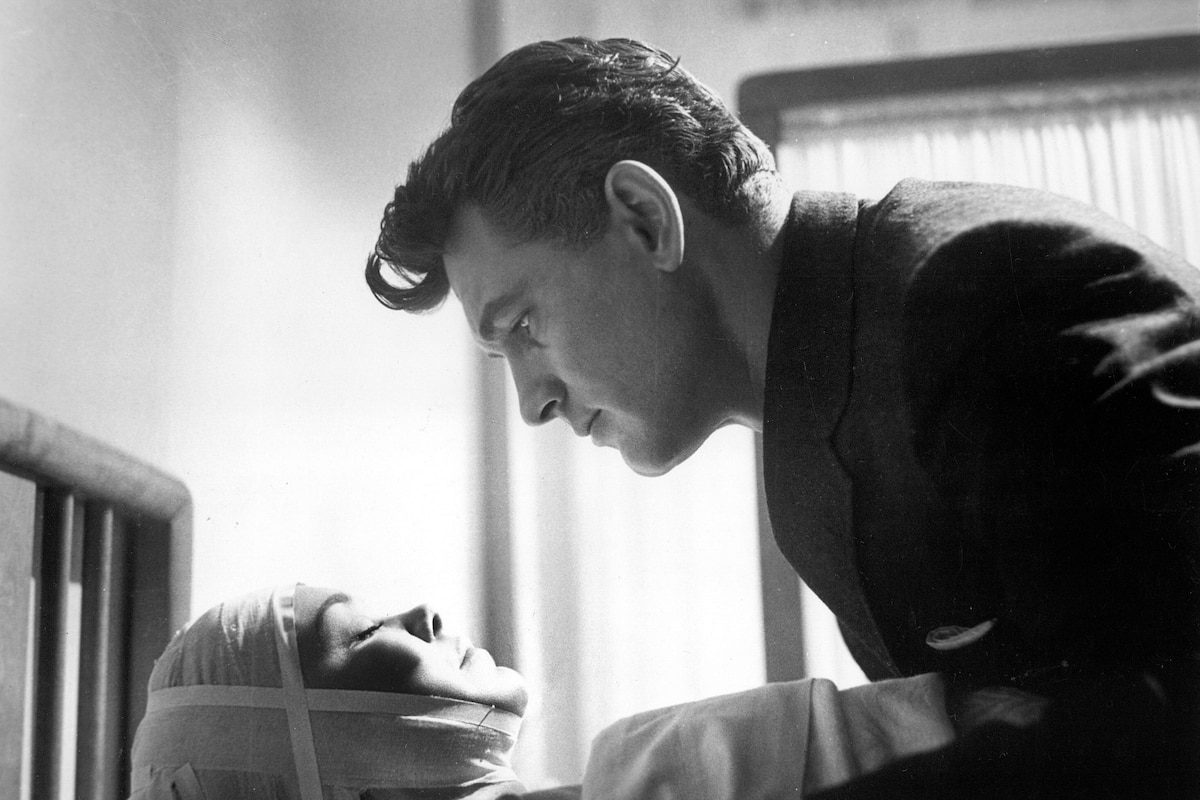
And just as it had two decades before, the role of the playboy reformed by
faith turned a Hollywood lightweight into a major star. Sirk had just
worked with Rock Hudson (and his Magnificent Obsession co-stars Barbara Rush and Gregg Palmer) in the 3-D Western Taza, Son of
Cochise (1954). With his sincere performance in Magnificent Obsession,
Hudson rose from standard beefcake roles to become one of the great stars of the
decade. He would re-unite with Sirk and Wyman for All That Heaven
Allows and continue with Sirk on Written on the Wind (1956) and
The Tarnished Angels (1958), both films often cited as the director's
best.
Besides bringing Sirk more opportunities to direct opulent soap operas and
making Hunter Universal's top producer, Magnificent Obsession has
become one of the '50s most influential films. In the '70s, German
director Rainer Werner Fassbinder openly acknowledged Sirk's influence on
his own high-octane romances like The Bitter Tears of Petra von Kant
(1972) and The Marriage of Maria Braun (1979). More recently,
director Todd Haynes imitated Sirk's style, along with key scenes and
themes, for his deconstructed soap opera Far from Heaven (2002),
starring Julianne Moore, Dennis Quaid and Dennis Haysbert. Hong Kong
action director John Woo copied from Magnificent Obsession in The
Killer (1989), in which a hired killer finds redemption by helping a
woman blinded when caught in the middle of one of his hits.
One of the more unusual tributes to Magnificent Obsession, however,
came from independent U.S. filmmaker Mark Rappaport. His study of the gay
subtext of Hudson's films, Rock Hudson's Home Movies (1992),
prominently features scenes between Hudson and his spiritual mentor, played
by Otto Kruger, as an example of "pedagogical Eros" in the actor's films.
According to Rappaport and other queer theorists, the prevalence of
on-screen relationships between Hudson and older mentors carries a
distinctly homoerotic subtext. Well, Kruger certainly does introduce
Hudson's character to a new lifestyle, though Rappaport's interpretation is
probably far removed from what the Rev. Douglas originally had in mind.
Then again, that's another thing about cult movies, they often reveal
meanings their original audiences and even some of their creators never
considered.
Producer: Ross Hunter
Director: Douglas Sirk
Screenplay: Robert Blees, Wells Root
Based on the Novel by Lloyd C. Douglas
Cinematography: Russell Metty
Art Direction: Bernard Herzbrun, Emrich Nicholson
Score: Frank Skinner
Principal Cast: Jane Wyman (Helen Phillips), Rock Hudson (Dr. Bob Merrick),
Barbara Rush (Joyce Phillips), Agnes Moorehead (Nancy Ashford), Otto Kruger
(Edward Randolph), Gregg Palmer (Tom Masterson), Mae Clarke (Mrs. Miller),
Theodore Kosloff (Electricity, "Ballet Mechanique").
C-108m. Closed Captioning.
by Frank Miller
Magnificent Obsession (1954)
by Frank Miller | March 23, 2004
SIGN UP FOR OUR NEWSLETTERS

CONNECT WITH TCM