"There are eight million stories in the naked city. This has been one of
them."
With that memorably stark declaration, producer Mark Hellinger closes one of
the greatest film noirs of all time, Jules Dassin's The Naked City (1948).
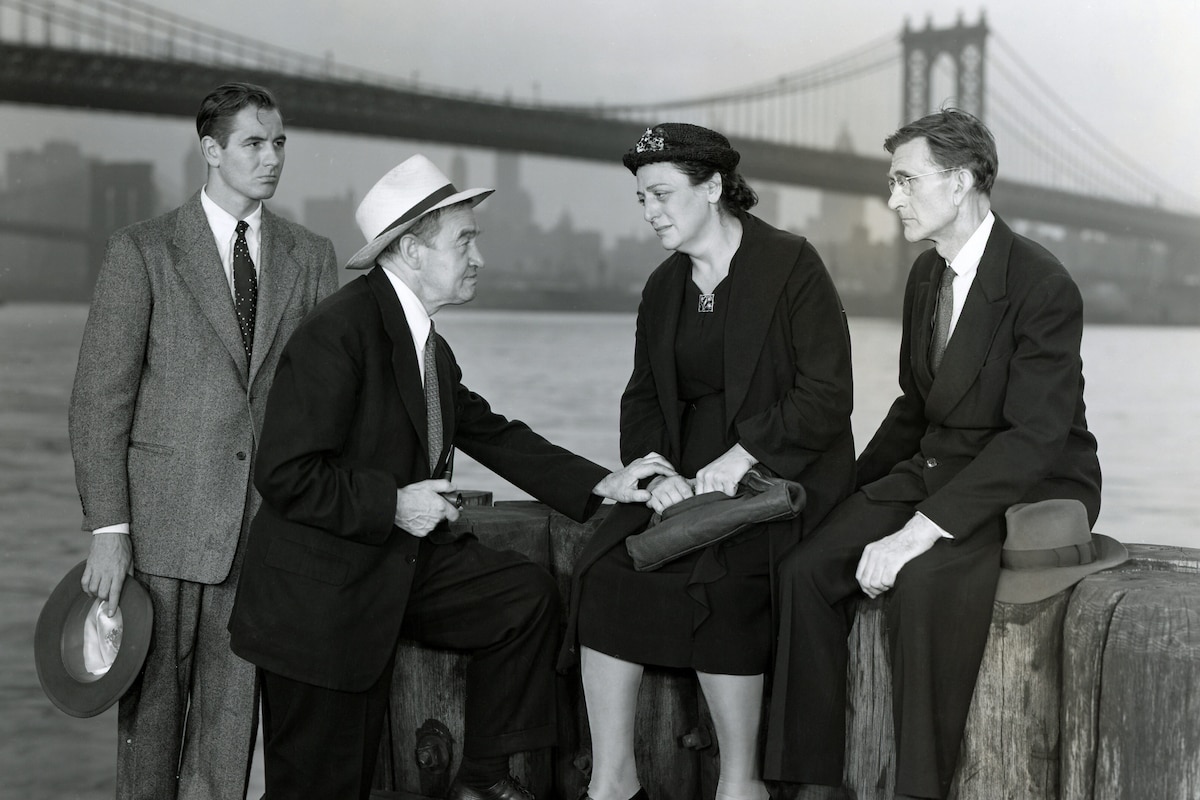
The picture itself is just as hard-edged as its narration, a groundbreaking detective story shot in raw documentary style amid the bridges and concrete
canyons of New York City. Nowadays, this sort of location filming is
commonplace, even on network TV. But Hellinger and Dassin were the first
filmmakers to venture into the streets of the Big Apple to shoot a
movie.
The Naked City opens in tawdry noir style, with the murder of a young model in her Manhattan apartment. We then follow the six-day investigation of her
death, which is lead by straight-shooting Lt. Dan Muldoon (Barry Fitzgerald)
and Detective James Halloran (Don Taylor.) Their often mundane police work
is interspersed with quick sequences about the private lives of the
detectives and the day-to-day rumblings of New York City itself. The
investigation will lead to a trio of men who may have wanted the woman dead,
including Frank Niles (Howard Duff), a shady type who seems to be hiding
something even when he spills his guts to the cops. The final foot chase
across the upper reaches of the Williamsburg Bridge is a classic sequence
that is helped immeasurably by cinematographer William Daniels' Oscar®-winning
camera work.
No doubt about it - this is one great-looking movie. Dassin and Daniels
delivered perhaps the most starkly realized movie of the 1940s. Hellinger
intended the images to resemble tabloid newspaper photographs. But it was
Dassin and Daniels who had the brilliant idea to shoot scenes with a camera
that was hidden inside a van, behind a tinted window. That way, the cast
could cover the sidewalks without passersby even knowing they were taking
part in a movie! The results are a virtual time capsule of life in post-war
New York City.
Dassin directed other memorable films in the same mold as The Naked
City, including Brute Force (1947), Night and the City (1950), and
Thieves' Highway (1949). But his career in Hollywood, like so many others, would be
tragically cut short when he was blacklisted during the ruthless
McCarthy-era witch hunts. Dassin took the fall rather than name names
before the committee...unlike several of his closest friends, including
actor Lee J. Cobb, director Elia Kazan, and playwright Clifford Odets.
After moving to Europe to find film work, Dassin settled in
Greece, a weary but idealistic man who later admitted to having been a
member of the Communist Party, although he never aimed to espouse his
beliefs in any of his pictures.
Nevertheless, even with Dassin at the helm, Hellinger is the most
fascinating person connected to The Naked City. A quick scan of his
biography reads like an elaborate, Damon Runyon-inspired put-on: His first
job was as a reporter for a theatrical publication called, mysteriously
enough, Zit's Weekly. During prohibition, he drank copious amount of
brandy and wrote the first-ever Broadway column, a wildly popular
slice-of-life called "About Town." He soon began dressing in his lifelong
uniform of dark blue shirts and white ties. He was so generous with his
money, people would line up on pay day and wait for him to slide bills into
their hands. In 1926, he married a beautiful showgirl whose actual name was
Gladys Glad. In 1931, he wrote sketches for the Ziegfeld show, Hot
Cha. He successfully toured the vaudeville circuit as an actor for a
year. He broadcast football games for Columbia University without knowing a
single thing about football...It goes on like that for pages.
Eventually, Hellinger wrote a couple of books that got sold to the studios
out in Hollywood. He then declared that he, too, would go to Hollywood, but
not as a mere screenwriter- he wanted to produce movies, too. After a
string of forgettable B-pictures, he insisted, in 1941, that
Humphrey Bogart play the lead in his production of High Sierra.
The film was an indisputable classic that made Bogart a major star. Later,
Hellinger would produce The Killers (1946), which introduced the world to
Burt Lancaster. It was around this time that Hellinger became good friends
with Ernest Hemingway, the author of the short story on which The Killers was based.
Hellinger dropped dead from a heart attack in 1947, having lived just long
enough to enjoy a successful preview of The Naked City. At long last, he finally got some sleep.
Producer: Mark Hellinger
Director: Jules Dassin
Screenplay: Albert Maltz and Malvin Wald
Cinematography: William Daniels
Editing: Paul Weatherwax
Music: Miklos Rozsa and Frank Skinner
Art Design: John DeCuir
Set Design: Russell A. Gausman and Oliver Emert
Costume Design: Grace Houston
Makeup: Bud Westmore
Principal Cast: Barry Fitzgerald (Lt. Dan Muldoon), Howard Duff (Frank
Niles), Dorothy Hart (Ruth Morrison), Don Taylor (Jimmy Halloran), Ted de
Corsia (Garzah), House Jameson (Dr. Stoneman), Anne Sargent (Mrs. Halloran),
Adelaide Klein (Mrs. Batory), Tom Pedi (Detective Perelli), Enid Markey
(Mrs. Hylton), Frank Conroy (Capt. Donahue), Mark Hellinger (Narrator).
B&W-96m.
by Paul Tatara
The Naked City
by Paul Tatara | March 26, 2004
SIGN UP FOR OUR NEWSLETTERS

CONNECT WITH TCM