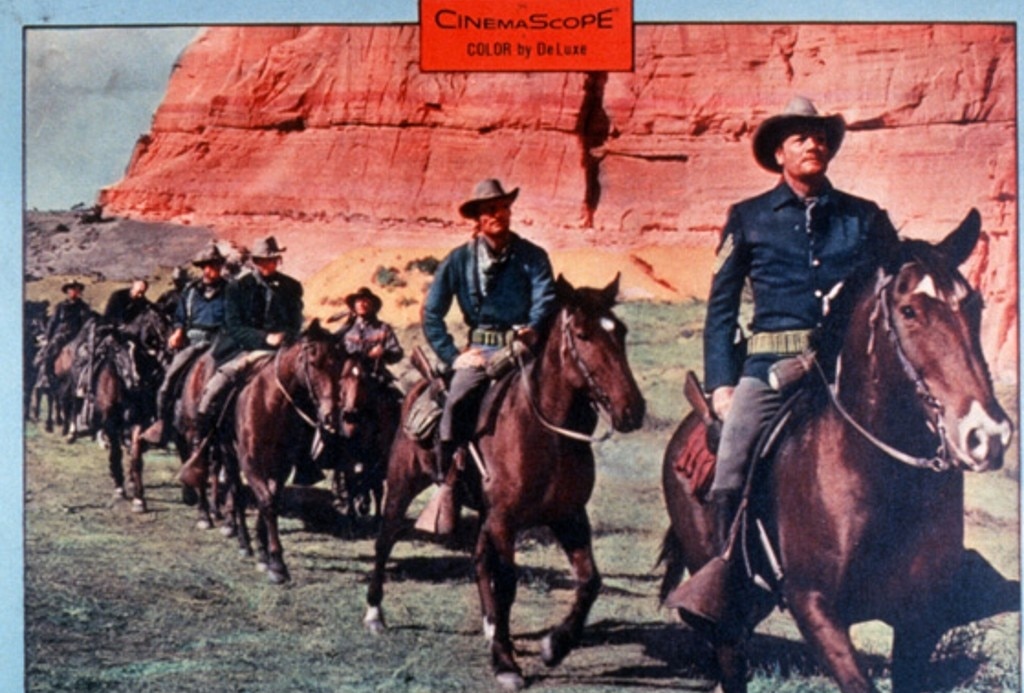
An off-beat psychological Western, Fort Massacre (1958) follows the story of a cavalry sergeant leading his troops through Indian territory after their commanding officer is killed in an ambush. The sergeant leads them through restricted Apache lands, claiming it's the shortest route back to the fort, but his men begin to suspect him of looking for an excuse to massacre Indians because his wife and children were slaughtered in an Apache raid years before. The troops are under constant attack and their numbers dwindle. The soldiers come to the conclusion that their leader is mad, and it's up to one of them to finally take matters into his own hands.
This was the first picture produced by the Mirisch Company after its founding in 1957 by Walter Mirisch and his brothers. Very little in Walter Mirisch's background and current reputation would indicate a producer of Westerns. His company is best known for such prestige pictures of the 1960s as The Apartment (1960), West Side Story (1961), The Great Escape (1963), and In the Heat of the Night (1967), for which he won his only Academy Award® as executive producer. Born in New York, Mirisch entered the motion picture business as an usher in a New Jersey movie theater, went to Harvard Business School, and became one of the youngest men ever to become an executive producer at an important Hollywood studio (Allied Artists). But his first assignments were on action flicks (starting with the B-movie Bomba, the Jungle Boy series) and he had already produced a handful of Westerns before he took on this project. And he later produced a great classic of the genre, The Magnificent Seven (1960).
The film's star, Joel McCrea, didn't start out as a Western hero either, although it had always been his ambition if not to be a cowboy, then to play one. Like many native Southern Californians of his generation (born in 1905), McCrea more or less drifted into movies, starting in silents with stunts and bits. His easy-going charm and clean-cut good looks soon earned him a reputation as an All-American type, and he became a popular leading man of the 1930s. But he had grown up around real cowboys, the last of their breed, and these were the men he admired most. He had a hard time convincing producers to cast him as an action hero on horseback, but he finally got his break with Wells Fargo (1937). He landed the occasional Western role over the next decade. But beginning in 1946, with enough clout by that time to call the shots in his career, he went exclusively into Westerns, making 11 in seven years and only breaking his run with one urban crime thriller (albeit with a very Western name), Rough Shoot (1953). After that, he went West again and never looked back, working exclusively in the genre for the remainder of his career - 17 more films in all.
Perhaps today McCrea's name isn't completely synonymous with Westerns, not only because of his acclaimed work in such comedies as Sullivan's Travels (1941) and The More the Merrier (1943), but because he never played in a classic of the John Ford caliber. His films of the 1950s are generally considered of the "B" movie variety, yet they made money and many of them still hold up well today. He played such true-life legends of the Old West as Sam Houston, Buffalo Bill, Wyatt Earp, and Bat Masterson. He was in the fourth of five versions of The Virginian (1946), a classic that starred Gary Cooper (to whom McCrea is often compared) in 1929 and was made into a popular TV series in the 1960s. And in his last major role he shared the screen with Randolph Scott (another handsome leading man of the 30s who went West later in his career) in what many consider a minor masterpiece of the genre, Ride the High Country (1962), the movie that launched Sam Peckinpah's directing career (he had previously helmed The Deadly Companions in 1961 but it was a relatively undistinguished effort).
McCrea's love of horse and saddle wasn't confined to the screen alone. He invested wisely in real estate and livestock, and listed his occupation as "rancher" on his tax returns, claiming movie acting was more of a hobby. He was inducted into the Hall of Great Western Performers of the National Cowboy and Western Heritage Museum in 1969.
McCrea's performance is the chief reason to see Fort Massacre. Playing against type, he is fascinating to watch as a man driven by personal demons to risk the lives of everyone around him. Also in the cast are other familiar players in the Western genre, Forrest Tucker, John Russell and Denver Pyle. Tucker was the star of a Western sitcom in the 1960s, F Troop, and Russell created the title role of the Western series The Lawman in the late 50s. Pyle appeared in the John Wayne films The Alamo (1960) and The Man Who Shot Liberty Valance (1962), played Sitting Bull's captor in Robert Altman's revisionist Western Buffalo Bill and the Indians (1976) and was a fixture of such homespun TV series as The Dukes of Hazzard, Grizzly Adams and The Andy Griffith Show.
Director: Joseph M. Newman
Producer: Walter M. Mirisch
Screenplay: Martin Goldsmith
Cinematography: Carl Guthrie
Editing: Richard V. Heermance
Original Music: Marlin Skiles
Cast: Joel McCrea (Sgt. Vinson), Forrest Tucker (McGurney), John Russell (Travis), Denver Pyle (Collins), Susan Cabot (Paiute Girl).
C-80m. Letterboxed.
by Rob Nixon
Fort Massacre
by Rob Nixon | March 26, 2004
SIGN UP FOR OUR NEWSLETTERS

CONNECT WITH TCM