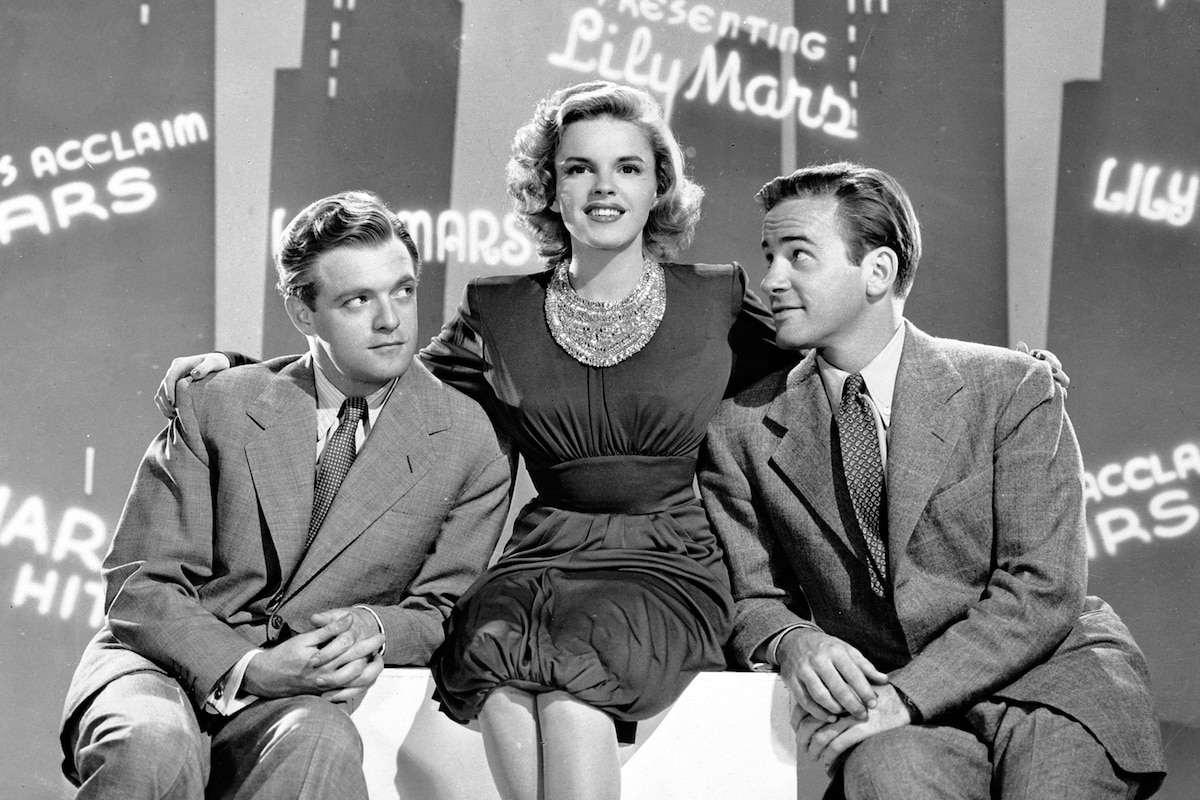
Judy Garland was already a screen veteran at the ripe old age of 19 in
1943, when she starred in Presenting Lily Mars, a coming-of-age musical for producer Joseph
Pasternak, the former-Universal honcho who had tried to get her for his
studio years earlier when she was first starting out. Although by the time
the film came out Garland was already a divorcee who could only sleep by
washing down sleeping pills with a generous dose of vodka, she was still
cast as the eternal innocent. It wasn't until the film's finale that MGM
allowed her to appear as an adult for the first time in a musical
number.
MGM had originally bought the rights to Booth Tarkington's 1933 novel about
a small-town girl who rises from the chorus to become a star as a vehicle
for Lana Turner. But as the film's producer, recent arrival Pasternak,
looked at the script, it seemed too lightweight for the glamour girl, who
was being groomed for more dramatic roles. Instead, he suggested the
studio add songs to make it more suitable for either Garland or Kathryn
Grayson. Pasternak had tried to put Garland under contract when he was at
Universal in the '30s, but when MGM decided to keep her, he snatched up
another young singer the studio had just let go, Deanna Durbin. After
turning Durbin into a star, he even tried unsuccessfully to borrow Garland
so the two could team up (they had done the 1936 MGM short "Every Sunday"
together) for a musical version of Little Women. With his move to
MGM, he finally had the chance to work with Garland.
Presenting Lily Mars would give Garland one of her last juvenile
roles at MGM. In some ways, it marked her coming of age on screen as she
was paired romantically with adult star Van Heflin. The film also gave her
one of her many on-screen musical highlights, as stage newcomer Lily
realizes that the theater's cleaning lady (Connie Gilchrist) is a former
star, and they duet to "Every Little Movement."
At the time, MGM was working Garland mercilessly. She was finishing
shooting on For Me and My Gal (1942), with Gene Kelly, as she
started musical rehearsals for Presenting Lily Mars and would start
musical numbers for her next film Girl Crazy (also 1943), while
completing the earlier picture.
Originally, Garland had filmed a patriotic finale for the film built around
the song "Paging Mr. Greenback." When studio head Louis B. Mayer and his
executives saw the rough cut, however, they thought the number didn't live
up to the rest of the film. With Pasternak's approval, he assigned his
resident musical genius, producer Arthur Freed, to come up with a new
finale. Garland would spend three months shuttling between the sets of
Girl Crazy and Presenting Lily Mars until the sequence was
shot. And since the Tommy Dorsey Orchestra was already appearing in the
other film, MGM recruited them for this one as well.
The result was a medley of popular classics anchored by "Broadway Rhythm,"
which Freed had co-written for Broadway Melody of 1936 (1935). Back
then, Eleanor Powell had danced one of her quick-fire, sexy tap solos to
the tune. This time out, Garland did some pretty impressive hoofing of her
own, partnered by future director Charles Walters. A former chorus boy now
moving into choreography, Walters had been brought to MGM at Gene Kelly's
request to help with the dances on Du Barry Was a Lady (1943). When
Mayer saw Walters dancing with Garland, he considered signing him as a
musical star, but Freed convinced him that the dancer's career lay behind
the cameras. Walters would go on to become one of the studio's top
directors, working with Garland again on Easter Parade
(1948).
MGM hailed the "Broadway Rhythm" finale as Garland's first appearance on
screen as an adult (she actually had played a married woman who dies in
childbirth in the early scenes of Little Nellie Kelly in 1940). For
the big number she was decked out in an adult evening gown and appeared
with her hair up for the first time on screen.
Garland's move into adulthood in Presenting Lily Mars was a case of
too little too late for many critics. Although, as ever, they hailed her
ability to sell a song and her effortless transitions from comic to
dramatic scenes, most complained that the studio had stuck her in juvenile
roles for too long. They weren't too crazy about the film either, with the
New York Times critic dismissing it as "glorified monotony." The
fans loved it, of course, easily pushing the picture into the profit
column. The critics would have to wait a little longer for the adult
Garland. She would follow Presenting Lily Mars and Girl
Crazy with a character two years younger, Esther Smith in Meet Me in
St. Louis (1944), before graduating to adult roles for good as the
young war bride in The Clock (1945).
Producer: Joe Pasternak
Director: Norman Taurog
Screenplay: Richard Connell, Gladys Lehman
Based on the novel by Booth Tarkington
Cinematography: Joseph Ruttenberg
Art Director: Cedric Gibbons, Harry McAfee
Music Director: Georgie Stoll
Principal Cast: Judy Garland (Lily Mars), Van Heflin (John Thornway), Fay
Bainter (Mrs. Thornway), Richard Carlson (Owen Vail), Spring Byington (Mrs.
Mars), Martha Eggerth (Isobel Rekay), Connie Gilchrist (Frankie), Leonid
Kinskey (Leo), Ray McDonald (Charlie Potter), Marilyn Maxwell (Chorus
Girl), Tommy Dorsey and His Orchestra, Bob Crosby and His Orchestra,
Charles Walters ("Broadway Rhythm" Dance Partner).
BW-104m. Closed captioning.
by Frank Miller
Presenting Lily Mars
by Frank Miller | March 26, 2004
SIGN UP FOR OUR NEWSLETTERS

CONNECT WITH TCM