The Squaw Man (1914) is the first film by director Cecil B.
DeMille, and reputedly, the first feature film ever made in Hollywood
(though some film scholars dispute this claim) . These noteworthy
"firsts" began when would-be stage producer Jesse Lasky approached
Cecil's brother, William C. de Mille (a celebrated Broadway playwright) to
collaborate on an operetta. William was managed by his mother, Mrs.
H.C. de Mille, who ran a theatrical agency. Since William was committed
to another project, she recommended her younger son Cecil, who also
had dramatic aspirations, and was not without experience both as a
writer and actor. A skeptical Lasky agreed to meet, and he and Cecil
quickly forged a bond and decided to work together -- not on a play, but
a film. Short films were the norm, but it was becoming evident that
feature-length films would soon dominate the marketplace. DeMille and
Lasky decided to wager on the future of cinema, and with an investment
of $26,500, they formed the Lasky Feature Play Company.
As
their first property, they chose a story that appeared to be an easily
exploitable property: The Squaw Man, written by Edwin Milton
Royle. It had begun as a successful stage play in 1905 (featuring future
cowboy star William S. Hart), and had been revived in 1907, 1908 and
1911. At a price of $5,000, the filmmakers recruited the star of the 1911
run, Dustin Farnum. Because DeMille had no experience as a filmmaker
(his apprenticeship consisted of a single day at the Edison Studios),
Oscar Apfel was brought along to co-direct, and to help initiate the
producers into the world of filmmaking.
In 1913 (when The Squaw Man began filming), plenty of motion
pictures were being filmed outdoors, but generally within driving
distance to the studios in New York and New Jersey. DeMille
recognized the power of exotic scenery and intended to use sweeping
plains and imposing mountains as the key visual component of his film,
so he boarded a train west, bound for the picturesque-sounding
Flagstaff, Arizona. Unfortunately, Flagstaff failed to deliver such
awesome vistas. Discouraged but not broken, De Mille, Farnum & Co.
remained on the train until it reached the end of the line: the junction city
of Los Angeles. They drifted into the sleepy community of Hollywood
and rented a large barn at Vine and Selma Streets for $200 per month.
The barn was the seed from which Paramount Pictures would eventually
grow, and still stands today, preserved as a museum of early Hollywood
filmmaking. On December 29, 1913, the cameras began to
turn.
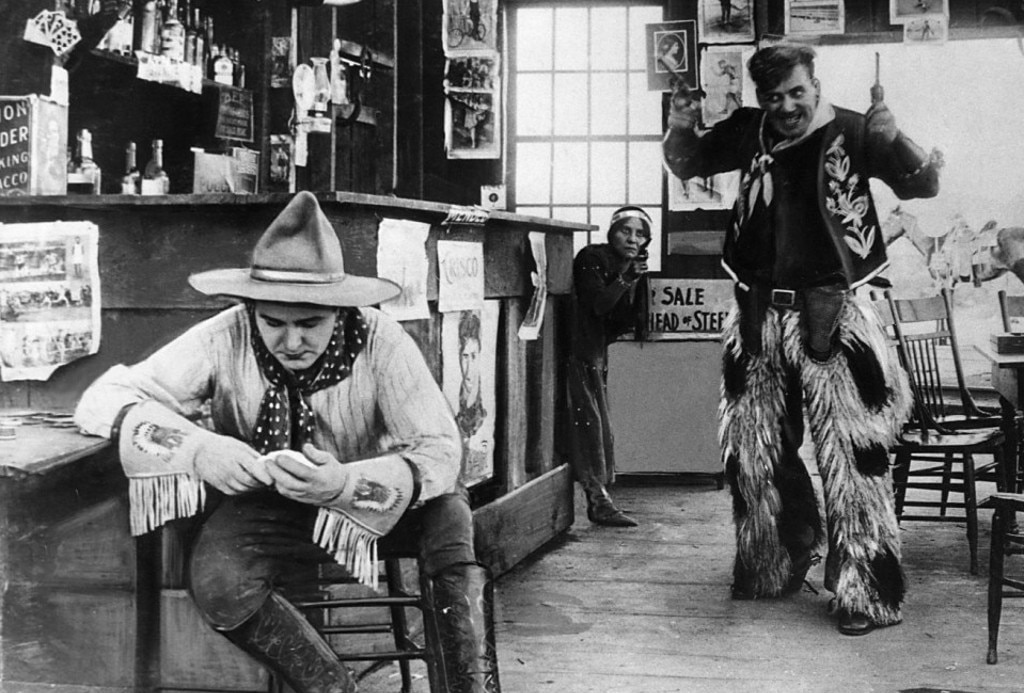
The melodrama concerns itself with the honor of
Captain James Wynnegate (Farnum), a peer of England. When his
cousin, Sir Henry (Monroe Salisbury) embezzles money from an
orphans' fund to pay his gambling debts, James accepts the blame and
is banished from high society. When the ship upon which he is traveling
burns and sinks, James is rescued and taken to America. Disgusted by
the crime and chicanery of the big city, he accepts a Westerner's
invitation to travel with him back to the plains. The sophisticated
Britisher is at first mocked, but quickly earns the respect of the
rangehands, with the exception of the villainous rustler, Cash Hawkins
(William Elmer). When Nat-U-Rich (Red Wing), a native American woman,
saves his life, they fall in love and are married. Suffering financial
hardship, James's future seems grim, until a dying confession, an
unexpected reunion with an old flame (Winifred Kingston) and a fateful
shoot-out bring the film (already bursting at the seams with narrative) to
a surprising and elaborately plotted resolution.
Cecil B.
DeMille would later become synonymous with grandiose spectacle, and
even in The Squaw Man, one detects his strong visual sense.
To add scale and drama to scenes in a small western town, he
constructed a set for the depot/general store within a few feet of a
roalroad track, so that scenes filmed there are punctuated by a roaring
steam enging passing almost through the set.
Even in
his first film, DeMille displayed a keen eye for lighting (influenced by the
stage plays of David Belasco). Using rudimentary techniques, DeMille
and cinematographer Alfred Gandolfi managed to the effects of firelight
and candlelight so that the visual impact of their western was not limited
to the quantity of actors on screen, but the quality of the
compositions in which they are presented.
Upon the
completion of The Squaw Man, the producers (and any
exhibitors who screened the film) were shocked to find the film
periodically shifting up and down on the screen. The inexperienced
DeMille and Lasky prepared to file a lawsuit against the Eastman Kodak
Company. They consulted film pioneer Sigmund Lubin, who explained
that the defect was not the film. "You used two different cameras,
didn't you?" asked Lubin, according to Terry Ramsaye's book A
Million and One Nights. "That's why...two different frame lines -- that
makes the picture jump." DeMille made sure the cameras were properly
calibrated after that, and Lubin secured a lucrative contracted to "fix" the
negative and process all the distribution prints of the film.
Producer: Cecil B. DeMille, Jesse L. Lasky
Director: Cecil B. DeMille, Oscar Apfel
Screenplay: Cecil B. DeMille, Oscar Apfel
Cinematography: Alfred Gandolfi
Film Editing: Mamie Wagner
Art Direction: Wilfred Buckland
Music: Scott Salinas
Cast: Dustin Farnum (Capt. James Wyngate), Monroe Salisbury (Sir Henry), Winifred Kingston (Lady Diana), William Elmer (Cash Hawkins), Foster Knox (Sir John), Joseph Singleton (Tabywana).
BW-78m.
by Bret Wood
The Squaw Man (1914)
by Bret Wood | March 25, 2004
SIGN UP FOR OUR NEWSLETTERS

CONNECT WITH TCM