There's no arguing that Alfred Hitchcock was responsible for several of the
greatest motion pictures of all time. But when asked to name his personal
favorite, he often mentioned The Trouble with Harry (1955), one of his rare
critical and box office bombs. The story of a group of small-town
Vermonters who have no qualms whatsoever about repeatedly digging up and
hiding a corpse, Harry was fairly outrageous when it was released
back in 1955. Nowadays, though, its subtle, absurdist humor goes down
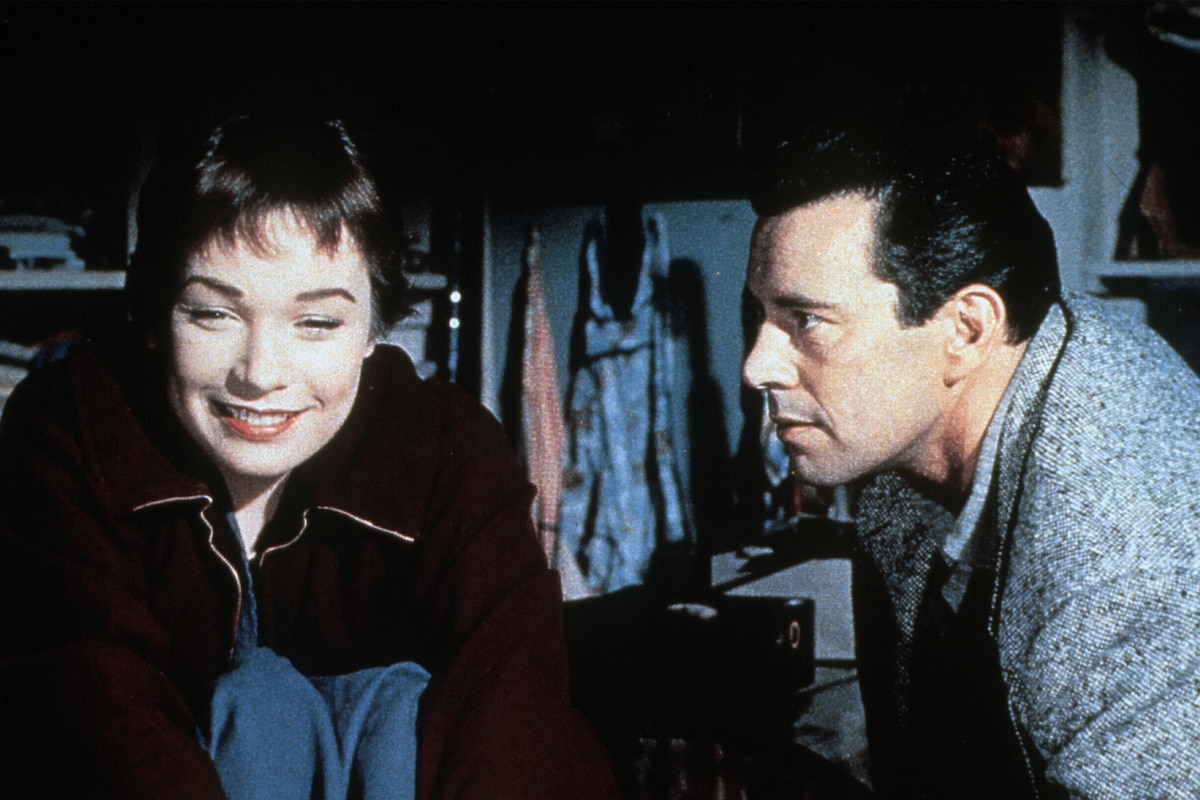
smoothly, and it features a charming debut performance by a young pixie
named Shirley MacLaine. This is hardly Hitchcock's most impressive film,
but it's good, quirky fun, and MacLaine is adorable throughout.
"With Harry," Hitchcock said, "I took melodrama out of the
pitch-black night and brought it out into the sunshine. It's as if I had
set up a murder alongside a rustling brook and spilled a drop of blood into
the clear water. These contrasts establish a counterpart; they elevate the
commonplace in life to a higher level."
The film opens with a very young boy (Jerry Mathers, before he gained fame as Theodore "Beaver" Cleaver on the TV series, Leave It to Beaver)
stumbling upon a dead body while playing in the golden New England
countryside. Wholly unperturbed by the discovery, he alerts his mother,
Jennifer Rogers (MacLaine), who recognizes the body as being her ex-husband,
Harry Worp. Jennifer recently struck Harry across the head with a bottle,
and she's afraid she may have killed him.
Ah, but Jennifer isn't the only possible killer. There's also a retired sea
captain (Edmund Gwenn) who thinks he may have shot Harry while hunting
rabbits, and a doddering old woman (Mildred Natwick) who believes she
may have done him in. This incites a round-robin of people burying Harry,
then digging him up again, as they attempt to dispose of the body. A local
painter (John Forsythe) is enlisted to help the "killers," and, as you might
expect, he finds himself falling in love with MacLaine. Gwenn and Natwick
also develop a romance, but, frankly, who cares when there's a body in the
bathtub?
MacLaine was as surprised as anybody that she was suddenly starring in an
Alfred Hitchcock movie...or any movie at all, for that matter. Originally,
Hitchcock wanted Grace Kelly for the role, but she was unavailable. Then he
briefly considered Brigitte Auber. But he decided he'd rather not wrestle
her French accent in such an American picture. The cast and crew was headed
to New England without a lead actress when producer Hal Wallis mentioned
MacLaine, a 21 year-old chorus girl who had triumphantly stepped into the
lead role for one night in Broadway's The Pajama Game.
Having nothing to lose, Hitchcock agreed to interview MacLaine, and was
thoroughly charmed by her. He was also intrigued by the prospect of
directing a performer who had no film or television experience. None.
MacLaine was floored when he told her, "All this simply means is that I
shall have fewer bad knots to untie. You're hired." Almost 50 years later,
MacLaine is still in the game.
Hitchcock intended to film all of The Trouble with Harry on location,
in the towns of Stowe, Morrisville, Craftsbury, and Sugarbush.
Unfortunately, the weather didn't always cooperate, and the shoot became a
headache. Many scenes where staged on sets that were built at a local
gymnasium. Even that was tough, however, as rainfall regularly echoed off
the building's tin roof, ruining takes. Later, the woods had to be
partially reconstructed on a Hollywood lot, so that Hitchcock could get a
few more shots of Harry lying in the leaves. To make it even more
difficult, the actor who played the corpse was in New York City, so a double
was cast and his head was hidden by a bush to maintain continuity. As a
finishing touch, one character's reference to Daniel Boone was changed to
Davy Crockett in post-production, to take full advantage of the
Crockett-mania that was then sweeping the nation. All in the name of
art.
This was Hitchcock's first film with Bernard Herrmann, who would go on to
write legendary scores for such pictures as North by Northwest (1959),
Vertigo (1958), and Psycho (1960). Herrmann's work on The Trouble with Harry is no less impressive than the above. But, this
time around, he served Hitchcock particularly well by inserting
Funeral March of the Marionette as temporary music over
Harry's opening credit sequence. It later became Hitch's trademark
when it was used as the theme song to TV's Alfred Hitchcock
Presents.
By the way, if you're looking for Hitchcock's cameo, this one is a little
hard to catch. He can be seen through the window of the general store,
walking past a Rolls Royce.
Produced and Directed by: Alfred Hitchcock
Screenplay: John Michael Hayes
Editing: Alma Macrorie
Cinematography: Robert Burks
Art Direction: John B. Goodman and Hal Pereira
Music: Bernard Herrmann
Costume Design: Edith Head
Set Design: Sam Comer, Emile Kuri
Makeup: Wally Westmore
Principal Cast: Edmund Gwenn (Capt. Albert Wiles), John Forsythe (Sam
Marlowe), Shirley MacLaine (Jennifer Rogers), Mildred Natwick (Miss Ivy Gravely),
Jerry Mathers (Arnie Rogers), Royal Dano (Calvin Wiggs), Parker Fennelly
(Millionaire), Barry Macollum (Tramp), Dwight Marfield (Dr. Greenbow).
C-100m. Letterboxed. Closed captioning.
by Paul Tatara
The Trouble With Harry
by Paul Tatara | March 23, 2004
SIGN UP FOR OUR NEWSLETTERS

CONNECT WITH TCM