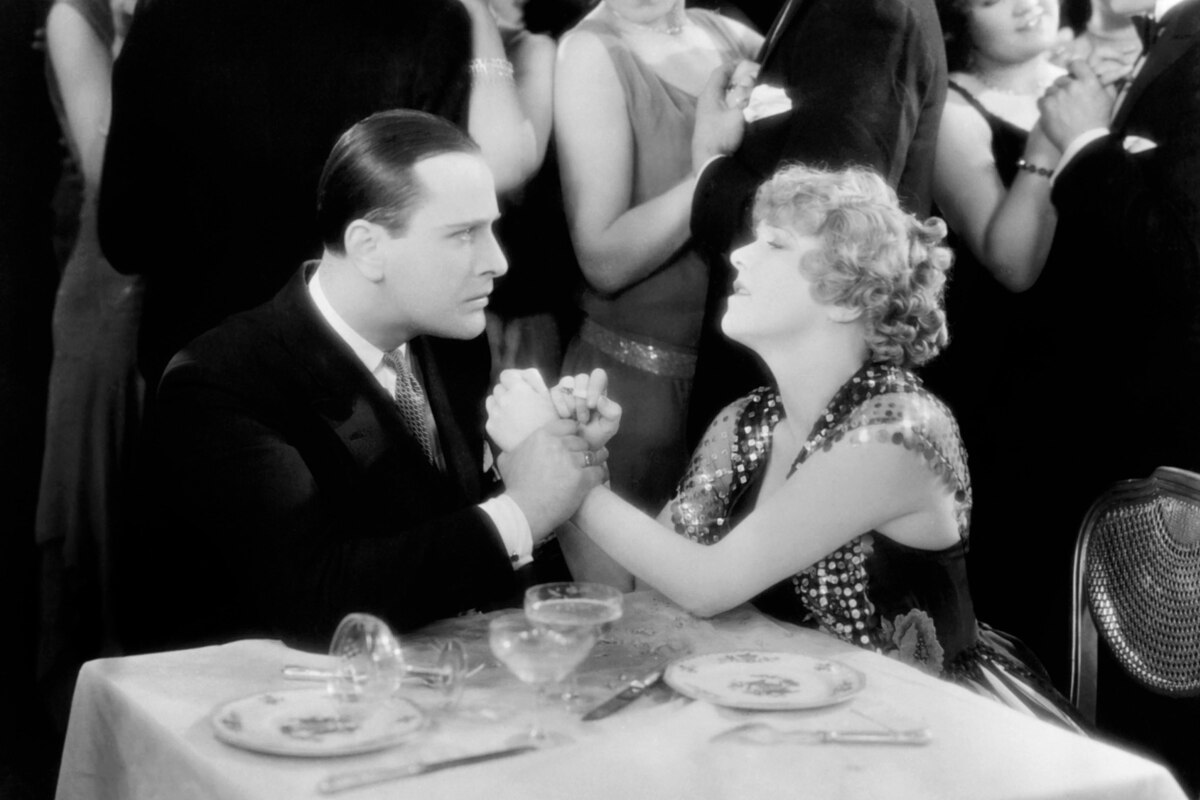
The British silent film Champagne (1928) was Alfred Hitchcock's eighth effort as a director, discounting one unfinished film and one made in collaboration with another director. Made for British International Pictures when Hitchcock was 28, Champagne was disliked by its director. He later remembered the film for its "hodge-podge of a story" and considered it "the lowest ebb of my output." But the movie, a light comedy that now seems uncharacteristic, has admirers who point out that Hitchcock's strength lay not merely in suspense but in his understanding of cinema.
Hitchcock's wit is abundantly in evidence in this story of a spoiled heiress (Betty Balfour) whose father (Gordon Harker), known as the "Champagne King," disapproves of the girl's fiancee nd is determined to teach her a lesson. He convinces his daughter that the family has met financial ruin, forcing her to take a job in a cabaret peddling the bubbly family commodity.
Some of the best directorial touches come in a sequence set on an ocean liner, where Balfour's character lands alongside in a seaplane, with her leather aviatrix outfit in stark contrast to the other female passengers' satins and pearls. A neat visual gag involves a drunk who staggers about the ship bumping into the other passengers, until a storm tosses the ship about and causes everyone to lose their balance -- except, of course, the drunk!
Champagne was made in both English and German versions. Hitchcock reportedly instructed assistant director Frank Mills to dismiss all the extras who had been hired to appear in the film, complaining that they were the same faces who had appeared in his earlier production The Farmer's Wife (also 1928). This led to a frantic search for new extras and delayed shooting for several days.
Balfour, considered Britain's most popular female star of the silent era, had turned down Hitchcock's original story for Champagne, which had her character working in a wine cellar. Harker, a successful comic actor of the period, was in his third successive appearance in a Hitchcock film, following The Ring (1927) and The Farmer's Wife. He later appeared in Hitchcock's Elstree Calling (1930).
Producer: John Maxwell
Director: Alfred Hitchcock
Screenplay: Alfred Hitchcock, Eliot Stannard, from novel by Walter C. Mycroft
Cinematography: Jack E. Cox
Set Design: Michael Powell (uncredited)
Principal Cast: Betty Balfour (Betty), Jean Bradin (The Boy), Gordon Harker (Betty's Father), Clifford Heatherley (The Manager), Jack Trevor (The Officer).
BW-86m.
by Roger Fristoe
Champagne
by Roger Fristoe | March 26, 2004
SIGN UP FOR OUR NEWSLETTERS

CONNECT WITH TCM