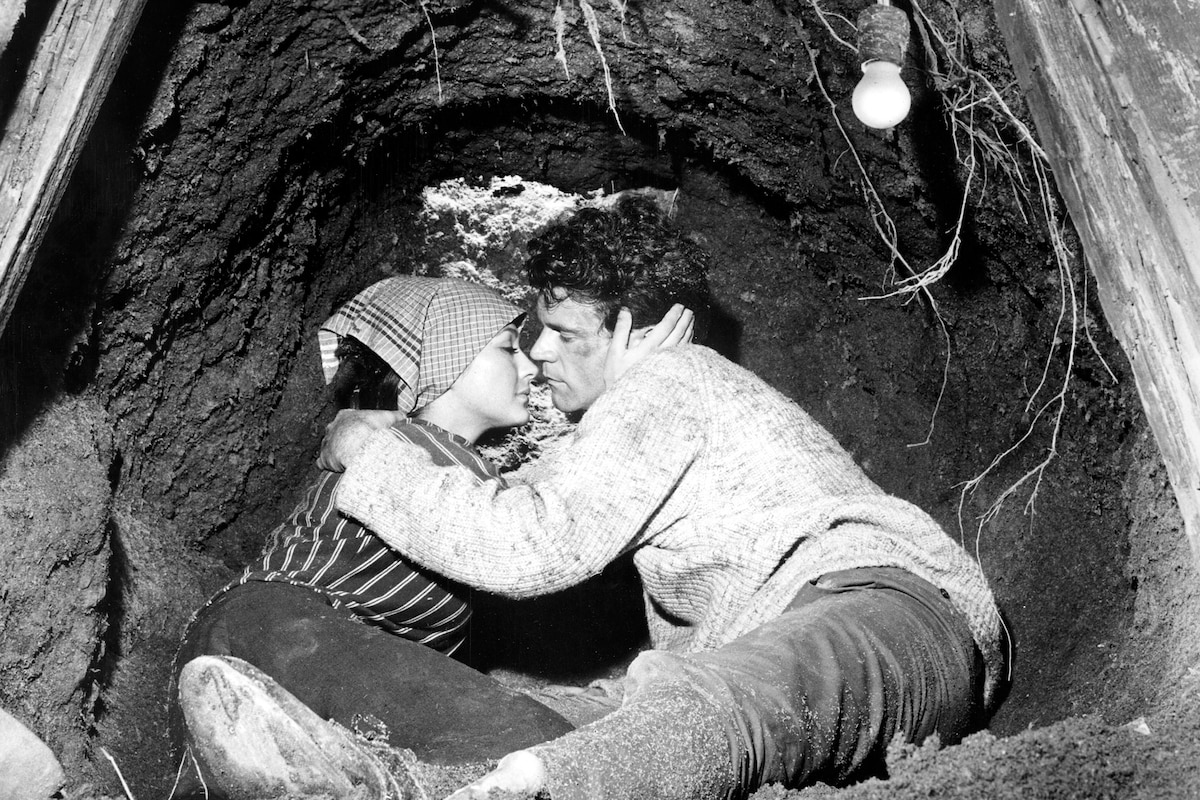
German-born director Robert Siodmak was back in his native country for Escape from East Berlin (1962), based on a true story about a group of East Germans who escape Communist rule by tunneling under the Berlin Wall. The story of the 29 escapees, led by Erwin Becker, a chauffeur in the car pool of the East German Parliament and technical adviser on this film, was still very fresh when the film went into production; the highly publicized escape had taken place in January 1962, the year of the picture's release.
Siodmak, with his German heritage and background in suspense movies, seemed a natural choice to direct, but he saw it as little more than a piece of "tedious liberalism." Never very interested in politics, he chose to focus on the suspense elements instead. But the political situation managed to overwhelm the picture anyway, not least because of an incendiary opening that compared East Germany to Hell. The propaganda aspects, however, backfired on the producers and their respective governments. Upon its release, Escape from East Berlin was met with angry denunciations, particularly in the French leftist press, which criticized the picture for its capitalist conflation of ideology and commerce. The West German press, on the other hand, slammed it for not effectively capturing what it considered the real horror of the Wall's existence. In fear of complicating an already volatile situation, then-secretary of State Dean Rusk got the NBC television network to shelve a planned broadcast of the film and the Kennedy administration cancelled a simultaneous premiere in Washington and Berlin. Siodmak later dismissed the work as "an insignificant film produced by MGM and destined for middle-class America," where, he noted, "it was a success."
Although cast primarily with German actors, the lead role of the heroic escape planner was played by American actor Don Murray. Also in the cast was a young German actress then married to Tony Curtis, Christine Kaufmann, who had turned down the title role in Stanley Kubrick's film Lolita (1962). Werner Klemperer, later famous as the flustered Colonel Klink on the TV sitcom Hogan's Heroes, played one of the escapees and was also credited with the film's casting. In Germany, the film was known as Der Tunnell.
Filming took place at the UFA-Templehof studio in West Berlin and various locations around the city including the neighborhoods of Schlesinger-Tor, Friesenstrasse and Oberbaumbrucke. Siodmak erected a 165-yard exact replica of the wall at the Tiergarten in Graf-Spee-Strasse and filmed there between May and July 1962 where many tourists mistook it for the real Berlin wall.
Siodmak made his debut as one of several directors of the famous semi-documentary Menschen am Sonntag (1930), which also launched the careers of Edgar Ulmer, Fred Zinnemann, Curt Siodmak (Robert's brother) and Billy Wilder. He fled the Nazi regime in the mid-30s, first to France and then to the U.S., where he became one of the leading stylists of film noir in such movies as The Spiral Staircase (1946), The Killers (1946) and Criss Cross (1949). In the early 1950s, Siodmak returned to Europe, where he worked for the rest of his life. Prior to Escape from East Berlin, he was trying to launch several projects, one of them a plan to direct six films with Richard Burton (none of which ever came to fruition). He briefly worked on an American-backed project about the last years of World War II based on a novel (A Season of Fear) by blacklisted director Abraham Polonsky. When that project fell through, Siodmak was hired for Escape from East Berlin inspired by events surrounding the heightening of the Cold War after the erection of the Wall in 1961. The West German government had already begun financing anti-Communist films when a group of daring East Germans made their break, and U.S. producers (encouraged by their government) were eager to capitalize on the sensational story. Despite Siodmak's low opinion of Escape from East Berlin, most critics praised the film's direction with the New York Times noting that Siodmak "charges the proceedings with a vivid visual style." Equally favorable was the Variety review which stated "the film is timely, topical and exploitable....Oddly enough, at times one tends to forget he is watching a depiction of a 1962 incident - it is almost as if the time is 1939, and the Nazis are in charge."
Director: Robert Siodmak
Producer: Walter Wood
Screenplay: Gabrielle Upton, Peter Berneis, Millard Lampell
Cinematography: Georg Krause
Editing: Maurice Wright
Art Direction: Ted Haworth, Dieter Bartels
Original Music: Hans-Martin Majewski
Cast: Don Murray (Kurt Schroder), Christine Kaufmann (Erika Jurgens), Werner Klemperer (Brunner), Ingrid van Bergen (Ingeborg Schroder), Karl Schell (Major Eckhardt).
BW-89. Letterboxed. Closed captioning.
by Rob Nixon
Escape from East Berlin
by Rob Nixon | March 24, 2004
SIGN UP FOR OUR NEWSLETTERS

CONNECT WITH TCM