Phantom Lady (1944) is a crackerjack piece of film noir that launched
European expatriate director Robert Siodmak's American career. Siodmak, who honed
his skills in Germany before fleeing the Nazis in 1938, utilized expressionistic
filmmaking techniques (with the help of cinematographer Elwood Bredell) to vastly
improve on Bernard C. Schoenfeld's pulpy script.
As the director, Siodmak deserves much of the credit for successfully
orchestrating Phantom Lady, but there really was a phantom lady behind the
scenes. Producer Joan Harrison, who broke into the film industry
under the tutelage of Alfred Hitchcock, was a fascinating character in her own
right, one of the few female producers to make her mark in the male-dominated
world of 1940s Hollywood.
In Phantom Lady, Alan Curtis plays Scott Henderson, a man who, as the film
opens, has just had a huge argument with his wife. When he heads out to a bar to
drown his sorrows, he meets a mysterious woman played by Fay Helm. The two agree
not to tell reveal their names, and spend the rest of the evening together. At one
point, they attend a floor show where the singer (Aurora Miranda, Carmen's sister)
is wearing a rather improbable hat that exactly
matches the one Helm is wearing. (Apparently, both Miranda sisters were into
ridiculous headwear.)
When he returns to his home, Henderson discovers that his wife has been strangled
with his own necktie. Unfortunately, he can't give the police an alibi, because
he doesn't know the name of the woman who was with him at the club. Eventually,
he's tried, convicted, and sentenced to death. The only
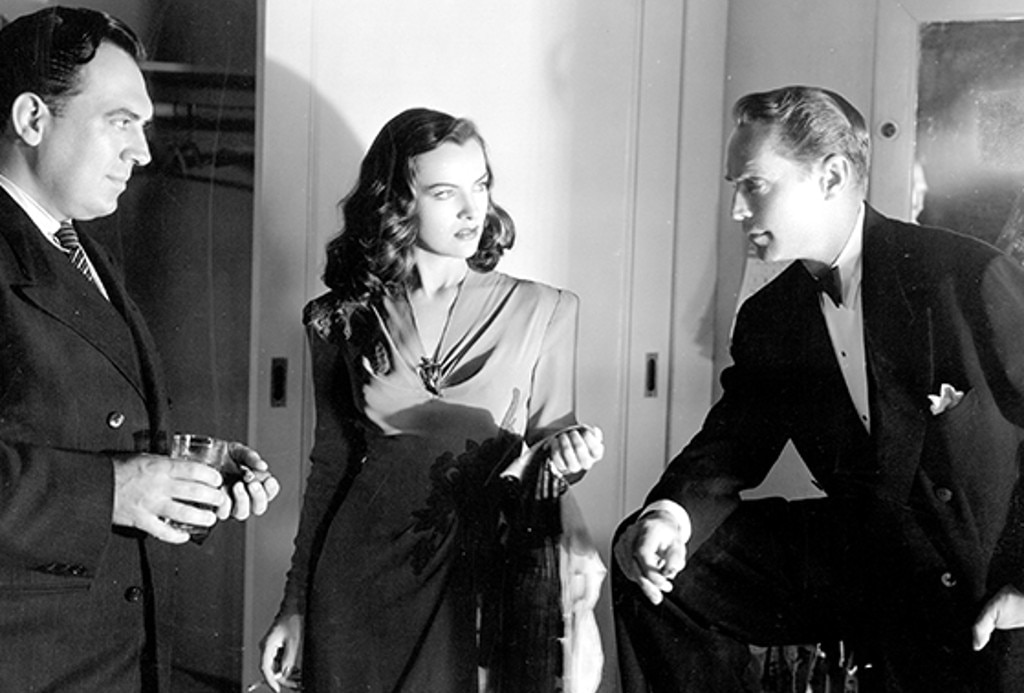
person who believes him is his longtime secretary, Carol "Kansas" Richman (Ella Raines.) "Kansas" then goes to great lengths - including, at one
point, pretending to be a prostitute - to track down the "phantom lady" and
free her boss. This all leads to some nastiness involving frame-up money
and Franchot Tone. You probably won't believe a single minute of it, but won't care because it's so well done.
Initially, Harrison seemed an unlikely candidate to end up working in movies. She
was born in Surrey, England, where her father was a prominent newspaper publisher. Brainy and determined from the beginning, she attended
Oxford University, then the Sorbonne. After graduation, much to her
well-heeled father's dismay, she became a copywriter. She then passed
through a journalism phase, and - for rather obscure reasons, given her background - started doing secretarial work. Dad must have loved that
one.
Luckily, Harrison's unexpected interest in typing and filing for a living
led to a job as Hitchcock's personal secretary. She was already a fan of
Hitch's movies, and loved crime novels, when she hooked up with him and followed him to the U.S. Eventually, she climbed the cinematic ladder and
received screenwriting credit on such films as Rebecca (1940),
Suspicion (1941), and Saboteur (1942). But she was involved in many aspects of their production, a crash course that gave her all the training she
needed to be a producer.
One day in Los Angeles, Harrison ran into Siodmak at a restaurant near the
Universal lot. The two began talking and immediately realized that they
were kindred spirits: talented, displaced Europeans who had an interest in
the underbelly of life and wanted to make movies that weren't what you
expected from the studio's well-oiled assembly line.
Breaking free of her mentor, Harrison soon talked Universal into letting her
produce a novel that she had purchased called Phantom Lady, with
Siodmak directing. This was no small accomplishment. Women seldom stood
toe-to-toe with studio executives in those days, although it probably helped that Phantom Lady seemed a great deal like a Hitchcock picture.
Hollywood likes nothing better than trying to duplicate past successes, and Harrison had a bona fide Hitchcock pedigree.
The resulting film was treated as a typical B-movie of the period by critics.
David Lardner, of The New Yorker, wrote, "There has been a tendency in
mystery movies lately to play down the detective and have the crimes solved more
by accident than by deduction. If this is meant to be realism, it is of an ill-advised sort." But that's being a spoilsport. Phantom Lady was
actually a profitable film and has grown in stature over the years. It's now rightfully viewed as one of the better film noirs of the period. Surely,
Hitchcock must have been proud of his secretary.
Producer: Joan Harrison
Director: Robert Siodmak
Screenplay: Bernard C. Schoenfeld (based on the novel by Cornell
Woolrich)
Music: H.J. Salter
Cinematography: Elwood Bredell
Editing: Arthur Hilton
Art Design: John B. Goodman and Robert Clatworthy
Set Design: Russell A. Gausman and Leigh Smith
Costumes: Vera West and Kenneth Hopkins
Principal Cast: Franchot Tone (Jack Marlow), Ella Raines (Carol "Kansas" Richman),
Alan Curtis (Scott Henderson), Aurora Miranda (Estella Monteiro),
Thomas Gomez (Inspector Burgess), Fay Helm (Ann Terry), Elisha Cook, Jr. (Cliff March), Regis Toomey (Detective), Joseph Crehan (Detective).
B&W-87m. Closed captioning.
by Paul Tatara
Phantom Lady
by Paul Tatara | March 24, 2004
SIGN UP FOR OUR NEWSLETTERS

CONNECT WITH TCM