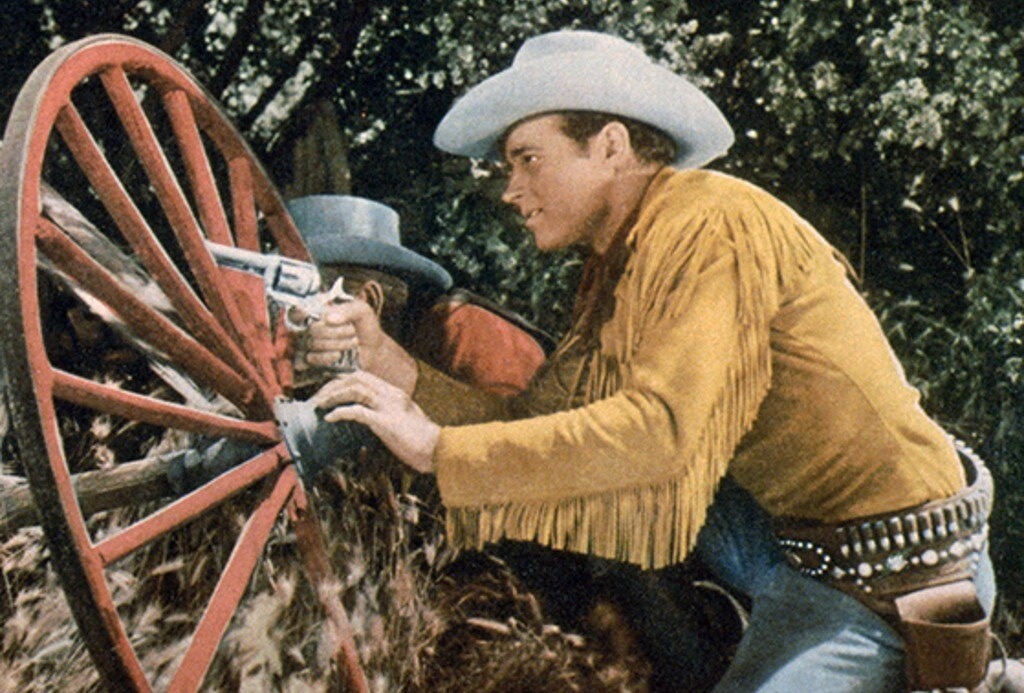
A prototypical B western from the '50s, heavy on social tension and moral ambiguity but made as cheaply as possible, Outlaw's Son (1957) offers the opportunity to eyeball the strange postwar Hollywood experience of Dane Clark. Born Bernard Zanville to Jewish immigrants in Brooklyn, Clark began as a brash New Yawk punk version of himself in wartime combat-propaganda ensembles like Action in the North Atlantic (1943) and Destination Tokyo (1943), and immediately he was pegged as a kind of next-generation Bogart and Garfield, a persona of intense gazes, working-class toughness and short-fuse volatility. This was a classic strain in Hollywood at the time, especially at Warner, where pugnacious urban-immigrant personalities like James Cagney and Edward G. Robinson galvanized moviemaking in the first days of early talkies. Clark was right up Warner's alley, and he prospered on the B list, and then in the postwar years was so busy in television and independently-made genre fodder that he never found the chance to work on a truly memorable movie. (Frank Borzage's odd Moonrise, from 1948, is the closest Clark ever came.)
This seems all the stranger once you look at his filmography - though his wary, streetwise Brooklyn personality might suggest a range of possibilities, and a number of noirs did occupy him in the late '40s, Clark made a lot of westerns in the '50s. Cagney and Bogart did their fair share of oaters, too, since the genre was for decades a reliable audience favorite and relatively inexpensive to produce. But the transposition of urban-bred East-coast-neighborhood ethnic men into the frontier paradigm of the western always clanged with a surreal dissonance, or at best required viewers to simply buy the apparent cultural anomaly and move on.
Clark came off in his prime as a kind of proto-Cassavetes, a shifty-eyed street lug in permanent, if private, disagreement with the world. With his lipless mouth pinched in contained rage, his fists always nearly clenched, and his emotional state seemingly always close to maddened tears, Clark could be a hypnotic character. (He always looked guilty of something.) In Outlaw's Son, as in his other westerns, Clark's simmering persona is the pivot upon which the story turns, as he plays the titular frontier crook returned to his son Jeff that he had had to abandon 12 years earlier. Now mothered by his dead wife's sister (a scene-owning Ellen Drew), the boy (Joseph Stafford, who's tiny career ended right here) is at first bitter, but then loves having his deadbeat bank-robber dad back, much to the chagrin of Drew's anxious matriarch and the rest of the rather small town. The story, based on a novel by forgotten western novelist Clifton Adams, ropes in a sudden bank robbery for which Clark's yearning outlaw dad is framed (he escapes anyway), and then leaps forward a decade, focusing on the now-grown Jeff (Ben Cooper), who's a rookie lawman given to beating prisoners and toying with the local womenfolk. (Lori Nelson, as a flirtatious ranch maiden, is as beguiling as Cooper is drippy.) Eventually, news of his father's unjust arrest is delivered from a dying stagecoach hijacker's lips, and Jeff spirals out toward a life of crime, forcing his errant father's return.
Fueled by paternal angst in ways that speak volumes about the difference between Hollywood pop culture before WWII and after (come the '50s, everyone was used to plot stakes being much higher than Roy Rogers had ever allowed), Outlaw's Son shows the influence of George Stevens' Shane (1953), but it also radiates the concern for internal combustion and acting realism that permeated the culture, epitomized by "the Method" style of performing exemplified by Marlon Brando, Montgomery Clift and James Dean. The film's narrative is nothing if not "modern" and unmythical in its depiction of family conflicts and frontier machismo, but having Clark stand, brooding and suspicious and seething with memories, at the center of a visually standard genre milieu (the town and its rooms look recycled from a thousand other films and TV shows) naturally pushes the tired old genre reflexes beyond their clichés, and toward the kind of exposed psychodrama that dominated American culture at the time, crystallized in various media by the work of Brando, Cassavetes, Tennessee Williams, Elia Kazan, Sidney Lumet, Joanne Woodward, Edward Albee, Saul Bellow, and others.
Outlaw's Son doesn't shine in the memory, but it's stratigraphic proof of the rise of sophistication and realist ambition in mid-century Hollywood. The contents-under-pressure presence of Clark is part of that story, and also its own illusory dynamic. Clark, it turns out, was hardly a demiurge toiling on Skid Row, but just an unpretentious journeyman (with a law degree) whose resonant screen profile does not reflect the man terribly well. He did, after all, thrive for decades thereafter doing over a hundred workaday spot roles on many dozens of TV series, for everything from The Twilight Zone to Murder, She Wrote, and nowhere did a tortured artist or a conflicted man emerge. Often enough, movies present their own unique vision of individual humans, and the actor we think we know we do not know at all. Initially, Clark appeared to us as the inheritor of the John Garfield intense rebel prototype, but only after many films and TV episodes, it became apparent that he was just a capable character actor blessed with a quick look and tongue, and a reasonably happy man.
By Michael Atkinson
Click here to visit the TCM shop if you would like to
purchase this DVD.
Outlaw's Son
by Michael Atkinson | October 22, 2013
SIGN UP FOR OUR NEWSLETTERS

CONNECT WITH TCM