Director Martin Scorsese has never been especially fond of his feature debut, Who's That Knocking At My Door (1967). Made over a period of four years when Scorsese was in his early twenties, and shown under various titles and in different versions, Scorsese later said the final version is "still a rough sketch to me." For audiences, however, the movie stands as an accomplished, micro-budgeted, independent feature and a fascinating first glimpse of what was still to come from this modern master filmmaker.
Who's That Knocking sprang from a student film made by Scorsese at New York University in 1965, Bring on the Dancing Girls. This he expanded into a feature entitled I Call First, which played at the 1967 Chicago International Film Festival. To get commercial distribution, Scorsese then had to add a nude scene, which he did in 1968. After some reediting, the final product was released in 1969 as Who's That Knocking At My Door, though a re-release in the early 1970s came under yet another title, J.R.
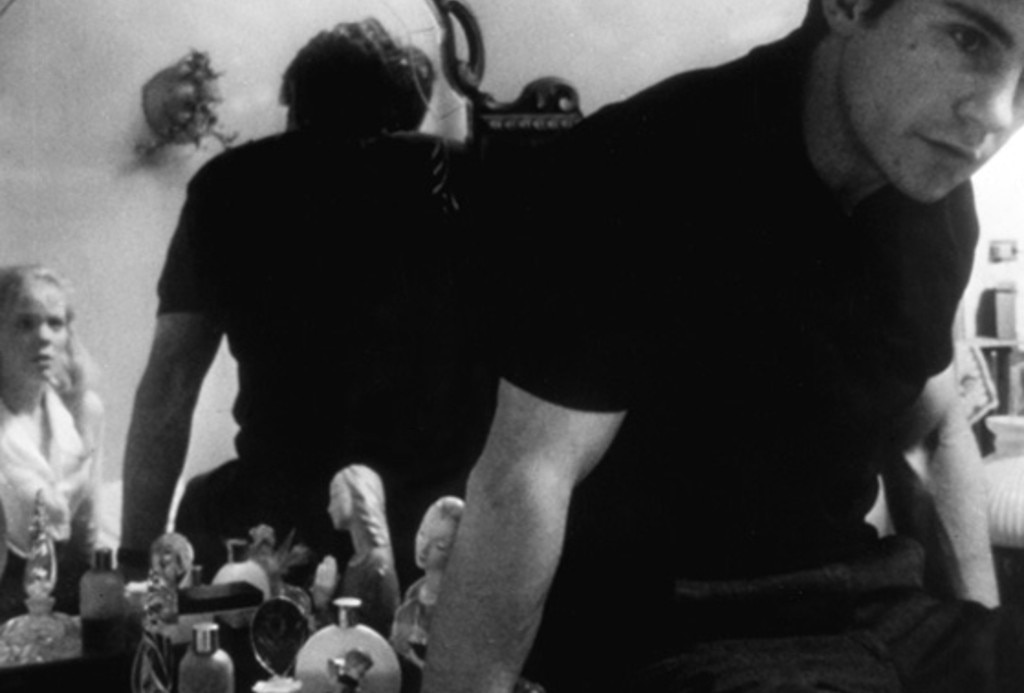
The film, which was also written by Scorsese, is the story of a young, Italian-American New Yorker (Harvey Keitel) who finds himself unable to accept the knowledge that his girlfriend -- and intended bride -- was previously raped. The setting, characters, and theme (Catholic guilt), all of which Scorsese would go on to explore throughout his career, are on display here in his first feature.
Also on display are filmmaking techniques that would become part of his signature style, such as a fluid, probing camera, excellent use of popular music, scenes of actor improvisation, and powerful integration of slow-motion -- all on a small, simple scale, but there nonetheless. Shot on black-and-white in both 35mm and 16mm, Who's That Knocking had a final cost of about $35,000.
In a 1975 interview, Scorsese explained that he wasn't satisfied with the film because it took so many years to make: "[It] was done over such a long period of time that there's no transition between scenes. You have no idea where people are. The only thread of it is the characterization. It was very heavily influenced by the New Wave movies and all the jump cuts and that kind of stuff. Mainly the jump cuts because we had no time to shoot establishing shots."
Sixteen years later, he hadn't changed his assessment, remarking in 1991 that he never clearly established the story's central conflict, which he described as "being in love with a girl who is an outsider, loving her so much that you respect her and you won't make love to her. Then he finds out she's not a virgin and he can't accept that. It's that whole Italian-American way of thinking, of feeling.... I never got [the film] right, except for the emotional aspects of it -- I got that."
Scorsese also related the genesis of the film's sex scene. The only distributor he could find who was willing to take on the film was a man named Joe Brenner, "a sex film distributor," and his one condition was the inclusion of a nude scene. Scorsese complied, and devised a sequence of Keitel cavorting with prostitutes. He shot the scene in Holland, where he was already directing some commercials. "We flew Harvey over," Scorsese said, "and we got the young ladies there and we did this nude scene. I came back, kind of smuggled it back into the country in my raincoat, put it in the middle of the film and then the film was released."
Who's That Knocking was Harvey Keitel's film debut. He would go on to work with Scorsese on four more features (as of 2013). Scorsese later related the amusing tale of their first meeting. Keitel answered an ad that Scorsese had placed in a trade paper for actors to come audition for his student film (as Who's That Knocking then was). "I didn't tell him this," said Scorsese, "but I had a friend of mine who was a comedian, Bill Minkin,...sit behind a desk. And Harvey walked in. Bill says, 'What are you doing here?' Harvey says, 'I came to answer an ad.' 'What ad?' Bill says, 'there's no ad. We didn't take out any ad. Who the hell are you?' And they got into a big argument. I thought it was great! That was the audition I set up, but I neglected to tell Harvey. And Harvey got so mad at me. But I said, 'You're wonderful!' He was a court stenographer at the time. And it was a big problem for him sometimes to get free to work with us."
Keitel later recalled, "We made the film for an entire winter on weekends, because we had to earn money weekdays to buy food and pay the rent. After I saw the first rushes, the scene inside the church, where the song 'Who's That Knocking At My Door' is played, I knew that I was with somebody special... Marty and I had a very similar sense of humor, and we seemed to possess a similar common denominator -- a certain truth, a need to express what we saw. I had a sense of his intensity, and I think we saw each other as being brothers of a kind, belonging to some secret society which I haven't got a name for....
"The best directors know how to provide an environment in which you can nourish, develop, become the character. They'll shape the play, the movie, through and around what you do, as opposed to imposing the character on you. I've been lucky. Scorsese was one who allowed that growth, that development, that nourishment. Marty is a comrade."
Even more significant than Keitel's involvement here was that of film editor Thelma Schoonmaker, also working with Scorsese for the very first time. She has since gone on to cut almost every film he has ever directed, racking up seven Oscar nominations in the process, and winning three times. Schoonmaker has said that she was immediately struck by Scorsese's artistic powers and strong ambition: "Marty has a very strong editing sense. He creates a great deal of what goes in his movies in the editing room, so we work very, very closely together. He's involved in every decision. Some directors don't work that way, but Marty does. I had seen a spark in his student films. Of course, they were smaller, and Who's That Knocking had problems, but the brilliance in certain scenes was stunning... The use of music, the imagery, the powerful combination of music and image, which he's continued to excel in, were fantastic.
"My memory of the film is of working terrible hours. We worked until two, three in the morning, on Eighty-sixth Street on the Upper West Side. I thought nothing of walking home at the most incredible hours. Marty was still getting up late and coming in late, and wanting to work very late... He was so driven... He just wanted to get there, he wanted to get to the place where he could make the films he wanted to make. He had much more drive and focus than any of the other people I met at NYU. Marty was burning up with wanting to get there."
Critics took immediate notice of Scorsese's fresh talent. The New York Times' influential film critic Vincent Canby declared, "Scorsese, who is 25 years old and won a number of festival prizes for shorts made while he was a student at New York University, is obviously a competent young filmmaker. Working on what must have been a miniscule budget, he has composed a fluid, technically proficient movie, more intense and sincere than most commercial releases."
Roger Ebert was an even earlier champion of this film, offering a rave when it screened in Chicago as I Call First. Later, Ebert gave another appraisal, calling the final product "a cohesive, affecting work, an evocation of the self-torture of a hero who cannot reconcile his lusts and his guilts. It is remarkable that Scorsese, in the first half of his twenties, was already so clear about the themes and characters that fascinated him."
By Jeremy Arnold
Sources:
Peter Brunette, editor, Martin Scorsese Interviews
Roger Ebert, Scorsese by Ebert
Marshall Fine, Harvey Keitel: The Art of Darkness
Pete Hamill, April 1986 Vanity Fair article
Mary Pat Kelly, Martin Scorsese: A Journey
Ben Nyce, Scorsese Up Close
Richard Schickel, Conversations With Scorsese
Who's That Knocking at My Door
by Jeremy Arnold | October 16, 2013
SIGN UP FOR OUR NEWSLETTERS

CONNECT WITH TCM