David O. Selznick's 1957 remake of Ernest Hemingway's A Farewell to Arms came about, oddly enough, because of Warner Bros.' plans to produce another remake, the 1954 A Star Is Born, starring Judy Garland. Selznick retained certain rights to that property after producing the original with Janet Gaynor in 1937, and proposed to studio head Jack Warner that they exchange rights for the two movies. Selznick, always on the lookout for projects to star his wife, Oscar-winning actress Jennifer Jones, envisioned A Farewell to Arms as a perfect vehicle for her. Warner had acquired the rights to the Hemingway story from Paramount after that studio had released a highly admired film version in 1933 starring Gary Cooper and Helen Hayes. Warner, who had produced an unofficial semi-remake called Force of Arms in 1951, agreed to the offer with the proviso that Selznick pay an additional $25,000 for the rights to A Farwell to Arms. Selznick happily complied, since he considered the novel to be one of American literature's great romances and an opportunity for him to replicate the success of such Selznick epics as Gone With the Wind (1939) and Duel in the Sun (1946).
Selznick had closed his own studio, Selznick International Pictures, in the early 1940s, so he struck a deal with 20th Century Fox to finance and distribute A Farewell to Arms. He asked celebrated screenwriter Ben Hecht to join him in creating a script from Hemingway's story of a tragic love affair during World War I, and hired John Huston to direct. From the outset Selznick's friends advised him against the project. Another illustrious producer, Sam Goldwyn, told him, "It's a mistake to remake a great picture because you can never make it better." Ray Klune, a production designer, cautioned about working with the equally volatile and willful Huston because "You'll kill each other. It's the old law of physics about an immovable object and an irresistible force."
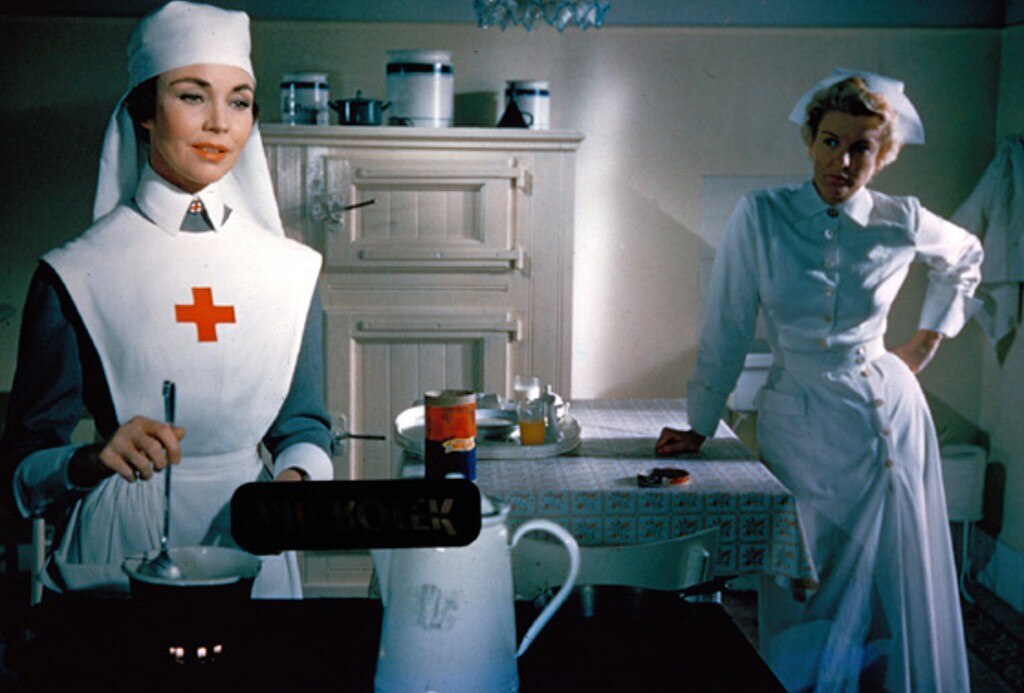
But Selznick forged ahead, immersing himself as usual in every detail of production including casting. He borrowed Rock Hudson from Universal Studios to play Lt. Frederick Henry, an American serving with Italian forces who falls in love with British Red Cross nurse Catherine Barkley (Jones). Then at the peak of his career after playing the lead in George Stevens' Giant (1956), Hudson had also been offered in the leads in two other high-profile films of the time, MGM's Ben-Hur (1959) and Sayonara (1957). To appear in Ben-Hur Hudson would have had to sign a three-year extension of his contract with his home studio. After nixing that deal, he chose A Farewell to Arms over Sayonara because, he said, all the elements "smelled right." In addition to Selznick, Huston and Jones, there was an outstanding supporting cast that included Vittorio De Sica, Mercedes McCambridge, Elaine Stritch, Oskar Homolka and Kurt Kasznar. After A Farewell to Arms failed to achieve the critical and financial success of the other two films, Hudson called this choice of role "the biggest mistake of my career."
The film was shot on location in Italian locations including Rome, Venzone, Lazio and the Italian Alps. Selznick arrived in Rome to take charge of the film in early 1957 and, in characteristic style, began firing off voluminous memos to everyone involved. Hudson recalled that even his prominent Adam's apple was a source of concern for Selznick, who gave him detailed instructions for minimizing it with makeup. The cameraman received a 20-page memo about photographing Jones to best advantage. One memo sent by telegram from Northern Italy was so lengthy that it cost Selznick $750.
As predicted, Selznick began clashing with Huston on a variety of matters, some as trivial as the style of Hudson's haircut, others as major as the degree of fidelity to Hemingway's original story. (Huston considered that Selznick was taking too many liberties in putting the film's focus on Jones.) In mid-March Selznick fired off a memo to Huston -- one of hundreds -- demanding that the director defer to his producer on all major decisions regarding the film's content and style. This particular one sent Huston over the edge, and he resigned, leading Selznick to issue a widely quoted remark: "I asked for a first violinist and got a soloist." Ben Hecht put it another way: "It was the case of two Caesars and one Alp."
Charles Vidor, a director accustomed to domineering producers after years at Columbia under studio head Harry Cohn, was hired to replace Huston. Even Vidor found Selznick's demands overwhelming, complaining that what he really wanted was not a first violinist but "a piccolo player." As filming wore on through the hot Italian summer and into the fall, tempers grew increasingly frayed. During the shooting of a sequence on Lake Maggiore where the two lovers are in a rowboat attempting to elude a German patrol boat, production manager Arthur Fellows dared to question Selznick's unreasonable demands. Selznick slapped him hard across the face, and Fellows returned the blow, breaking Selznick's glasses, cutting his face and making his eyes bleed. Jones tried to join the fray, and the three had to be subdued by crew members. Needless to say, Fellows departed the production immediately.
A Farewell to Arms opened in New York in December 1957 to mostly negative reviews that described it as "old-fashioned" and "overproduced." In his review in The New York Times, Bosley Crowther wrote that the film "lacks that all-important awareness of the inescapable presence and pressure of war. That key support to the structure of the theme has been largely removed by Ben Hecht's script and by a clear elimination of subtle overtones." Crowther went on to note that both Jones and Hudson seemed miscast. Viewed today, the film seems, if nothing else, a handsome and imposing example of old-style moviemaking, with the two stars generating a measure of sympathy for their characters. De Sica, Oscar-nominated as Best Supporting Actor, shines as Major Rinaldi, Hudson's charming Italian friend who has a breakdown after experiencing the horrors of war.
Hemingway himself offered the opinion that "the 41-year-old Mrs. Selznick" looked too mature for his 24-year-old heroine. (Jones was actually 38 at the time of filming.) Although Hemingway had long ago signed away the rights to his novel, Selznick made the gesture of offering him $50,000 from the film's anticipated profits. In response, Hemingway, who had never liked Selznick, commented that it would be "a miracle" if the movie made any money, then offered an obscene suggestion as to what Selznick could do with the proposed payment after converting it into nickels. As it turned out, Selznick did not recover his costs, and Fox made only a small profit. The film, which had cost well over $4 million to make, earned an estimated $5 million in North American rentals upon its original release, with worldwide rentals of $6.9 million. It would be the last film personally produced by Selznick.
By Roger Fristoe
Source: Selznick by Bob Thomas, Doubleday & Company, Inc., 1970
A Farewell to Arms (1957)
by Roger Fristoe | October 16, 2013
SIGN UP FOR OUR NEWSLETTERS

CONNECT WITH TCM