You don't have to be a film critic to map the holes in Let's Rock (1958), starting with the title. It's not about rock, it's about Julius La Rosa's singer of lush ballads from the pre-rock era fearing he won't be able to switch to the new style in the face of commercial pressures brought about by ongoing career slippage. It's accelerated by economics -- his studio sessions require 48 string players, while the new rockers cost far less with their instrumental quartets and four backup singers. But your instinct is to not stomp Let's Rock. It would be like walking into a day care center and kicking a toddler. Let's Rock is a surprisingly disarming and, above all, an endearingly innocent film. And it is timely, given that its real subject is looming unemployment.
Just don't look for anything like Elvis Presley's sullen pout and sexy gyrations in Jailhouse Rock (1957) or Jerry Lee Lewis pounding a piano from the bed of a flatbed truck in High School Confidential! (1958). This film subsists mainly on a diet of white bread, although one of its likable elements is its unforced inclusion of African-American talent and its honest acknowledgment of rock's black antecedents. Phyllis Newman's songwriter girlfriend to La Rosa's singer, Tommy Adane, is a smart cookie. She's switching styles to stay current, and doesn't see why he can't. It's not that he's afraid to try, as she laments. It's that he knows it isn't him, that he couldn't do it from the heart and that the result would be hollow and empty.
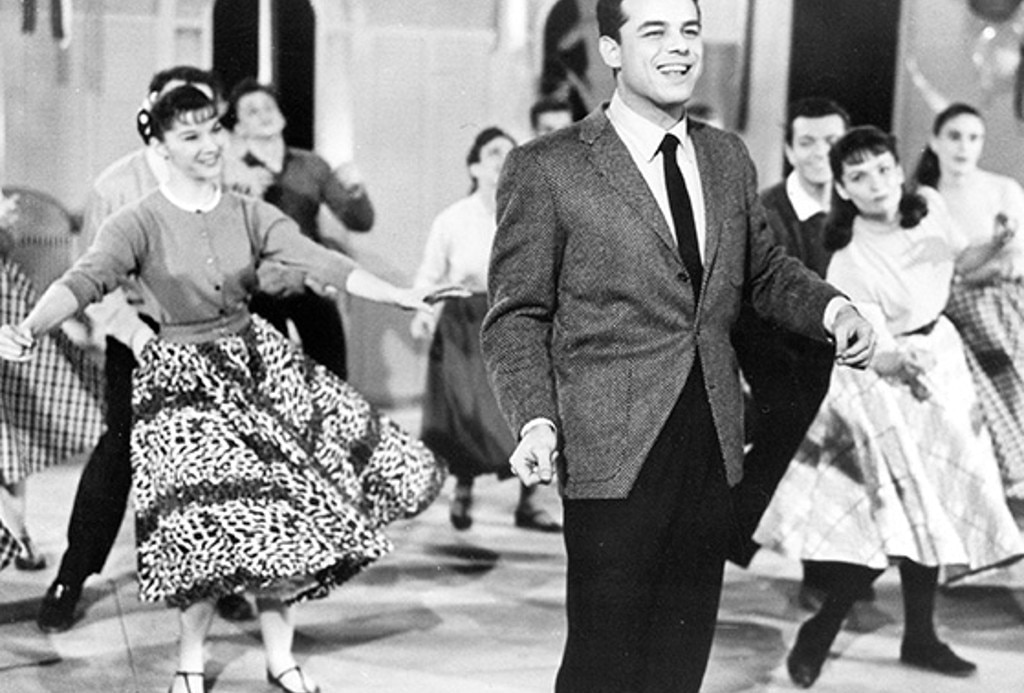
A neatly-written scene tells the story better than any of the dialogue, when he points out to Newman four black school kids improvising rock dance steps as they circle Central Park's lake. He could never do it with their naturalness, he tries to explain. But no go. After a lot of back and forth, he capitulates at the end, threatened with cancellation of his record deal. On a variety show featuring Dick Clark-like host Wink Martindale, he and a dance ensemble perform a number called Crazy, Crazy Party. Crazy is the one thing it is not. It's staged on an upper middle-class suburban living room set in which not a drop of lemonade is spilled nor a single paper cup tipped over.
Of course, it didn't quite go down that way in real life, as audiences knew. For years Brooklyn-born La Rosa was famous for being fired on air by powerful variety show host Arthur Godfrey for lacking "humility." At the time, some said it was because La Rosa was getting more fan mail than Godfrey and because La Rosa wiggled out from under Godfrey's thumb, signed his own record deal and promptly recorded the biggest single of his career, Eh Cumpari. Godfrey's big variety host rival, Ed Sullivan, promptly invited La Rosa to his show for multiple appearances, while Godfrey's bile undermined his folksy image and sent his career into decline. Nobody liked seeing Goliath trample David.
It helped that La Rosa projected an easy amiability and never responded to Godfrey in kind. He never took a career run at his idol Frank Sinatra (who did?). But he was an honest, full-throated singer who brought emotional conviction to his ballads. He has enjoyed a long career (although not in feature films - this was his only one) as a TV actor, disc jockey and mostly singer. His persona doesn't just count for a lot in Let's Rock. It keeps the film on life support. Certainly none of the dozen songs do (La Rosa sings four - one a duet with Newman), although the professionalism of Paul Anka, Roy Hamilton and especially Della Reese in a generic number called Lonelytown are distinct assets.
Hamilton, more recalling Johnny Mathis than James Brown, died of tuberculosis, aged 40. There's no telling where his honeyed tones might have risen on the rising tide of rock, after enjoying huge hits with You'll Never Walk Alone and Unchained Melody. More than any of the others, Hamilton's instrumental backing by The Tyrones also reminds us that before the guitar dominated rock, a lot of it pushed off from saxophones, underscoring jazz's contribution to the emerging form. The supporting slots also include Danny & The Juniors performing At the Hop and The Royal Teens with their sassy Short Shorts. Ironically, Conrad Janis, who never goes near an instrument in his role as Tommy's agent and Brill Building denizen, long had been a professional real-life jazz trombonist. Despite its reminder in a barroom pickup scene that bullet bras did far more damage than '50s rock, the film remains a sweet little preserved-in-amber artifact.
It's plain, straightforward and unpretentious, and while it may be argued that Let's Rock has a lot to be unpretentious about, it also is kept alive by an emotional honesty at its core. Most films starring luminaries from another medium are tailored to the stars' public personae. This one makes contact with the career anxieties dogging La Rosa and other balladeers at the time. When he sits on the stoop of Newman's apartment house, in his ever-present raincoat, agonizing over what lies ahead, not wanting to fire the hangers-on from his payroll or give up his $1000-a-month penthouse apartment (those were the days!), you know the convivial crooner didn't have to take acting lessons to find the scene's dramatic engine. In later years, La Rosa could look back upon a quite durable career and say, "We didn't have to contend with rock 'n' roll back then, and when it came, I still didn't have to contend with it." But he couldn't say it for sure in 1958.
By Jay Carr
Let's Rock
by Jay Carr | October 10, 2013
SIGN UP FOR OUR NEWSLETTERS

CONNECT WITH TCM