Charles Dickens' novella A Christmas Carol is one of the most familiar and beloved stories in the English language. The tale of a greedy old miser who barks out "Bah, humbug!" in response to holiday greetings and grumbles at giving his employee Christmas Day off continues the author's interest in the plight of the poor and the welfare of children in the time of the industrial revolution in 19th century England and celebrates generosity as the answer to misery. The story, first published in December of 1843, was an instant success, popularizing traditions such as the Christmas Tree and the singing of carols and turning the name Scrooge into a descriptive term for the uncaring and miserly. The book has never been out of print and has been the basis for film adaptations almost as long as films have been made; the first short film version was made in 1901, the most recent big screen incarnation was Robert Zemeckis' lavish 2009 version, utilizing motion capture to create a dizzying animated incarnation with Jim Carrey playing Scrooge and all three ghosts.
The 1970 Scrooge was not the first film to take the name of the story's protagonist but it was the first musical version on the big screen (following a couple of original TV musical versions) and the first in color. It is also a thoroughly British picture, from cast to crew to production. Victorian England is recreated on the biggest stage at Shepperton Studios, covered in fireman's foam and Epsom salts to simulate snow and filled with cheery faces and dancing choruses in bright, colorful winter costumes. The screenplay and original music is by Leslie Bricusse, a Tony and Oscar nominated composer, lyricist, and writer (and an Oscar winner for the song "Talk to the Animals" from Doctor Dolittle, 1967). Cinematographer Oswald Morris, a regular John Huston collaborator, had also shot such British films as Look Back in Anger (1959), The Spy Who Came in the from the Cold (1965), and Oliver! (1968), another big, bright, musical adaptation of a Dickens classic.
Director Ronald Neame was the very model of the British film professional, earning his directing stripes by working his way up through the ranks of the British film industry. He began as an assistant cameraman on Alfred Hitchcock's Blackmail (1929) and shot dozens of low budget films in the thirties before teaming up with David Lean. He was cinematographer and co-screenwriter on a quartet of Noel Coward adaptations directed by Lean, beginning with In Which We Serve (1942), and producer and co-writer of Lean's two Dickens pictures, Great Expectations (1946) and Oliver Twist (1948). Those credentials led to the director's chair, where he helmed such films as The Horse's Mouth (1958) with Alec Guinness, the lighthearted caper Gambit (1966), and The Prime of Miss Jean Brodie (1969).
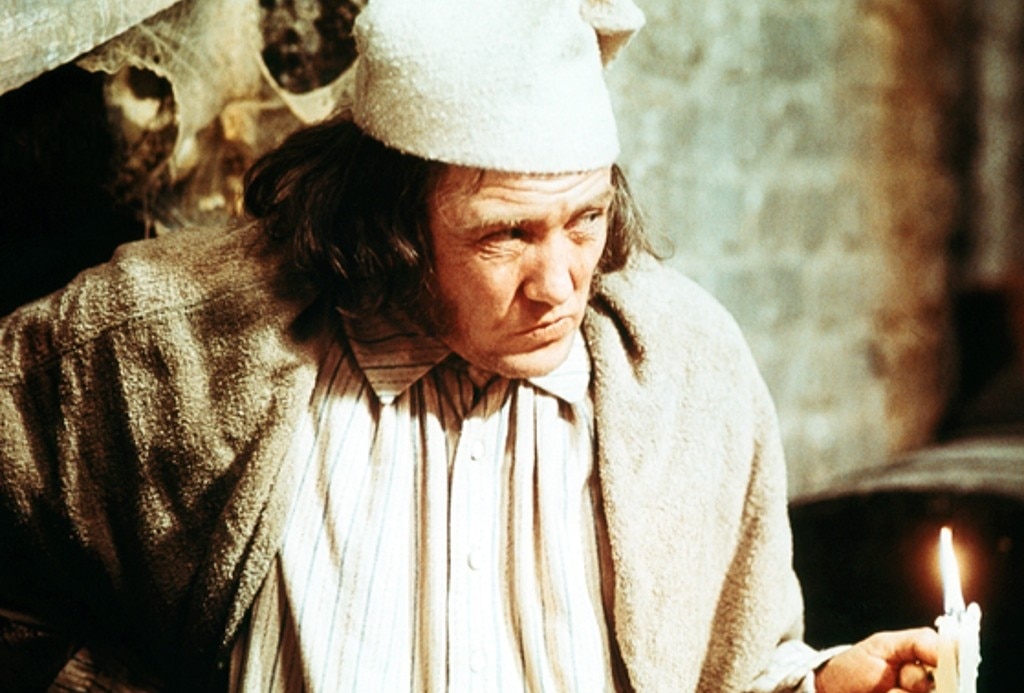
Albert Finney stars in the title role, a part he originally turned down. The offer went to Richard Harris, a screen musical veteran thanks to Camelot (1967), who dropped when production on a film dragged on, and then Rex Harrison (whose musical credentials are courtesy of My Fair Lady (1964) and Doctor Dolittle), who had to back out due to a stage commitment. Finney snatched up the role when it became available again. He was only 34 years old at the time and played the part with gray whiskers, layers of old age make-up, and a stooped, creaky manner, but he looked positively fresh as his younger, happier incarnation in the "Christmas Past" sequence, which required far less make-up. Oddly enough, Finney was actually younger than the actor who played his nephew Fred, the 46-year-old Michael Medwin.
Finney was no singer and his performances shifted between talking the lyrics and then slipping into song. "The transition wasn't apparent," insisted Neame. "His voice was pitched so that when he went into melody, it was as if it hadn't happened." Most of the songs were lip-synched to pre-recorded playback but Finney insisted in performing his final number, which begins when he wakes up after the final ghost and a nightmarish descent into hell (one of the film's few liberties with the original story). He was outfitted with an earpiece that channeled in live piano accompaniment and he performed the number in a single, unbroken take.
The ghost of Jacob Marley, Scrooge's old partner, is none other than Alec Guinness under a gray pallor. "I didn't want to do Scrooge but Ronnie can be very persuasive," recalled Guinness. The small but essential role called for the actor to be suspended in a harness for scenes with his character flying through the air with other translucent spirits. It turned out to be more of an ordeal than the 56-year-old actor had anticipated and he suffered a double-hernia that required surgery, which Neame only learned of later. The actor never complained on set.
The production took some liberties with the Ghost of Christmas Past, casting Edith Evans in the role and making her a refined, dignified chaperone through his past. Kenneth More played Christmas Present as a jolly figure bedecked in jewels and a big, heavy cloak. Christmas to Come was played by the film's choreographer, Paddy Stone, covered ominously in a shroud that fell back to reveal a skeleton underneath, like something out of a Hammer film (or a medical school classroom).
Scrooge received four Oscar nominations (for Art Direction, Costume Design, Original Score and the original song "Thank You Very Much"), the first adaptation to be nominated and still the only feature version so honored (the animated short film Mickey's Christmas Carol received one nomination as well), and Finney won the Golden Globe for Best Actor in a Musical or Comedy. In 1992, Bricusse adapted his work for a stage musical, with his former collaborator Anthony Newley in the lead role of Scrooge.
By Sean Axmaker
Sources:
Straight from the Horse's Mouth: Ronald Neame, an Autobiography, Ronald Neame and Barbara Roisnam Cooper. Scarecrow Press, 2003.
A Cut Above: 50 Film Directors Talk About Their Craft, Michael Singer. Lone Eagle, 1988.
IMDb
Scrooge (1970) - Scrooge
by Sean Axmaker | October 10, 2013
SIGN UP FOR OUR NEWSLETTERS

CONNECT WITH TCM