Blonde Venus, the fifth of seven collaborations between Josef von Sternberg and Marlene Dietrich, wasn't particularly successful with the public when it opened in 1932, and the critics didn't care for it much, either. New York Times's Mordaunt Hall called it "a muddled, unimaginative and generally hapless piece of work," though he did have some nice things to say about its star: "There are good portraits of Miss Dietrich, who sings two or three songs."
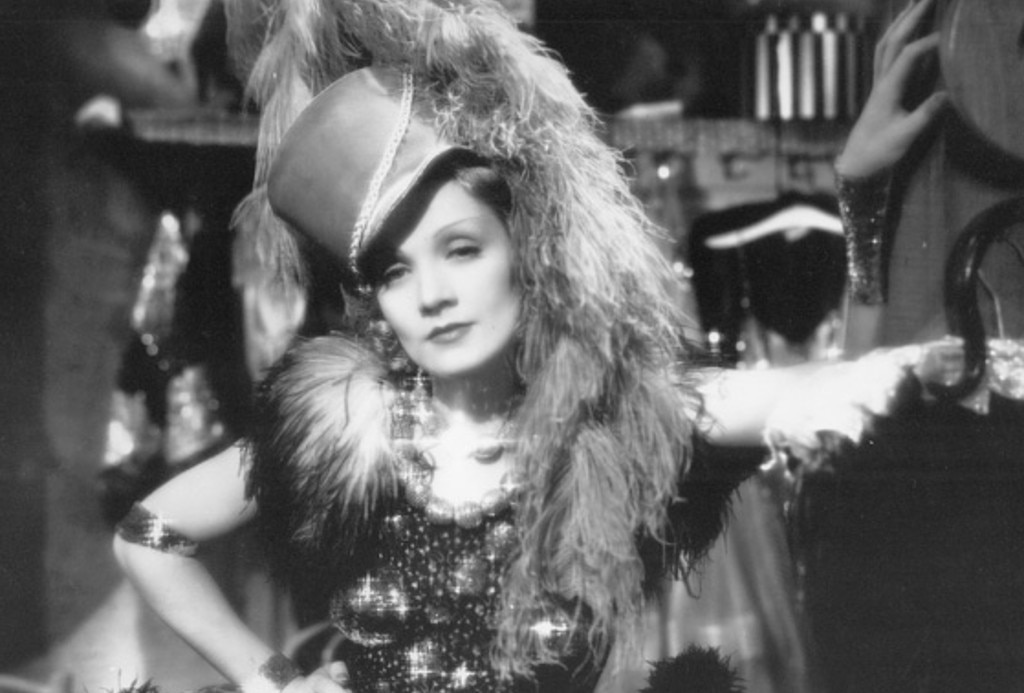
But wait: Hall spends most of his review decrying the melodramatic and convoluted plot, complaining that he can't sympathize with any of the characters, and noting that Cary Grant, a newcomer at the time, deserves a much better role than the small one Sternberg cast him in. Only then does he get around to mentioning Dietrich's "two or three songs" (there are in fact three). And even then, he fails to mention that one of these numbers involves Dietrich's stepping onto a nightclub stage dressed in a gorilla suit. After cavorting with a chorus line of scantily clad native cuties, she removes the gorilla mask, tops her smoothed-back hair with an ethereal blonde Afro-wig, and steps out of her furry suit to finish the number in a scanty costume made of spangles and feathers. In 1932, or even today, it would have been unlike anything Hall had ever seen in cinema. You have to wonder if he even had eyes.
Or maybe he simply found that musical number, "Hot Voodoo," too hot to handle in the paper of record. And today, the routine certainly wouldn't win any prizes for political correctness - it has to be accepted as a product of its time. But it's a stunning sequence, and just one of the reasons that Blonde Venus, underappreciated in its day, deserves a careful look.
Hall is right when he says that the storyline is a little nutty. Dietrich plays Helen Faraday, a successful German cabaret singer who has given up her career to move to New York and be a wife and mother: Her husband, Ned (Herbert Marshall), is a chemist; her son, Johnny (Dickie Moore), is simply adorable. Then Ned contracts radium poisoning. He must travel to Europe for the treatments that can save him, but how will the family afford it? Helen decides to return to the stage only long enough to earn the money she needs to save her husband, but she succumbs to the advances of a suave but unusually principled playboy, Nick (Grant). Ned, discovering her infidelity, tries to wrest Johnny away from her, but she kidnaps him and begins an odyssey that takes her from New Orleans to Paris and, eventually, back to New York and domestic happiness.
Blonde Venus is a melodramatic fantasy, but it has roots in social realism, too. Seeing a refined beauty like Helen struggling to support herself and her young son brings home the reality that hard times could hit anybody. And if you look beneath the surface of the picture's (supposedly) happy ending, you'll see that Dietrich's character is actually very much in control of her own destiny, as well as her sexuality. In her study of women in movies, From Reverence to Rape, critic Molly Haskell cites Dietrich's character in Blonde Venus as one of the pre-code era's "sensualists without guilt." Haskell writes, "Until the Production Code went into full force, between 1933 and 1934, women were conceived of as having sexual desire without being freaks, villains, or even necessarily Europeans - an attitude surprising to those of us nurtured on the movies of any other period. Women were entitled to initiate sexual encounters, to pursue men, even to embody certain 'male' characteristics without being stigmatized as 'unfeminine' or 'predatory.'" That certainly is true of Dietrich's character in Blonde Venus: She's two things at once, a doting housewife and mother but also an unapologetically sensual being - before the Hays Office cracked down, you could find that kind of complexity in a character. And the white tuxedo Dietrich wears late in Blonde Venus is just one of many examples of how the actress defied the boundaries of her gender throughout her career.
The picture is notable for other reasons, too: It's fun to watch Dietrich playing the role of a mother, and considering how hypnotically aloof and elegant an on-screen presence she could be, she's surprisingly good at it. Her scenes with Moore are casual and sweet without ever being cloying; in these moments, she's pleasingly naturalistic, a screen goddess who has temporarily stepped down from her Mount Olympus to mingle with mere mortals.
As it turns out, Dietrich, a mother in a real life, was facing some unusual difficulties of her own as Blonde Venus was being filmed. Just as shooting was about to commence, Dietrich received a threatening letter from an anonymous extortionist, demanding that she pay the sum of $10,000 or her young daughter, Maria, would be kidnapped. Though nothing came of the threat, Dietrich was terrified and refused to let Maria out of her sight during the making of the film, bringing her to the studio every day.
Even beyond that, the film was beset with problems. Sternberg and B.P. Schulberg, then the head of Paramount, had quarreled over the script: Both the censors and Schulberg took issue with the story, though not necessarily for the same reasons, and Sternberg was forced to negotiate. Upon the film's release, Sternberg himself wrote it off as a disaster. And the mysterious, complicated relationship between Sternberg and Dietrich was apparent to everyone working on the film, particularly Grant, who was at that time just launching his career. As Grant would later say to Peter Bogdanovich, he could see what Sternberg and Dietrich "were up to" and he steered clear of them as much as possible. He did say that Sternberg gave him one invaluable bit of advice. Bogdanovich quotes Grant, including the actor's famous inflections: "The first day of shoot-ing he took one look at me and said, 'Your hair is part-ed on the wrong side.'" So what did Grant do? "I parted it on the other side and wore it that way for the rest of my career!"
By Stephanie Zacharek
SOURCES:
Charlotte Chandler, Marlene Dietrich: A Personal Biography. Simon & Schuster, 2011
Peter Bogdanovich, Who the Hell's in It: Portraits and Conversations. Knopf, 2004
Molly Haskell, From Reverence to Rape: The Treatment of Women in the Movies. University of Chicago Press, 1987.
IMDb
The New York Times
Producer: Josef von Sternberg (uncredited)
Director: Josef von Sternberg
Screenplay: Jules Furthman, S.K. Lauren
Cinematography: Bert Glennon
Music: W. Franke Harling, John Leipold, Paul Marquardt, Oscar Potoker (all uncredited)
Film Editing: Josef von Sternberg
Cast: Marlene Dietrich (Helen Faraday), Herbert Marshall (Edward Faraday), Cary Grant (Nick Townsend), Dickie Moore (Johnny Faraday), Francis Sayles (Charlie Blaine)
Blonde Venus
by Stephanie Zacharek | October 10, 2013
SIGN UP FOR OUR NEWSLETTERS

CONNECT WITH TCM