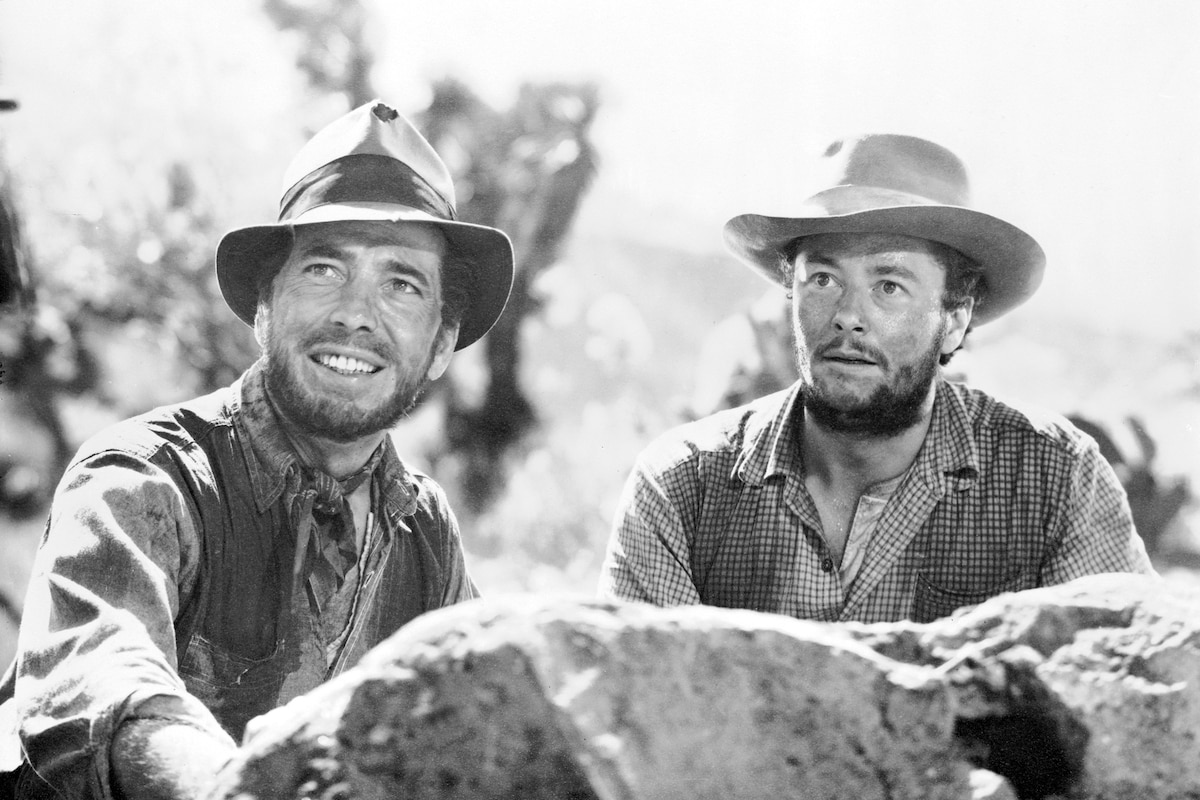
The Treasure of the Sierra Madre would be Humphrey Bogart's third of six films directed by John Huston. The duo had first met on the set of High Sierra (1941), which Huston wrote but did not direct. The other films Huston directed Bogart in were The Maltese Falcon (1941), Across the Pacific (1942), Key Largo (1948), The African Queen (1951), for which Bogart won the Academy Award® for Best Actor, and Beat the Devil (1953).
The Treasure of the Sierra Madre was shot in and around the mountainous region surrounding the village of Jungapeo, near San Jose Purua. John Huston and his art director, John Hughes (no, not the 1980s teen-movie director), found this location while on an 8,000-mile scouting trip through Mexico.
Various actors who were nearly cast in The Treasure of the Sierra Madre included: Edward G. Robinson as Dobbs; Walter Huston as Dobbs; Ronald Reagan as Curtin; John Garfield as Curtin; and Zachary Scott as Lacaud or Cody. One actor who did make the final cut was a juvenile named Bobby Blake, now known as Robert Blake, playing the little scamp who sells Bogart his winning lottery ticket.
During the shoot, Humphrey Bogart suffered from a vitamin deficiency that caused his hair to fall out in chunks. He had to have three wigs of varying lengths to wear for the film.
Actress Ann Sheridan was in Mexico at the same time The Treasure of the Sierra Madre was being shot there. As a good luck gesture, Sheridan agreed to appear in the film in an unbilled, walk-on part. After Dobbs leaves the barbershop in Tampico, he notices a passing prostitute who returns his look. In studying the scene carefully, it is rather difficult to believe that the woman is Ann Sheridan. Seconds later, the woman is again picked up in the frame, but only in the distance. It is possible that the switch was made to Sheridan at that point, or an alternate take without Sheridan was used in the final film. Either way, TCM's own Robert Osborne has watched this film countless times, and he has never spotted Ann Sheridan.
Executives at Warner Bros. were not quite sure what to do with The Treasure of the Sierra Madre, an admittedly offbeat film. Initially, the suits promoted it as a Western. To further support the opening of the film, the studio lackeys distributed treasure maps showing the locations of the action in the film for display in theater lobbies.
Perhaps in retaliation for a rift with director John Huston over the editing of Key Largo (1948), Warner Bros. released The Treasure of the Sierra Madre and Key Largo across the country in a double bill without mentioning Huston's name in its promotion ads.
Co-star Tim Holt's father, Jack Holt, a star of silent and early sound Westerns and action films, makes a brief one-line appearance at the beginning of the film as one of the many down-on-their-luck sad-sacks at the Oso Negro Hotel.
Humphrey Bogart had nothing but love and admiration for his good friend, John Huston. But Bogie also knew how to throw a backhanded compliment to Huston; he told an interviewer about Huston's exacting standards when shooting The Treasure of the Sierra Madre. Bogie said, "John wanted everything perfect. If he saw a nearby mountain that could serve for photographic purposes, that mountain was not good; too easy to reach. If we could get to a location site without fording a couple of streams and walking through snake-infested areas in the scorching sun, then it wasn't quite right."
Famous Quotes from THE TREASURE OF THE SIERRA MADRE
Howard: Hey you fellas, how 'bout some beans? You want some beans? Goin' through some mighty rough country tomorrow, you'd better have some beans.
Dobbs: Can you help a fellow American down on his luck?
Dobbs: Nobody puts one over on Fred C. Dobbs!
Gold Hat: Badges? We ain't got no badges. We don't need no badges. I don't have to show you any stinking badges.
Howard: We've wounded this mountain. It's our duty to close her wounds. It's the least we can do to show our gratitude for all the wealth she's given us. If you guys don't want to help me, I'll do it alone.
Bob Curtin: You talk about that mountain like it was a real woman.
Fred C. Dobbs: She's been a lot better to me than any woman I ever knew. Keep your shirt on, old-timer. Sure, I'll help ya.
Bob Curtin: You know, the worst ain't so bad when it finally happens. Not half as bad as you figure it'll be before it's happened.
Compiled by Scott McGee
Trivia & Fun Facts About THE TREASURE OF THE SIERRA MADRE
by Scott McGee | August 01, 2006
SIGN UP FOR OUR NEWSLETTERS

CONNECT WITH TCM