SPELLBOUND - Trivia and Other Fun Stuff
Spellbound grossed nearly $8 million on a budget of $1.7 million.
It was the third highest grossing film of 1945.
Since psychiatry was still a relatively new subject for Hollywood, the
cast and crew had to take lessons in how to pronounce the technical terms.
Seventeen-year-old Rhonda Fleming, a Selznick discovery, had to ask her
mother what a nymphomaniac was before going to the studio to play
one.
In the dream sequence, Hitchcock included a shot of a man cutting
curtains decorated with large eyeballs as a tribute to Dali's work on the
classic surrealist short film Un Chien Andalou. One of the most
famous images of that film depicts a man slicing a woman's eyeball with a
straight razor.
Credited as "Psychiatric Advisor" to the film was producer David O.
Selznick's analyst, Dr. May Romm, who had also advised Selznick contract
player (and later his wife) Jennifer Jones on how to play her mentally
unbalanced character in Love Letters (1945). Selznick biographer
David Thompson viewed Spellbound as Selznick's personal thank you to
Dr. Romm, whom he only saw for one year.
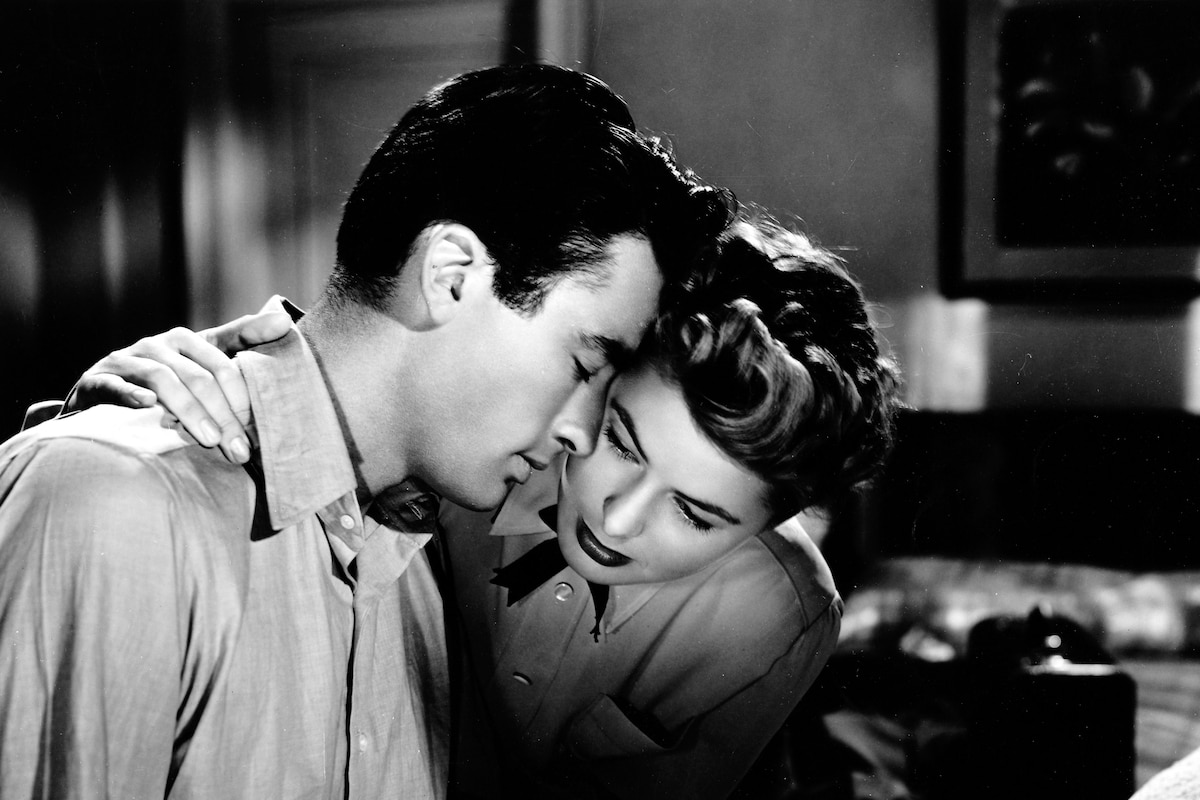
The superimposed shot of doors opening as Bergman and Peck kiss for the
first time was Selznick's idea, based on his fascination with psychiatry.
Hitchcock thought that the actors had done enough with their playing of the
preceding scene to suggest a new level of intimacy between them. The opening doors, however, literally spelled out that both
were opening up to each other as never before.
To create the snowflakes falling on Bergman and Peck during the skiing
scenes, technicians used corn flakes.
Leo G. Carroll (Dr. Murchison) appeared in more Alfred Hitchcock films
than any other actor. His other movies for the director are Rebecca,
Suspicion (1941), The Paradine Case, Strangers on a
Train (1951) and North by Northwest (1959).
Originally, the Spellbound theme was to have had lyrics, with
Selznick contract player Rhonda Fleming recording it for the soundtrack
album. When she performed the theme for Hitchcock and Selznick, however, they
found it unexceptional and cut them from the album.
When producer David O. Selznick learned that composer Miklos Rozsa was
using the theremin, the instrument he had introduced to film scoring in
Spellbound, on The Lost Weekend (1945), he was furious.
Fearing that the other film, likely to be released earlier than his, would
steal his thunder, he called Rozsa to ask if he was really using the
electronic instrument. "Yes," Rozsa replied, "I'm using the theremin, and
I'm also using the violin, the oboe and the clarinet as
well."
At the insistence of her economy-minded husband, Bergman bought
portions of her character's wardrobe from Selznick after shooting was
completed. The cost for the second-hand clothes was $122.77.
The ads for Spellbound sold it as a love story rather than a mystery.
They still caught the film's suspenseful nature, with the tag line "Will he
kiss me or kill me?" But the other tags -- "Irresistible their love!
Inescapable their fears." and "The Maddest Love that ever possessed a
woman" - were pure love story.
In the first week of its New York premiere at the Astor Theater,
Spellbound grossed $60,000, breaking the theater's box office
record, previously set by Gone With the Wind (1939).
Spellbound's box office success prompted Hitchcock to put
together another project to star Bergman in a script by Ben Hecht the
following year, Notorious (1946).
Famous Quotes from SPELLBOUND
"The analyst seeks only to induce the patient to talk about his hidden
problems, to open the locked doors of his mind. Once the complexes that have been disturbing the patient are uncovered and
interpreted, the illness and confusion disappears and the devils of unreason
are driven from the human soul." - Screenwriter Ben Hecht's written prelude
to the film.
"You're a sweet, pulsing, adorable woman underneath. I sense it every time
I come near to you."
"You sense only your own desires and pulsations - I assure you, mine in no
way resemble them." - John Emery as Dr. Fleurot, flirting fruitlessly with
Ingrid Bergman as Dr. Constance Peterson.
"People often feel guilty for something they never did, and it usually goes
back to something in their childhood. A child often wishes something
terrible would happen to someone - and if something does happen to that
person, the child believes he has caused it, and he grows up with a guilt
complex over a sin that was only a child's bad dream." - Ingrid Bergman as
Dr. Peterson, citing the psychoanalytic theory that will ultimately explain
the film's mystery.
"I'm haunted, but I can't see by what." - Gregory Peck as Dr. John "J.B."
Ballantine.
"We're all just bundles of inhibitions." - Bergman as Dr. Peterson.
"Now, this honeymoon is complicated enough without your dragging medical
ethics into it." - Peck as J.B.
"Good night and sweet dreams...which we'll analyze in the morning." -
Michael Chekhov as Dr. Brulov, welcoming Bergman and Peck to his
home.
"I seemed to be in a gambling house, but there weren't any walls, just a
lot of curtains with eyes painted on them. A man was walking around with a
large pair of scissors cutting all the drapes in half. Then a girl came in
with hardly anything on and started walking around the gambling room
kissing everybody. I was sitting there playing cards with a man who had a
beard. He said, 'That makes 21 - I win.' But when he turned up his cards,
they were blank. Just then the proprietor came in and accused him of
cheating. The proprietor yelled, 'This is my place, and if I catch you
cheating again, I'll fix you.' Then I saw the man with the beard. He was
leaning over the sloping roof of a high building. I yelled at him to watch
out. Then he went over - slowly - with his feet in the air. And then I
saw the proprietor again. He was hiding behind a tall chimney, and he had
a small wheel in his hand. I saw him drop the wheel on the roof. Then I
was running and heard something beating over my head. It was a great pair
of wings they were chasing me and almost caught up with me when I came to
the bottom of the hill. That's all I remember. Then I woke up." -Peck as
J.B., describing his dream.
"Women make the best psychoanalysts until they fall in love. After that
they make the best patients." - Chekhov as Dr. Brulov, in a line often
hissed by contemporary audiences.
"It is very sad to love and lose somebody, but in a while you will forget,
and you will take up the threads of your life where you left off not long
ago. And you will work hard. There is lots of happiness in working hard -
maybe the most." - Chekhov, comforting Bergman on her failure to solve
Peck's problems to this point.
Compiled by Frank Miller
Trivia - SPELLBOUND (1945)
by Frank Miller | September 15, 2004
SIGN UP FOR OUR NEWSLETTERS

CONNECT WITH TCM