Spellbound went into production on July 7, 1944. July 10 was
Ingrid Bergman's wedding anniversary, so director Alfred Hitchcock ordered
a large cake to be delivered on the set after the day's
shootings.
Although most of the film was shot on Hollywood sound stages, the
company went on location to the Wasatch Mountains in Utah for the skiing
scenes and the Cooper Ranch in Northridge, Calif., for the picnic
scene.
Producer David O. Selznick wanted a written forward to the film that
would help the audience understand the psychoanalytical concepts behind the
mystery. He first asked his own analyst, Dr. May Romm, who had served as a
psychiatric advisor on Spellbound and other recent films of his, but she couldn't
come up with the right opening. Then he appealed to Dr. Karl Menninger,
director of the famous Menninger Clinic, but the doctor refused to get
involved in what he saw as an over-simplification of psychoanalysis.
Finally, screenwriter Ben Hecht hammered it out.
Selznick had little involvement in the actual production because at the
time he was tied up with his World War II family drama, Since You Went
Away (1944). Nonetheless, director Alfred Hitchcock kept to his word
about filming efficiently. He was filming an average of four and a half
pages a day, and by the end of the first month he was a week ahead of
schedule.
One thing that contributed to Selznick's lack of interference on the
film was Hitchcock's habit of developing camera problems whenever the
producer would visit the set. The moment Selznick arrived, Hitch would
discover that the camera wouldn't work. As soon as the producer left,
however, it miraculously started to function again.
Bergman had problems with one of the film's more emotional scenes and
told Hitchcock she just couldn't build up the appropriate feeling. His
advice: "Ingrid, fake it!" She would later call it the best piece of
direction she had ever received. Throughout her career she would remember
his advice whenever she was faced with similar problems.
Hitchcock wanted to film the picture's climactic suicide from the
victim's point of view. Since the shot started with the gun in the
foreground while Bergman's character walks out of the room in the
background, this required some special thinking, as there was no way to
keep the killer's hand, the gun and Bergman all in focus at the same time.
They solved the problem by creating a false hand and gun four times larger
than life. The hand had to be movable so the gun could follow Bergman as
she leaves the room, then turn 180 degrees to point at the gun's owner
before firing. And to add a special shock to the system, Hitchcock had the
gunshot flash red in the otherwise black and white film. This required
hand coloring individual frames of film, a process not followed in later
prints.
As originally conceived by Salvador Dali, the dream sequences would
have run 22 minutes and included such strange elements as a sculpture that
breaks in two to reveal that it's filled with ants that then crawl over
Bergman's face. Hitchcock finally got him to come up with something more
filmable. Instead, they showed a sequence in which Peck watched Bergman
turn into a statue. Technicians coated her with plaster, then attached
parts of an arrow to either side of her neck, as though it had pierced her.
While the cameras rolled, she broke out of the plaster. Then the scene
was shown backwards, so the plaster seemed to be encasing her body.
Bergman thought it was brilliant.
Hitchcock completed principal photography on October 13, 1944 and left
for London.
Selznick was totally dissatisfied with the dream sequences Hitchcock
had filmed from Dali's scenario. He found them pedestrian, like something
out of a Poverty Row quickie. With Hitchcock out of the country, Selznick
turned first to director Josef von Sternberg, who turned down his
invitation to film the dream sequences. Then he turned to designer William
Cameron Menzies, who had directed the visionary British science fiction
film Things to Come (1936) and supervised the visuals on Selznick's
Gone With the Wind. Menzies came up with a new scenario for
the dream sequence, which was approved by Dali and Hitchcock when the
latter returned to the U.S. in December 1944. Selznick still wasn't happy
with what came out on film. Eventually the dream was cut to about two
minutes, and Menzies declined any screen credit.
As he was preparing the film for previews, Selznick decided that he
didn't care for the title The House of Dr. Edwardes. As he had in
the past, he held an in-house competition to rename the film, with the $50
prize going to secretary Ruth Batchelor, who suggested
Spellbound.
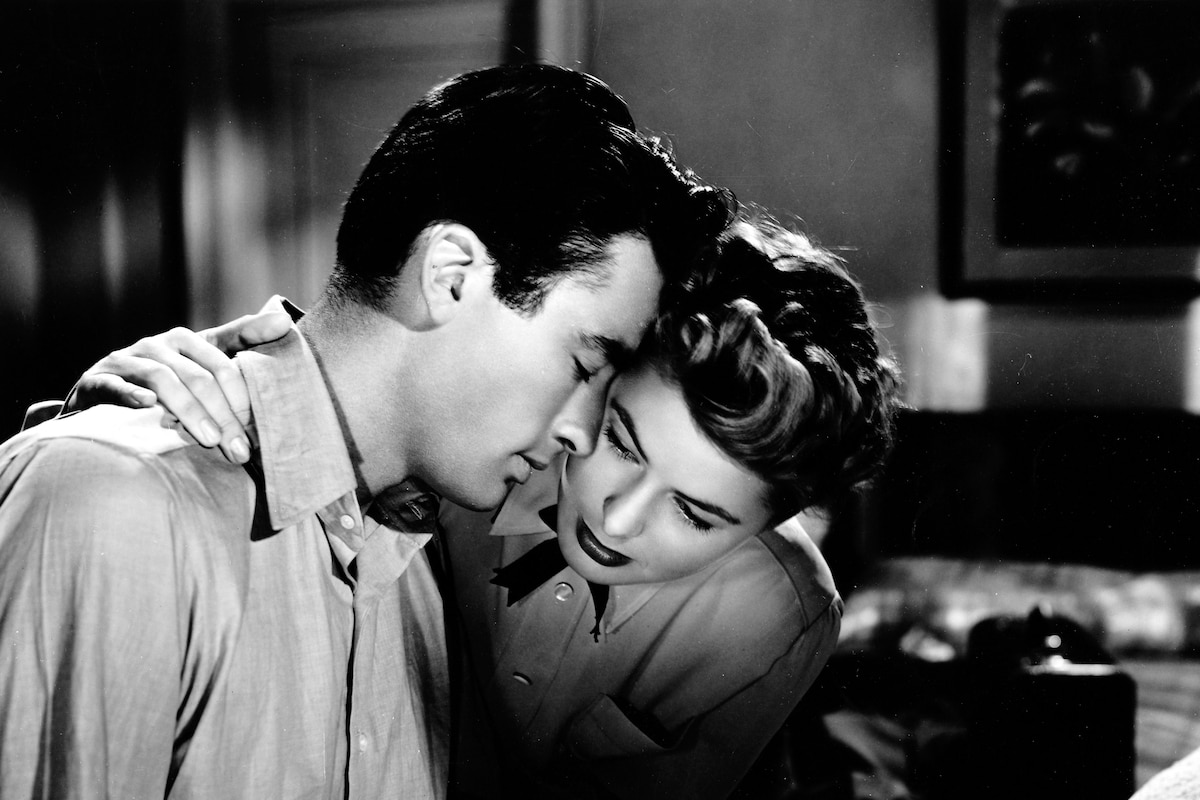
Spellbound performed well in previews, with the biggest surprise being
audience reaction to Peck in the male lead. By this point in time, he had
scored a hit in 20th Century-Fox's religious drama The Keys of the
Kingdom (1944). That and his publicity had turned him into a major sex
symbol. As Selznick reported in one of his famous memos: "We could not
keep the audience quiet from the time his name came on the screen until we
had shushed them through three or four sequences and stopped all the dames
from 'oohing' and 'ahing' and gurgling."
After the first preview, Selznick cut about 20 minutes out of the film,
including an opening montage depicting treatment in mental
hospitals.
Selznick was still looking for something to increase the film's
prestige and decided to give it a more ambitious score. On the advice of
actor Lionel Barrymore, he caught a screening of Double Indemnity
(1944), scored by Miklos Rozsa, a classical composer. Rozsa had already
achieved a first when his music for producer Alexander Korda's Jungle Book became the first film score sold to the public. At
the time, other studio heads had not considered the commercial
possibilities of film soundtracks on record. Most weren't even tying up
the recording rights for themselves. Selznick reasoned that a soundtrack
album with popular stars Peck and Bergman on the cover would be a big
seller. He first asked Rozsa to score a suspense sequence in which Peck
menaced Bergman with a straight razor. With the instructions to produce
"an unusual sound - something new," the composer decided to use the theremin,
an early electronic musical instrument. Selznick and Hitchcock were so
impressed they signed him to the film. Selznick also released a hit
soundtrack album, one of Hollywood's first.
With the delays in finishing the dream sequence and the glut of wartime
product, Spellbound premiered in October 1945, almost a year after
Hitchcock completed principal photography. Selznick was concerned that
Bergman's other 1945 release -- The Bells of St. Mary's, completed
after Spellbound -- was set to premiere the same month. So he
turned the event into a plus by advertising 1945 as "The Year of
Bergman."
by Frank Miller
Behind the Camera - SPELLBOUND (1945)
by Frank Miller | September 15, 2004
SIGN UP FOR OUR NEWSLETTERS

CONNECT WITH TCM