The Big Idea Behind SPELLBOUND
Spellbound's script was adapted from the 1927 novel The House
of Dr. Edwardes, about a female intern who arrives at a posh asylum in
Switzerland to discover its head, Dr. Edwardes, on vacation and his staff
behaving strangely. Gradually she realizes that they are members of a
satanic cult. They're about to sacrifice her when Edwardes rescues her and
reveals that they're all inmates who had broken free and taken over the
asylum. The novel is attributed to Francis Beeding, which was a pseudonym
for the team of John Leslie Palmer and Hilary Aidan St. George
Sanders.
The impetus to make Spellbound came from independent producer
David O. Selznick's own dabbling with psychoanalysis. Although he only
spent a year in therapy, he was overwhelmed with the healing possibilities
of treatment. He began pestering director Alfred Hitchcock to come up with
a psychological thriller grounded in Freudian theory.
Hitchcock discovered the novel The House of Dr. Edwardes while
on a visit to England in 1944 and bought the rights for a nominal fee. He
had started working on a screenplay with writer Angus MacPhail, but was
having problems with the story. In their version, there were three love
stories complicated by psychological problems that were resolved when the
leading lady, a psychiatrist, helped her amnesiac patient realize that the
death he thought he had caused was just an accident. Although he wasn't
satisfied with the script, Hitchcock suggested it to Selznick as his next
film.
Initially, Selznick wanted to team Joseph Cotten and Dorothy McGuire in
the leads, with Paul Lukas as the villainous Dr. Murchison. He also
considered luring Greta Garbo back to the screen to star.
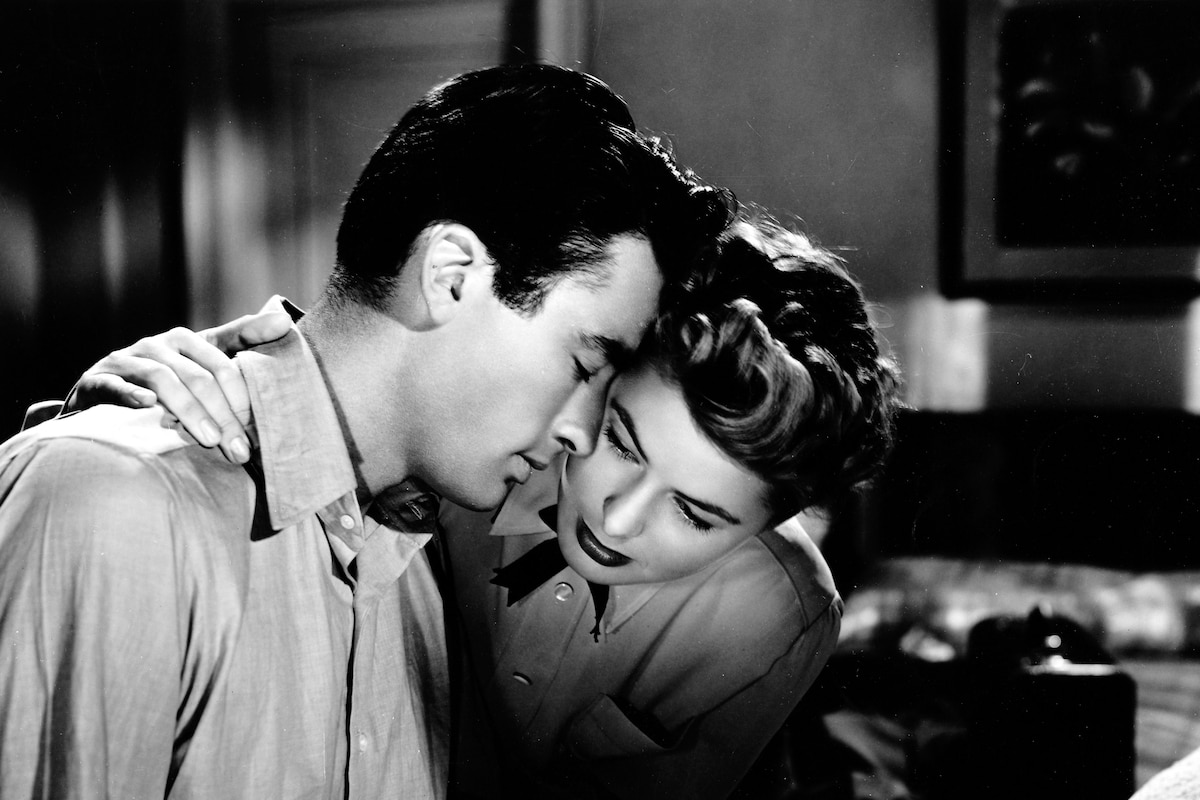
Ultimately, Selznick decided to team contract players Ingrid Bergman
and Gregory Peck for the film. As an independent, he had only produced a small number of films each year, loaning his contract talent out
to other studios. He hadn't yet produced any of Peck's films and he hadn't
produced a Bergman film since her U.S. debut in Intermezzo: A Love
Story (1939) or a Hitchcock film since his Oscar®-winning Best
Picture, Rebecca, in 1940. With all three growing in popularity and
demonstrating solid box-office appeal, Selznick decided to find a project
that would allow him to team all three.
Unhappy with Hitchcock's initial treatment of the story, Selznick
suggested that they hire Ben Hecht, who had saved the script for Selznick's
Gone With the Wind (1939), to write the final draft. He also
insisted that Hecht and Hitchcock cut any of the supernatural material
remaining from the original novel.
At the time, Hecht was undergoing psychoanalysis and found the idea of
a mystery based in Freudian theory fascinating. He suggested cutting the
peripheral love stories to focus on the female psychiatrist and the amnesiac
patient with whom she had fallen in love. Since psychoanalysis had proven
successful as the subject of the hit Broadway musical Lady in the
Dark (1941), Hitchcock and Selznick approved of this approach to the
material.
Hitchcock and Hecht toured mental hospitals in Connecticut and New York
to do research on the film. They spent most of their time in the
psychiatric ward of New York City's Bellevue Hospital.
To be doubly sure of the project's appeal to audiences, Selznick
commissioned a poll by the Audience Research Institute on the idea of a
mystery based on psychoanalysis, various star pairings and such titles as
The House of Dr. Edwardes, The Couch and The Man who Found
Himself. The novel's original title received a 70 percent approval
rating, although there was less than 50 percent acceptance of the subject.
Joseph Cotten was most appealing as the film's star, though researchers
noted that Peck was still a relatively new leading man. Bergman was the
most popular of the actresses suggested for the film, far outranking
Garbo.
When Selznick's business office estimated the film's budget at $1.25
million, he almost canceled the picture. Hitchcock had to promise to make
the film quickly and efficiently to change his mind.
Bergman initially turned down the script, complaining that the love
story was unbelievable. Hitchcock supervised re-writes that put more focus
on the situation of two lovers on the run or, as he described it, "a
manhunt story wrapped up in pseudo-psychoanalysis.
As originally scripted, Peck's character's dreams, which held the key
to the film's mystery, were only described in the dialogue. During
pre-production, however, Hitchcock decided he needed to show them
on-screen. But he also wanted to break with Hollywood tradition in
presenting them. He later said, "Traditionally, up to that time, dream
scenes in films were always done with swirling smoke, slightly out of
focus. This was the convention, and I decided I wanted to go the other
way to convey the dreams with great visual sharpness and clarity, sharper
than the rest of the film itself."
With screenwriter Ben Hecht, he
suggested hiring surrealist painter Salvador Dali to design Ballantine's dreams, which hold the secret to the film's mystery. Dali was
already famous for his dreamlike paintings, including his famous portrait
of Mae West in which her features were depicted as furniture in a bedroom.
He also had worked with filmmaker Luis Bunuel on the early surrealistic
films Un Chien Andalou (1929) and L'Age d'Or (1930). Selznick agreed
to his hiring on the grounds that it would be good for
publicity.
Under his original agreement, Dali was to sketch out the dream
sequences for Hitchcock's approval, then turn their agreed upon images into
a series of paintings for which he would receive $1,000 each. These final
concepts could not be altered without his permission. He handed in five
paintings in June 1944, and Selznick's financial department budgeted the
dream sequence at $150,000. Once again, Selznick was ready to pull the
plug, at least on the dream sequences. But Hitchcock devised a plan to use
special effects and projections of Dali's paintings that lowered the
projected cost to $20,000. Selznick gave him the go-ahead.
Hitchcock's salary for the film was $150,000.
Famed acting teacher Michael Chekhov, a nephew of playwright Anton
Chekhov and a former member of the Moscow Art Theater, was cast as
Bergman's mentor, Dr. Brulov.
by Frank Miller
The Big Idea - SPELLBOUND (1945)
by Frank Miller | September 15, 2004
SIGN UP FOR OUR NEWSLETTERS

CONNECT WITH TCM