The Critics' Corner on PAPILLON
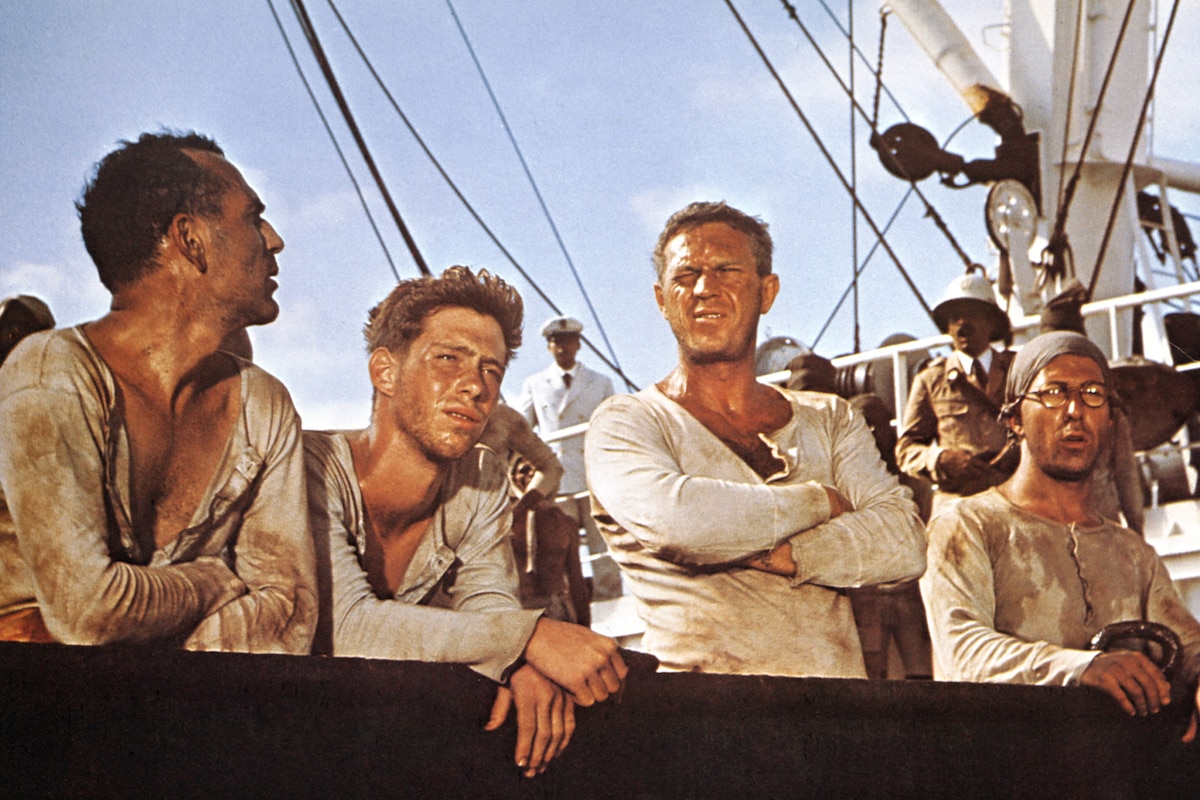
"Hoffman does an excellent job in portraying his character's adaptation to the corruptibilities of prison life, amidst an inexorable physical and mental deterioration. McQueen has thrown himself into the part with at least as much verve as he did for Robert Wise in The Sand Pebbles [1966], and with equally strong results. McQueen has become Charriere, in an outstanding performance." -Variety, December 12, 1973
"Franklin J. Schaffner's film version of the late Henri Charriere's book "is a big, brave, stouthearted, sometimes romantic, sometimes silly melodrama with the kind of visual sweep you don't often find in movies anymore." - Vincent Canby, New York Times, December 17, 1973
"Papillon is not that good a film, but McQueen is very touching as the man who defies solitary confinement, madness, and aging and becomes a wistful genius of survival. In the last hour of that film, he has moments of inspired, heroic craziness - and he makes Dustin Hoffman look like an artful actor." - David Thomson, A Biographical Dictionary of Film (Knopf, 2000)
"It's a big-budget epic that doesn't compromise; it's gloom and doom on such a large scale that it becomes the cinematic equivalent of a Wagner opera or a Zola novel...To anyone familiar with how softness commonly goes along with Hollywood bigness, the daring of "Papillon" is breathtaking...Schaffner has made his most personal film, a moving and powerful testament to the life force." - Stuart Byron, The Real Paper.
"Schaffner has really made an exhilarating movie out of the most dangerously depressing material." - Andrew Sarris.
"Visually, "Papillon" cannot be vaulted, and with it Schaffner joins the ranks of screen imagists who have turned the resources of epic filmmaking to their own private concerns, like DeMille, Griffith and Von Stroheim." - Alan R. Howard, The Hollywood Reporter.
Awards & Honors
Papillon was very costly to make (more than $13 million) owing to its arduous location shooting, McQueen's salary ($2 million) and Hoffman's ($1.25 million), but it earned $22 million in its U.S. release alone, and $60 million worldwide within a year. That was a great relief to its distributor, Allied Artists, which put up $7 million of the budget ($2 million on promotion alone) out of its proceeds from the highly successful musical Cabaret (1972). Released in the 1973 Christmas season, the movie became the third highest-grossing movie of 1974.
The movie received only one Academy Award nomination for Jerry Goldsmith's score.
Compiled by Rob Nixon
The Critics Corner - PAPILLON (1973)
by Rob Nixon | September 15, 2004
SIGN UP FOR OUR NEWSLETTERS

CONNECT WITH TCM