The Big Idea Behind PAPILLON
Henri Charriere was probably one of the very few who escaped from France's notorious South American prison Devil's Island and lived to tell about it. He was almost certainly the only one to reap a huge financial windfall from it. His autobiography sold five million copies in the U.S. and 17 million abroad, and when producers were understandably eager to turn it into a motion picture, they had to fork over a half million dollars and percentage of the profits to the author.
Roman Polanski was one of the first directors interested in bringing Charriere's story to the screen, with Warren Beatty as its star. Lack of finances, however, ended that possibility.
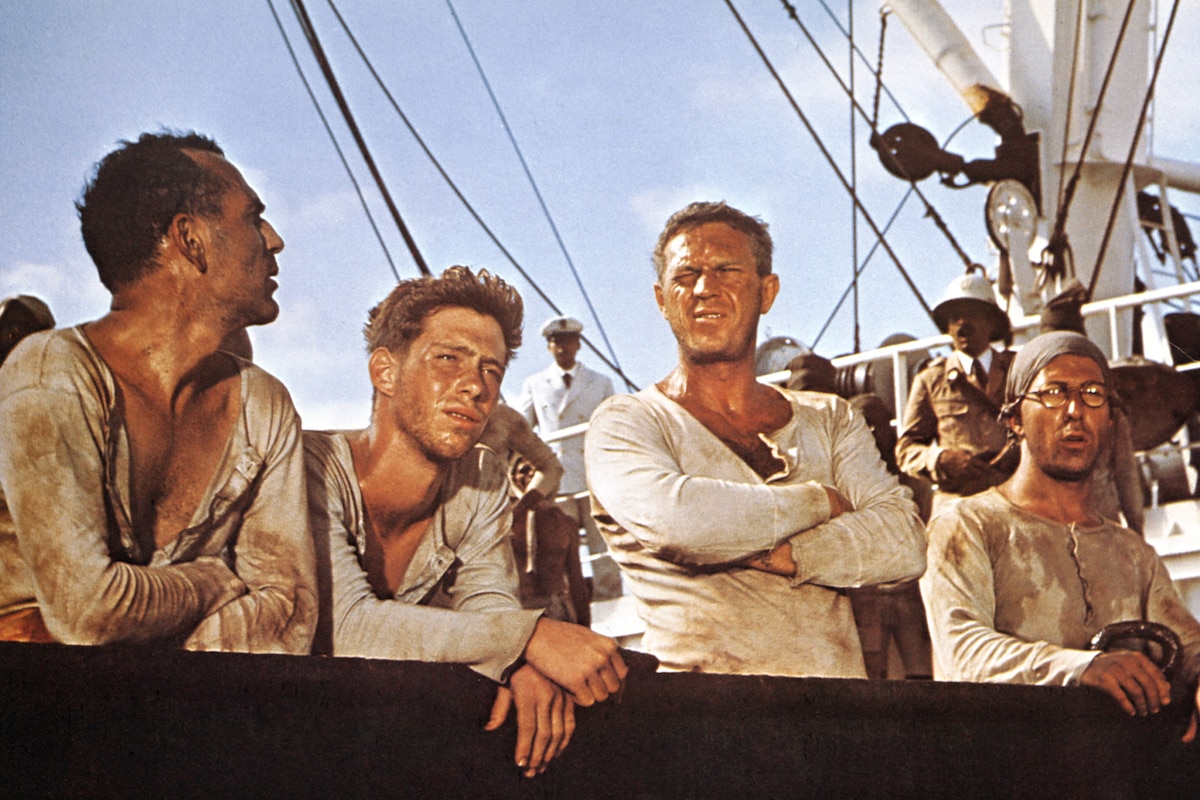
Producers Ted Richmond and Robert Dorfmann optioned a screen adaptation by Lorenzo Semple, Jr. that was deemed quite satisfactory. But because it would be an expensive undertaking, they needed to insure their investment with a big name on the marquee. Steve McQueen was then one of the biggest stars in movies, and he saw in it not only a chance to expand his range and screen image but a good opportunity to ask for - and get - what was then a fairly staggering salary for an actor, $2 million.
Even with McQueen attached, the producers felt they needed more than one box-office name, and so shortly before production began, they negotiated a deal with Dustin Hoffman at a salary of $1.25 million. With the addition of recent Oscar®-winner Franklin J. Schaffner as director, the producers were able to convince distributor Allied Artists to put up $7 million of the ever-inflating budget. Nevertheless, the company took additional steps to secure its investment by officially declaring it a French production for corporate tax reasons.
The problem with the original script was there was no other major role beyond Papillon in the story, certainly not for someone of Hoffman's magnitude. So a new writer had to be brought in to create a part for him. It was decided that only one man was up to the task of producing a quality script at the eleventh hour - Dalton Trumbo. "I may not be the best screenwriter in Hollywood," Trumbo once said, "but I am incomparably the fastest."
Trumbo had little time for research beyond reading the book, which he later commented he found "pretty damned dull." He quickly outlined a structure that would put Hoffman in the role of the forger Dega. But in the book, Dega was only a minor character who disappeared quickly from the story.
Trumbo and Hoffman got together in the remaining few weeks before production began to discuss what kind of character Dega would be. As they got to know each other better, Hoffman became more certain the forger should be patterned after Trumbo himself. "He's a real feisty man," Hoffman later said, "and he's got a combination of toughness and sophistication and integrity that I felt were right for Dega."
Trumbo quickly cranked out 60 pages of the script in time for the first day of production in Spain. Thereafter, he traveled with the company on location, writing constantly, never more than 20 pages ahead of the shooting schedule.
by Rob Nixon
The Big Idea - PAPILLON (1973)
by Rob Nixon | September 15, 2004
SIGN UP FOR OUR NEWSLETTERS

CONNECT WITH TCM