THE RED BADGE OF COURAGE - Trivia and Other Fun Stuff
The Red Badge of Courage was a box-office flop, failing to recover
its $1.6 million investment.
Huston's preparations for the film were complicated by three major life
events: his father Walter died; he took his fourth wife, Ricki Soma; and
Soma delivered his second child (the first to survive), Walter Anthony
Huston, later known as Tony (e would play a small role in his
father's The List of Adrian Messenger (1963) and write the
screenplay for his The Dead, 1987).
Huston started out directing the film on horseback, something he'd
always dreamed of doing. He eventually had to abandon his dream when it
proved too hard on the horse.
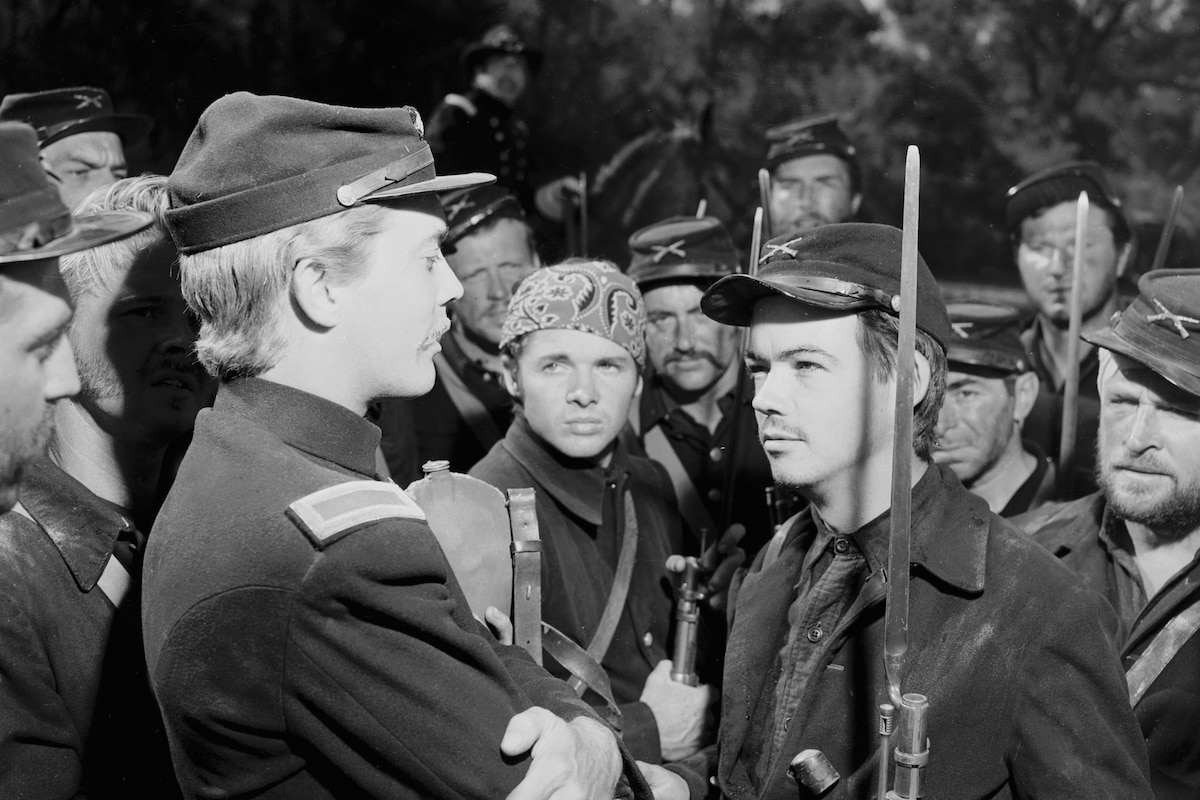
Huston appears in a crowd scene as one of the experienced Union
soldiers jeering the Youth and other raw recruits.
Filming the battle scenes required 80,000 rounds of ammunition at a
cost of $110 per thousand.
For the river-crossing scene, Douglas Dick (Lieutenant) wore a
silver-sheathed sword Huston's great grandfather had carried in the Civil
War. Unfortunately, Dick played around with the sword a bit too much. At
one point he tried to stick it in the ground and ended up putting it
through his foot. Huston worked his injury into the film.
During location filming, Murphy dated Sharon Quiggle, a student at
Chico State College who worked as a window dresser in the town's leading
department store. He even brought her up to Los Angeles with her family
for a visit. Their relationship cooled off after she returned to Chico,
where she eventually married another man.
John Dierkes (Tall Soldier), who had barely acted before, developed an oversized ego during filming and started demanding a private dressing room like the
ones Murphy and Mauldin had. To shut him up, Huston put his name on one of
the portable toilets set up on location.
During production Huston and Reinhardt played poker. At first Huston,
who was a master at bluffing, had Reinhardt in debt to him. Then Mauldin
took pity on Reinhardt and gave him a book on how to play poker. By the
time the production was finished, Huston owed Reinhardt about
$15,000.
When Royal Dano filmed his character's death scene, Huston was so
impressed he told reporters Dano was the only actor he'd worked with who
was as easy to direct as his father, Walter Huston. Later, when told his
death scene had been cut because audiences had laughed at war hero Audie
Murphy running away from a dying man, Dano commented, "They removed the
turning point of the story. It was like removing the baby and leaving the
afterbirth.".
Famous Quotes from THE RED BADGE OF COURAGE
"How do you know you won't run when the time comes?" -- Audie Murphy as
Henry Fleming to Bill Mauldin as the Loud Soldier.
"He wished that he, too, had a wound, a red badge of courage." -- James
Whitmore's narration, explaining the title.
"Always seems like more of you is getting killed than there are." -- Andy
Devine as the Fat Soldier.
"Just turn your affairs over to the Lord, and go on and do your duty. Then
if you get killed, it's his concern. Anyway, dying's only dying.
Supposing you don't hear the birds sing tomorrow, or see the sun go down.
It's going to happen anyway. And, you know, son, that thought gave me
peace of mind." -- Devine.
"I got holes in my pants, holes in my shoes, but there ain't no holes in me
other than the ones God intended." -- Arthur Hunnicutt as Bill Porter, on
his good fortune in battle.
"By diddy, here we are! Everybody fightin'! Blood and dee-struction!" --
Hunnicutt.
"Lordy, what a fight! And I got shot!" -- John Dierkes as the Tall
Soldier, rambling on in shock after the big battle.
"I ain't never seen no fella do like that afore. He were a dandy, weren't
he?" -- Royal Dano as the Tattered Man, commenting on Dierkes'
death.
"So it came to pass that as he trudged from the place of blood and wrath
his soul changed. He had been to touch the Great Death and found that,
after all, it was but the Great Death. Scars faded as flowers and the
youth saw that the world was a world for him. He had rid himself of the
red sickness of battle and the sultry nightmare was in the past. He turned
now with a lover's thirst to images of tranquil skies, fresh meadows, cool
brooks, an existence of soft and eternal peace." -- Whitmore, delivering
the film's final narration.
Compiled by Frank Miller
Trivia - THE RED BADGE OF COURAGE (1951)
by Frank Miller | September 15, 2004
SIGN UP FOR OUR NEWSLETTERS

CONNECT WITH TCM